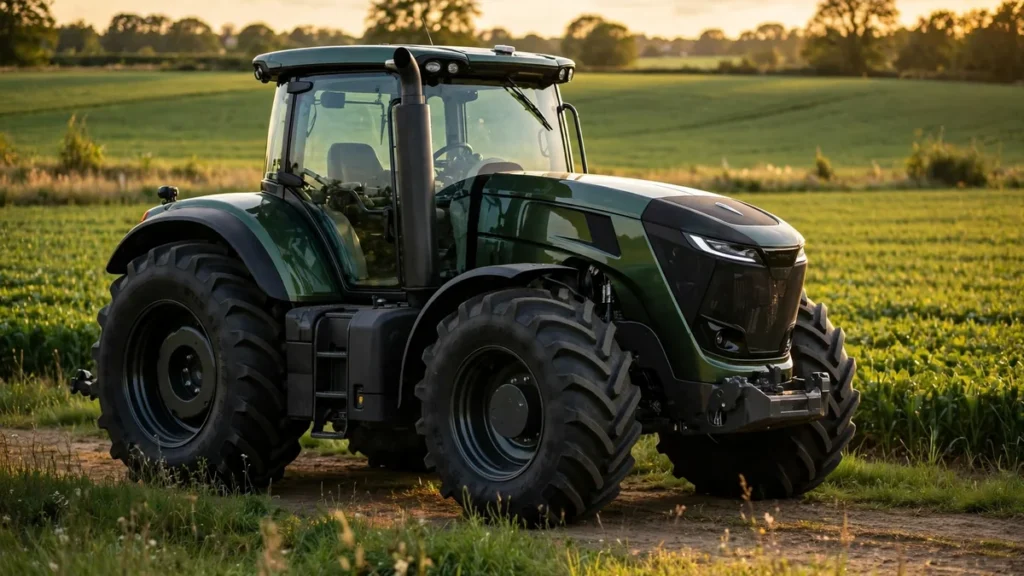
At first light, a tractor moves across a field so quietly that the birds do not fly away. There is no diesel rumble, no exhaust smoke, and no vibration shaking the cab. The luxury electric tractor is not a novelty. It is a working machine, built to pull, lift, and power its way through a long day, and it does it without a drop of fuel.
Tractors are different from cars. They do not need speed. They need torque, the twisting force that pulls a plough through heavy soil, and they need it at walking pace, for hours on end. Electric motors are perfect for this, because they deliver their full torque from a standstill, and they do it silently. This guide explains how a luxury electric tractor works, from the battery under the cab to the smart systems that help it farm with precision.

How It Works
Step 1: A big battery under the cab
Under the cab of the tractor sits a large battery pack, usually from 100 to 200 kWh, made of hundreds of cells grouped into modules and sealed in a strong, waterproof case. The battery is the fuel tank, and it is built to survive a farm: dust, mud, rain, and the constant shaking of rough ground. Cooling channels keep the cells at the right temperature, and the case is protected by a steel belly plate that shrugs off stones and stumps.
Step 2: Motors that pull from a standstill
Most electric tractors use one or two large motors, driving the wheels through a simple gearbox, or driving each axle directly. There is no clutch to slip and no gears to grind. The motor delivers its full torque the moment the driver presses the pedal, so the tractor pulls away smoothly, even with a heavy plough behind it, and it can crawl at walking pace for hours without overheating or stalling. The power is smooth and precise, which matters when the driver is trying to keep a straight line across a field.
Step 3: Regenerative braking and power take-off
Going downhill, the tractor’s motors become generators, turning the motion back into electricity and feeding it into the battery, just as an electric car does. But the tractor has another trick that cars do not: the power take-off. This is a shaft at the rear that drives farm implements, from mowers to balers, and on an electric tractor it is driven by its own motor, so its speed can be set precisely, independent of the wheels.
Step 4: Charging on the farm
Charging a tractor happens where it works. Most farms charge overnight from a wall box in the barn, and the tractor is ready every morning with a full battery. Some farms use solar panels on the barn roof, so the tractor runs on sunshine, and the fuel bill disappears entirely. On a long day, a fast charger can top the battery up during a lunch break, and the driver can plan the work around the charge, doing the heavy pulling in the morning and the lighter work in the afternoon. The charging port is sealed against dust and water, and the battery is designed to be charged thousands of times without losing much of its capacity.
Step 5: The cab, built for a long day
The cab of a luxury electric tractor is a quiet office on wheels. Because there is no diesel engine shaking the floor, the cab is calm, and the driver can hear the radio, talk on the phone, or simply enjoy the silence. The seat is suspended and heated, the controls are laid out around a touchscreen, and the glass is large, giving a clear view of the implements behind. Air conditioning, filtered air, and a suspension system that smooths the roughest ground mean the driver finishes the day less tired than on a diesel tractor.
Step 6: Precision farming with GPS and sensors
A luxury electric tractor is also a computer. GPS guidance steers it along perfectly straight lines, accurate to a few centimetres, so seed and fertiliser are not wasted on ground that has already been covered. Sensors measure the soil, the speed, and the load on the implements, and the tractor adjusts itself as it goes, slowing down in heavy soil and speeding up in light ground. The driver can watch all of this on the touchscreen, and the data is saved for the next season, so the farm gets smarter every year.
Step 7: Maintenance, software, and the long life
The last advantage of the electric tractor is how little it needs. There is no engine oil to change, no fuel filters to replace, and no exhaust system to maintain. The motors have a single moving part each, and the brakes last for years, because regenerative braking does most of the slowing. Software updates arrive over the air, improving the driving, the charging, and the precision farming, and the tractor can be checked remotely by the dealer, who can see a fault before the driver notices it.

Key Specifications
The figures below describe a typical current luxury electric tractor; individual models vary.
| Specification | Typical figure |
|---|---|
| Battery capacity | 100 to 200 kWh |
| Power output | 100 to 200 horsepower |
| Torque | High torque from standstill, ideal for pulling |
| Working time | 4 to 8 hours per charge, depending on the work |
| Top speed | Around 40 km/h on the road |
| Charging | Overnight from a farm wall box, or fast charging during a break |
| Power take-off | Electric, with precise speed control independent of the wheels |
| Guidance | GPS guidance accurate to a few centimetres |
How Much Does It Cost?
A luxury electric tractor typically costs from around $120,000 to $250,000, depending on the maker, the battery size, and the specification. That is an estimate based on current premium models, and the price can rise with a larger battery, GPS guidance, or a higher specification cab. The running costs are far lower than a diesel tractor: electricity is cheaper than diesel, servicing is minimal, and the tractor can be charged from solar panels on the farm. For the build story, how a luxury tractor is made shows how the machine is put together. For the cost in detail, why a luxury tractor is so expensive explains where the money goes. And for another hard-working machine in harsh conditions, how a luxury snow cat works follows a vehicle built for snow, not soil.

A Rare Fact
Here is a detail that farmers notice first: the electric tractor does not scare the animals. On a diesel tractor, the noise and the smell of exhaust send livestock moving away, and the driver has to work around them. On an electric tractor, the cows stay where they are, the sheep keep grazing, and the birds stay in the hedges. Some farmers say their animals now follow the tractor, curious about the quiet machine, and the dogs ride along in the cab. It is a small, unexpected benefit, but it tells the story of the electric tractor in one detail: the same work, done more gently, and the farm barely notices it is there.
The luxury electric tractor proves that the hardest work on the farm does not need noise, smoke, or fuel. It needs torque, patience, and a battery that lasts the day, and it needs a cab where the driver can think. It pulls at walking pace, in near silence, and it leaves the field exactly as it found it, only better worked. It is the tractor, perfected for the electric age.