A luxury electric train does not announce itself when it leaves a station. There is no roar, no shudder and no smell of fuel, just a smooth, silent surge as the carriages glide away, and the only sound inside is the soft hum of the air conditioning and the murmur of passengers settling into wide, comfortable seats.
That calm is not an accident. It is the result of a chain of systems, from the overhead wire to the wheels, each one doing a small job perfectly and passing its work to the next. A cheap train is a collection of parts that happen to move together. A luxury electric train is a single machine, designed as a whole, where every motor, brake and sensor knows what the others are doing. This is how it works.
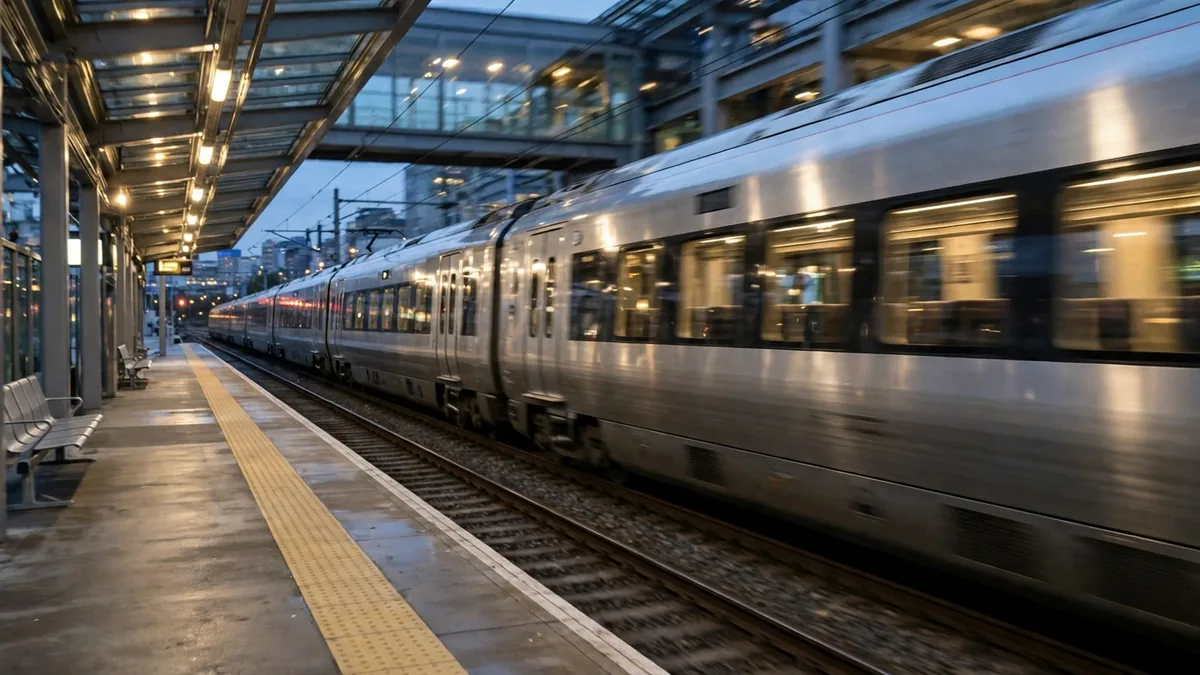
How It Works
Step 1: Power comes down from the overhead wire
Everything starts above the train, at the pantograph, the folding arm on the roof that presses a carbon strip against the overhead wire. The wire carries high-voltage alternating current, and the pantograph draws it down into the train while the train is moving, keeping contact through curves, over points and at full speed. Springs and dampers hold the strip against the wire with exactly the right pressure, firm enough to keep the current flowing, gentle enough not to wear the wire away, and if the contact is lost for even a moment, the train’s systems notice at once.
Step 2: The transformer steps the voltage down
The power from the wire is far too strong for the motors to use directly, so the next step happens in the transformer, a large, oil-cooled box slung beneath the train. Inside it, coils of copper wire step the high voltage down to a lower level, and the transformer hums quietly as it does so, shedding heat into radiators along the side of the carriage.
Step 3: The motors turn electricity into pull
With the voltage stepped down, the power flows to the traction motors, one on each powered axle, and this is where the train actually moves. Each motor is a compact, powerful machine that spins a shaft at high speed, and a gearbox turns that speed into the slow, strong torque that drives the wheels. The motors are controlled by electronics that feed each one exactly the power it needs, so that the train accelerates smoothly, without a jerk, and every wheel pulls its share. When the driver asks for more speed, the motors answer in a fraction of a second, and the train surges forward as if it were being pushed by an invisible hand.

Step 4: The wheels grip the rails and steer the train
The pull of the motors means nothing without grip, and the wheels are where that grip happens. Each steel wheel is machined to a precise profile, slightly conical, so that it centres itself on the rail and steers the train gently through curves without any help from the driver. The bogies that hold the wheels are sprung and damped, soaking up every bump and joint in the track, so that the ride stays smooth even at high speed. A luxury train’s wheels are balanced and checked regularly, because a wheel that is even slightly out of true will shake the whole carriage and wear the rail beneath it.
Step 5: Braking turns motion back into electricity
Slowing a luxury electric train is as clever as speeding it up. When the driver brakes, the traction motors reverse their role and become generators, turning the train’s motion back into electricity and feeding it up through the pantograph into the overhead wire, where another train can use it. Friction brakes take over only at low speed, when the motors can no longer do the job, and the two systems blend so smoothly that passengers feel nothing more than a gentle slowing. The brakes are tested constantly, because a luxury train must stop in a straight line, on wet rails, with a full load of passengers, every single time.
Step 6: The computer keeps every system in step
The last step is the one that ties everything together, the train’s central computer. Sensors watch the speed, the motor temperature, the brake pressure and the position of every door, and the computer links them all into one system, so that the motors, the brakes and the signalling agree with each other at every moment. The driver sees it all on a pair of clear screens, speed, power, signals and track ahead, and the computer will slow the train itself if a signal is passed or a limit is exceeded. It is the quiet brain of the train, and it is why a luxury electric train feels less like a machine and more like a single, calm animal gliding along the rails.
| Spec | Detail |
|---|---|
| Power supply | High-voltage overhead wire, collected by a roof pantograph |
| Transformer | Oil-cooled unit beneath the train, stepping voltage down for the motors |
| Motors | Electric traction motors, one per powered axle, driving through gearboxes |
| Wheels | Conical steel wheels on sprung bogies, self-centring on the rails |
| Braking | Regenerative braking feeding power back to the wire, plus friction brakes |
| Control | Central computer linking motors, brakes, doors and signalling |
The most remarkable part of a luxury electric train is not any single system, but the way they work together. The pantograph, the transformer, the motors, the wheels, the brakes and the computer are all built to the same standard, and each one trusts the others to do its job, which is why the train feels so calm. A failure in any one system is noticed at once, and the others compensate, so that the train can always slow safely and reach the next station, even on its worst day.
What One Costs
A luxury electric train typically costs an estimated $20 million to $50 million, and the price is set mostly by the traction systems, the transformer and the custom interiors rather than the number of carriages. A long, high-speed model with a premium interior, full regenerative braking and the latest safety systems sits at the top of the range, while a shorter regional train with a simpler interior costs far less. The price is in the engineering, not the badge, and how a luxury train carriage is made shows how the coaches behind the motors are built, while how a luxury electric tram works explains how a smaller electric rail vehicle uses the same kind of power.
A Rare Fact
Some luxury electric trains can coast for kilometres with the motors switched off, because their steel wheels are so smooth and their bogies so well balanced that the train loses almost no speed to friction. Drivers use this on downhill stretches, letting gravity and momentum do the work, and the train glides silently along, using no power at all, which is why the factory spends so long on the wheels and the suspension.

A luxury electric train is a wire, a transformer, a set of motors and a computer, working together so smoothly that the passengers feel nothing but calm. It draws power from the sky, turns it into pull, and gives it back again every time it brakes. For the price of the railway it runs on, the luxury electric bus specs explained shows how a similar electric drivetrain is packaged for a vehicle with no rails at all.


