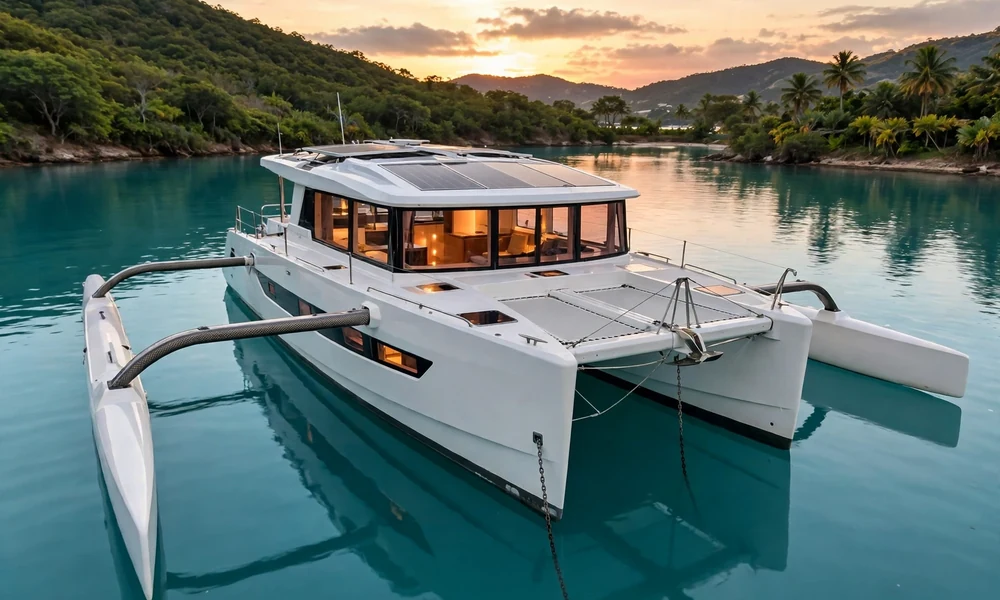
A luxury electric trimaran leaves the marina without a sound. There is no diesel rumble, no exhaust haze, and no vibration through the deck. The three hulls slide through the water, the boat picks up speed, and the only noise is the water itself. Passengers on the aft deck keep talking in normal voices as the boat accelerates to a speed that would make a diesel yacht work hard.
That quiet speed comes from the electric drive, not from the three hulls alone. The trimaran has a battery bank, electric motors, and a power system that manages every watt, and the hull shape exists to make that electric power go further. This is how a luxury electric trimaran works, and why its owners rarely hear a motor at all.

The three hulls and why they matter
A trimaran has three hulls: a long central hull that carries the living space, and two smaller outriggers that give it stability. The central hull is narrow, which keeps drag low, and the outriggers sit clear of the water at rest, only touching down when the boat heels.
The hulls are built from carbon fibre with a foam core, light and stiff, and the crossbeams that join them carry the loads that try to twist the hulls apart in a seaway. Because the boat is light, the electric motors do not have to work as hard, and the battery lasts longer. How a luxury trimaran works explains the same three-hull layout on a conventional boat, where the shape is used for speed under sail or diesel power, and the electric version uses that shape to stretch every kilowatt.
The battery bank below deck
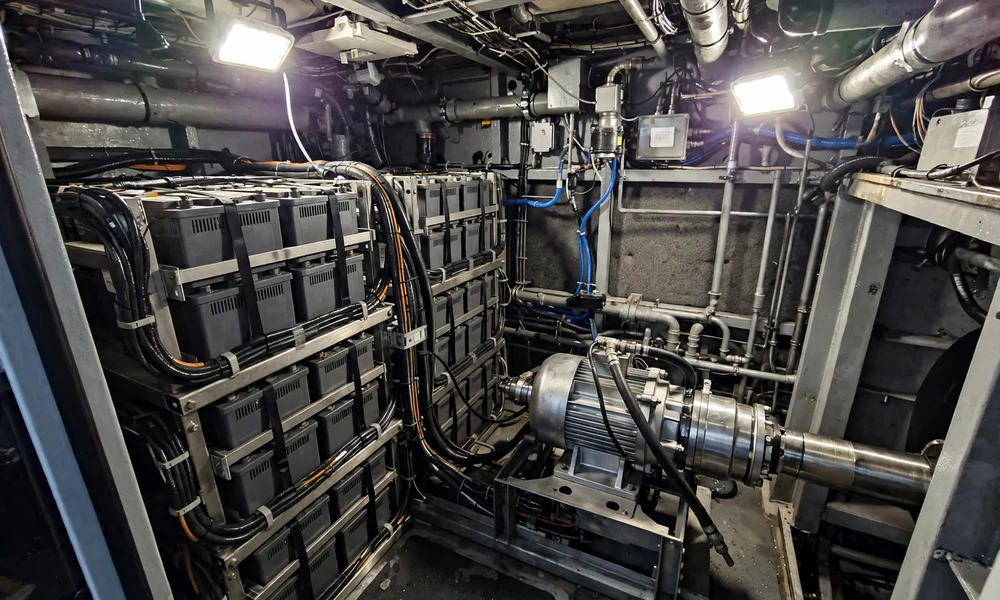
The battery bank is the fuel tank of the trimaran, and it sits low in the central hull, where its weight keeps the boat stable. Lithium modules are packed into sealed compartments with liquid cooling and fire protection, and they are wired together into a bank that can be several hundred kilowatt-hours. The bank is split across compartments so that a fault in one section does not take out the whole system.
A battery management system watches every module for temperature, voltage, and state of charge, balancing the charge between them and warning the crew long before a problem appears. The bank powers the motors, and it also powers everything else on board: the air conditioning, the galley, the lighting, and the navigation systems.
The electric motors and propellers
The trimaran is driven by electric motors mounted in the central hull, usually one or two units driving propellers or saildrive legs at the stern. Electric motors give their full torque from a standstill, so the boat accelerates smoothly and instantly, with no gears to change and no revving engine. The motors are quiet by nature, and they are mounted on flexible mounts that keep what little vibration they make from reaching the cabins.
The propellers are sized for efficiency rather than top speed, with large, slow-turning blades that move a lot of water gently.
Charging: shore power, solar, and regeneration
An electric trimaran gathers power from several sources. In a marina it plugs into shore power, which charges the bank overnight. On the water, solar panels across the hard-top roof and the crossbeams add power through the day, and many boats carry hydrogenerators: small turbines on the propellers that make power while the boat sails under wind power alone.
The most surprising source is regeneration under power. When the boat slows down, the motors can act as generators, feeding a little charge back into the bank. How an electric catamaran works describes the same mix of charging sources on a twin-hull boat, and the trimaran adds the sailing regeneration that its narrow hull makes possible.
The power brain and the helm
The system that decides how the power is used is the energy management computer, and it works quietly in the background. It reads the speed the captain has set, the charge in the batteries, and the power the hotel systems are drawing, and it chooses the most efficient way to meet the demand. The captain can override it, but most of the time there is no need, and the boat simply runs at the speed asked with the least energy it can.
The computer also plans ahead. If the boat is heading for a quiet anchorage, it makes sure the batteries are full on arrival, so the boat can sit in silence all evening with the air conditioning running and no generator at all.
Silent running at anchor
The luxury of an electric trimaran shows most at anchor. With no generator running, the boat sits in a quiet bay, the air conditioning hums softly, the lights glow, and there is no diesel throb under the deck. The battery bank carries the hotel load through the night, and in the morning the solar panels top it back up while the crew makes breakfast.
If the bank does run low, a small range-extender generator can start automatically and charge the batteries, but it is a backup, not the main source of power. The solar panels and the shore charging cover the daily use, and the boat is designed to live on its batteries for days at a time.
Specifications
| Detail | Specification |
|---|---|
| Length | Around 18 to 24 metres |
| Beam | Around 9 to 11 metres |
| Battery bank | Around 200 to 400 kilowatt-hours |
| Electric motors | Two motors, around 80 kilowatts each |
| Cruising speed | Around 8 to 10 knots on electric power |
| Top speed | Around 14 to 16 knots |
| Range on battery | Around 40 to 80 nautical miles |
| Guests | Around 8 guests and 2 crew |
Price
The estimated price of a new luxury electric trimaran is around 4 million dollars, and that figure is an estimate only, because the cost depends on length, battery size, and the standard of the interior. The carbon hulls, the battery bank, and the electric drive account for a large share, followed by the fit-out. A buyer is paying for a yacht that cruises in silence, anchors for days without a generator, and uses its three hulls to make every kilowatt of battery power go further.
A rare fact
Few people know that an electric trimaran can recharge its batteries while it sails under wind power alone. If the boat carries sails, the propellers spin in the water as the boat moves, turning the motors into generators. On a long downwind passage, that free charging can add hours of silent electric running at the other end, and the boat arrives at its anchorage with fuller batteries than it left with.
When the trimaran returns to its berth and the motors stop for the last time that day, the boat goes quiet again, and the guests step ashore without ever having raised their voices over an engine. The best electric catamaran brands, ranked compares the builders working with this kind of electric drive, and the trimaran takes the same technology and gives it a third hull, so the power goes further and the silence lasts longer.