From the viewing gallery of a small airfield outside Munich, the aircraft on the apron looks too quiet to fly. It has no tail rotor, no jet exhaust, and no smell of fuel. Eight small rotors sit on slim booms around a cabin the size of a luxury car, and the whole machine gleams in a way that makes the watching engineers grin. A luxury eVTOL aircraft — an electric vertical take-off and landing craft — is built to do something helicopters never could: lift a handful of passengers straight off a city rooftop, fly them across town in near silence, and land on a pad no bigger than a tennis court.
Building one is nothing like building a conventional aeroplane. There is no single big engine to bolt on, and no fuel system to plumb through the wings. Instead, dozens of small electric motors, a battery pack that weighs as much as the passengers, and software that flies the aircraft even when the pilot does nothing are all woven into a carbon shell. The factory floor looks more like a clean room crossed with a boat yard than an aircraft plant, and every gram is argued over. Here is how that strange, quiet aircraft comes together.
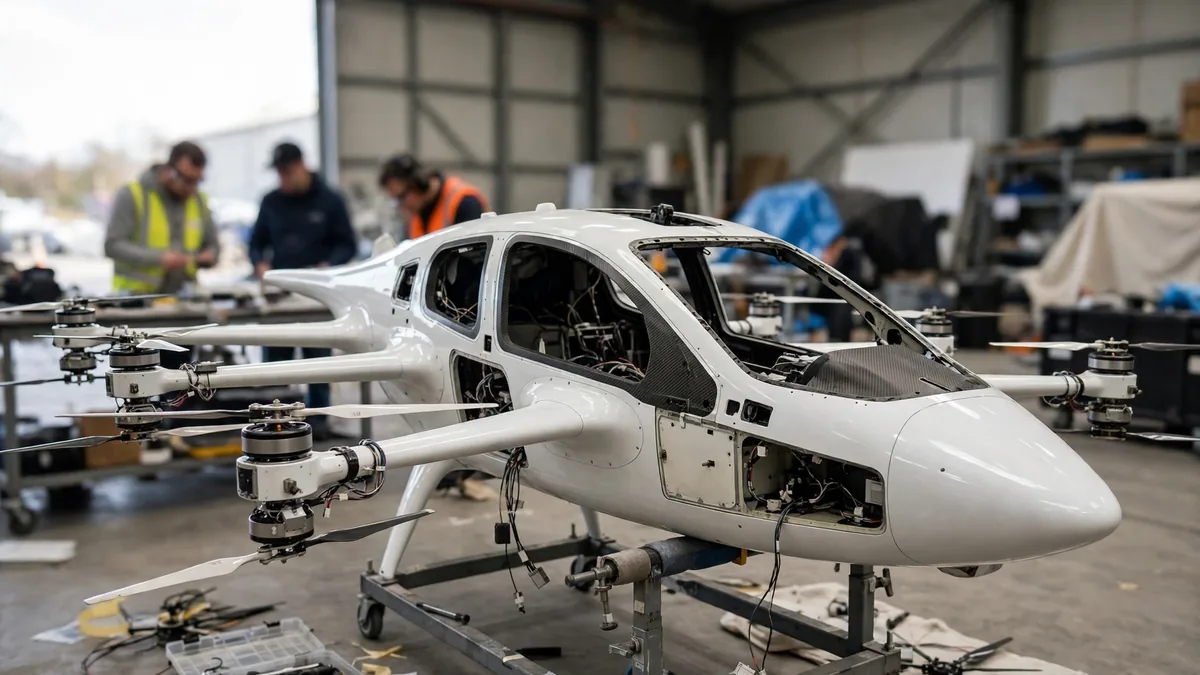
How a luxury eVTOL aircraft is made
Step 1: Designing for lift, not speed
Designers start with a simple question: how many people, how far, and from how small a pad? A luxury eVTOL is usually drawn for four passengers plus a pilot, flying around a hundred kilometres between charges. The airframe is shaped to lift vertically on rotors, then tilt or hand over to a wing for efficient forward flight, so the design team spends months in simulation balancing hover power against cruise efficiency. Redundancy is designed in from the first sketch: if one motor or one battery string fails, the others must still land the aircraft safely. Nothing in the design is allowed a single point of failure.
Step 2: Laying up the carbon airframe
The fuselage and wings are built from carbon fibre composites, laid up by hand in moulds and cured in autoclaves, much like a racing yacht hull. The structure has to be both feather-light and immensely strong, because the battery pack alone can weigh several hundred kilograms and the rotor booms must carry the full weight of the aircraft in hover. Technicians lay fibre cloth in precise orientations, vacuum-bag the parts, and cure them under heat and pressure. Every finished part is inspected with ultrasound to find hidden voids, and any panel that fails the scan is scrapped, however expensive it was to make.
Step 3: Installing the battery pack
The battery is the heart of the aircraft and its heaviest single component. Modules are assembled in fireproof, crash-resistant housings and fitted low in the fuselage, where their weight keeps the aircraft stable. Each module has its own cooling channels and sensors, and the pack is split into independent strings so that a fault in one cannot take down the rest. Wiring is routed through shielded conduits, away from anything hot or sharp, and the whole installation is tested for insulation and short-circuit protection before the motors are ever connected. Range is the constant trade-off: more battery means further flight, but also more weight to lift.
Step 4: Fitting the rotors and electric motors
Where a helicopter has one complex rotor head, an eVTOL has many small ones. Each rotor is driven directly by its own electric motor, with no gearbox in between, and the motors are mounted on booms or tilting nacelles around the airframe. Technicians balance every propeller to a fraction of a gram, because vibration at thousands of revolutions per minute would shake the cabin apart over time. The motors are wired to independent controllers, so the flight computer can speed up one rotor and slow another to steer, climb or hold a hover without any mechanical linkages at all.
Step 5: Avionics, sensors and the flight computer
The cockpit of a luxury eVTOL looks almost empty: a few screens, a sidestick, and little else. Behind the panels sit triple-redundant flight computers, GPS and inertial sensors, radar altimeters and cameras that watch the ground during landing. Software engineers load flight-control code that translates the pilot’s simple commands into the precise rotor speeds needed to keep the aircraft level, even in gusty wind. The avionics are tested on rigs that simulate entire flights before the aircraft leaves the ground, and the wiring looms are built on benches, tested, and only then installed, because tracing a fault inside a finished fuselage can take days.
Step 6: Interior, finishing and flight testing
Only when the engineering is proven does the luxury cabin go in: four leather seats, panoramic glazing, noise-absorbing panels and a cabin so quiet that passengers can talk at normal volume. Painters finish the airframe in the owner’s colours, and the aircraft moves to flight testing, which begins tethered to the ground and progresses through short hops to full transition flights, where the rotors tilt and the wing takes over. Test pilots log hundreds of hours before the first passenger flight, and certification authorities review every test result. Delivery happens only when the aircraft has proven it can lose a motor, lose a battery string, and still land safely.
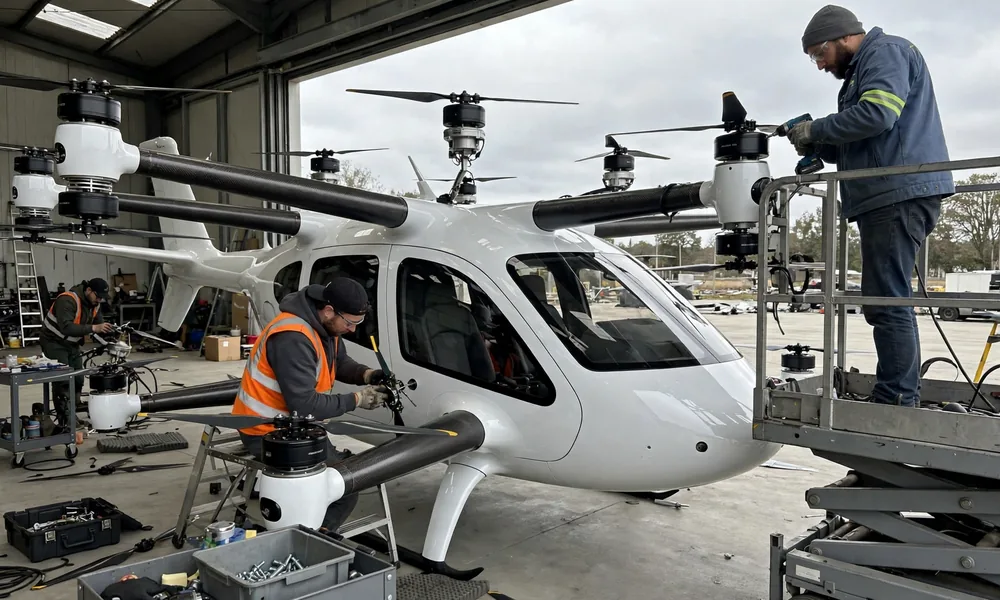
Luxury eVTOL aircraft specifications
| Specification | Typical figure |
|---|---|
| Passengers | 4, plus pilot |
| Range | 100 to 250 kilometres |
| Cruise speed | 200 to 300 km/h |
| Rotors | 6 to 12 electric rotors |
| Battery capacity | 150 to 300 kWh |
| Take-off footprint | About 15 metres square |
What a luxury eVTOL aircraft costs
There is no settled showroom price yet, but industry estimates put a luxury eVTOL aircraft at an estimated $3 million to $7 million, depending on range, certification and cabin finish. That figure reflects low production volumes, expensive certification, and battery packs that still cost far more per kilowatt-hour than car batteries. Operators expect the economics to improve as production scales, but for now the eVTOL is a premium machine for owners and air-taxi services who value time over ticket price. To see how the finished aircraft behaves in the air, read how an eVTOL aircraft works, and for a sense of how other small luxury aircraft are put together, see how a luxury gyrocopter is made.
A rare fact about luxury eVTOL aircraft
Some eVTOL designs are so quiet in cruise that engineers measure their noise in the same range as a busy conversation, and the loudest sound passengers hear is often the wind over the canopy rather than the rotors. That is why city regulators are more interested in these aircraft than in any helicopter: the machine that lands on a rooftop need not wake the street below.

Building a luxury eVTOL is an act of faith in batteries, software and carbon fibre, three technologies that barely existed in aviation a generation ago. The factories that succeed treat redundancy as a design principle rather than an afterthought, and the result is an aircraft that asks its passengers to trust a computer with the flying. The same electric thinking is reshaping cars too, as how a luxury electric hypercar is made shows, but nowhere is the bet on electric power quite as bold as it is in the sky.


