The helm seat is where the skipper spends the voyage, and on a long passage it is the most important seat on the boat. A good helm seat holds you steady in a seaway, lets you see clearly over the bow, and keeps you comfortable for hours without aches. It is also the seat you return to, watch after watch, while the rest of the boat’s seating goes unused. A bad one leaves you sliding around, craning your neck, and standing up to steer because sitting down has become unbearable.
This ranking rates the helm seats you will actually find on yachts, from the simplest to the finest. We judged each one on comfort over long hours, support in rough water, adjustability, visibility from the seated position, durability in sun and salt, and how well it suits the helm station it belongs to.

How we ranked them
Comfort comes first, because a helm seat exists to be sat in for hours. Support comes next, and it is the quality most buyers underestimate until their first rough passage. Support comes next: a seat must hold the skipper in place when the boat rolls, without belts or bracing. Then adjustability, since no two skippers are the same height, and visibility, since a seat that puts your eyes below the windscreen frame is a hazard. The best yacht helm stations, ranked covers the station as a whole, and this ranking is about the seat within it.
10. The fixed bench seat
The fixed bench is the simplest helm seat there is: a padded bench bolted to the deck, with no adjustment and no back support worth the name.
9. The basic flip-up seat
Flip-up seats fold away when not in use, which saves space in a crowded cockpit. They are common on smaller yachts where every centimetre counts. The problem is that they are built to fold, not to sit in: thin padding, a narrow seat, and a backrest that flexes. After half an hour the thin padding compresses to nothing, and the skipper is effectively sitting on a board.
8. The pedestal bucket seat
A pedestal bucket seat — a moulded seat on a fixed post — is a step up. The bucket shape holds the skipper better than a flat bench, and the pedestal lifts the seat to a good steering height. The bucket shape holds the skipper better than a flat bench, and the pedestal lifts the seat to a good steering height. The weakness is the fixed height: a tall skipper sits too high and a short one too low, and neither can see properly over the bow.
7. The adjustable pedestal seat
Add height adjustment and a sliding base to the bucket seat and it becomes a much better thing. The skipper can set the seat to their own height, slide forward to reach the wheel comfortably, and slide back when standing to steer. The skipper can set the seat to their own height, slide forward to reach the wheel comfortably, and slide back when standing to steer.
6. The suspension helm seat
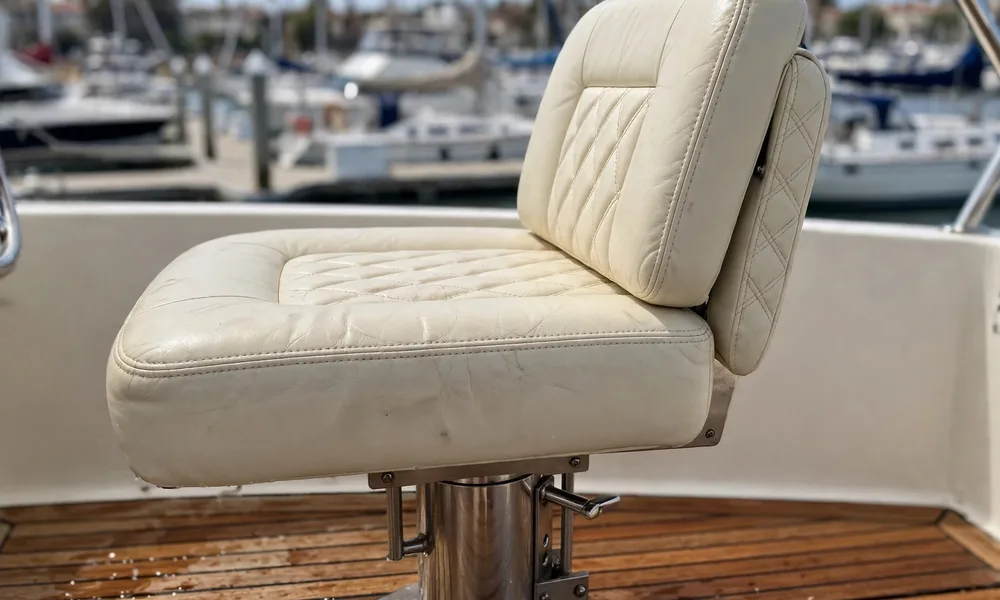
A suspension seat adds a sprung and damped base that absorbs the shock of waves, protecting the skipper’s spine on a rough passage. Anyone who has helmed a fast boat through chop knows the value of this: without suspension, every wave is a jolt through the seat and into your back. Anyone who has helmed a fast boat through chop knows the value of this: without suspension, every wave is a jolt through the seat and into your back. Suspension seats are standard on workboats and increasingly common on fast cruising yachts.
5. The leaning post
A leaning post is not a seat at all, strictly speaking — it is a padded bolster you lean against while standing or half-sitting at the helm. It is the choice of fast centre-console boats and sportfishing yachts, where the skipper stands to drive and only rests against the post.
4. The double helm seat with armrests
A wide double seat with armrests lets the skipper and a companion share the helm, which is how most cruising yachts are actually used — one person steering, one person keeping company and watching the horizon. — one person steering, one person keeping company and watching the horizon. The armrests give lateral support in a roll, and the width lets the skipper shift position during a long watch.
3. The heated and ventilated helm seat
Heating and ventilation sound like luxuries until you have helmed through a cold dawn or a tropical afternoon. A heated seat keeps the skipper warm and alert on a chilly morning watch, and ventilation stops the sticky discomfort of a long hot passage. A heated seat keeps the skipper warm and alert on a chilly morning watch, and ventilation stops the sticky discomfort of a long hot passage.
2. The fully adjustable captain’s chair
The fully adjustable captain’s chair is the helm seat most skippers dream about: height, slide, swivel, recline, lumbar support, armrest height, and a flip-up bolster, all adjustable. It fits any skipper, it supports any posture, and it stays comfortable for a full day at the helm. It fits any skipper, it supports any posture, and it stays comfortable for a full day at the helm. The best ones are built on a suspension base as well, combining adjustment with shock absorption.

1. The custom-fitted helm seat
The best helm seat is one made for the boat and the skipper: custom-fitted, with the seat height, back angle, and bolster position set for the helm station it serves and the person who uses it most. It combines the adjustability of a captain’s chair with the suspension of a shock-absorbing base, the grip of quality upholstery, and materials that survive sun and salt for years. Luxury electric yacht specs, explained shows how the best yachts are put together, How the electric boat anchor works covers the other end of the journey.
Helm seat materials: what lasts at sea
The frame of a helm seat matters as much as its shape. Stainless steel pedestals resist corrosion for decades, while painted mild steel rusts from the inside out and fails without warning. Aluminium is light and strong, but it needs proper anodising or it pits in salt air. The upholstery matters even more: marine-grade vinyl is the workhorse, because it shrugs off sun, salt, and spray and can be hosed down after a wet passage. Real leather looks and feels better, but it demands regular conditioning and suffers in constant sun. Mesh fabrics are the newest option — they breathe, they dry fast, and they stay cool in tropical heat, though they can feel less substantial than vinyl. Whatever the material, the stitching is the weak point: UV-resistant thread and sealed seams are what separate a seat that lasts ten years from one that splits in two seasons.
The verdict
A helm seat is not furniture — it is a working position, and the best ones are designed like the rest of the boat: with the sea, the weather, and the human body in mind. If you are choosing a yacht, sit in the helm seat for ten minutes before you look at anything else. Slide it, swivel it, lean back, and imagine ten hours there in a chop. Slide it, swivel it, lean back, and imagine ten hours there in a chop. The seat will tell you more about the yacht than the brochure ever will.