Slip below the surface in a luxury expedition submarine and the world goes quiet. The blue deepens, the sunlight fades to a soft glow, and through the great round viewport a reef drifts past, close enough to touch. There is no engine roar, no rush of wind, just the gentle hum of the motors and the slow, weightless feeling of flying underwater.
That calm is the result of careful engineering. An expedition submarine is a small, strong pressure vessel, built to carry a handful of people safely to depths a diver could never reach, and to bring them back with air to spare. Every system, from the hull to the life support, is designed twice over, so that no single failure can end a dive.
This is how a luxury expedition submarine works, from the pressure hull that keeps the sea out to the viewport that lets the ocean in.
How It Works
Step 1: The pressure hull that keeps the sea out
The heart of the submarine is its pressure hull, a sphere or a short cylinder made from thick steel or titanium. A sphere is the strongest shape for the job, because water pressure pushes on it evenly from every side, and the hull is built in sections, welded, then tested to far beyond its rated depth before it ever carries a passenger.
The hull is small by design, usually seating two to seven people, because a smaller hull needs less material to resist the same pressure. Every hatch, cable and pipe that passes through the hull is sealed with multiple gaskets, and each one is pressure-tested on its own. The luxury expedition submarine build explains how that hull is welded and tested, while this guide looks at what it does on a dive.
Step 2: Diving, surfacing and staying level
To dive, the submarine takes water into ballast tanks, making itself slightly heavier than the water around it, and sinks slowly under the control of its thrusters. To surface, it blows the water out with compressed air, becoming lighter than the sea and rising gently. Fine trim is adjusted with small amounts of water moved between tanks, so the boat stays level.
The pilot controls the dive from a simple joystick, with the submarine’s computers keeping the depth steady. If the pilot lets go, the boat holds its depth on its own, hovering in the water column like a slow-moving balloon, which is what lets guests watch a reef for an hour without drifting away.
Step 3: Thrusters, batteries and silent running
Power comes from large battery packs, usually lithium-ion, housed in sealed pods outside the pressure hull. The batteries drive electric thrusters, small propellers in steerable pods that can push the submarine in any direction, including sideways and straight up or down.
Electric thrusters are quiet, which matters twice over: the passengers hear almost nothing, and the marine life is not frightened away. The batteries are sized for a dive of six to twelve hours, with a generous reserve, and they are recharged from the mothership between dives. A luxury submarine uses the same quiet electric idea, though its larger hull carries far more battery and range.

Step 4: The viewport and seeing underwater
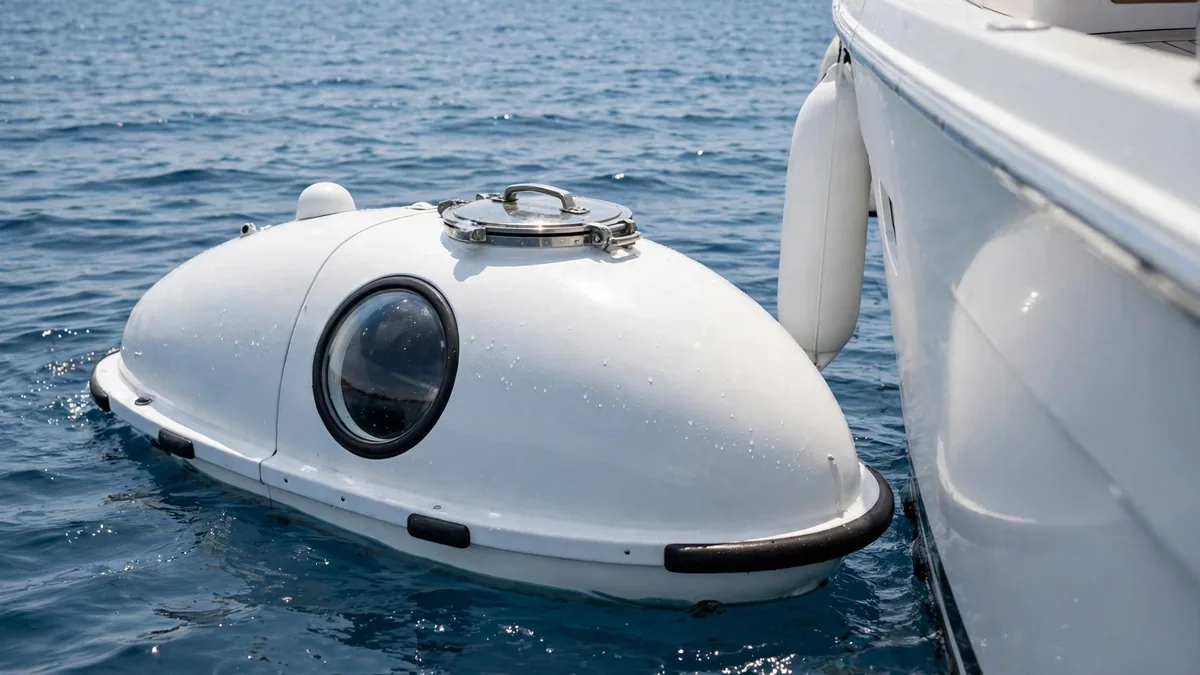
The great round viewport is the submarine’s window on the world, and it is made from a single thick piece of acrylic, sometimes more than ten centimetres thick. Acrylic is used because it is clear, strong and slightly flexible, so it can take the pressure without cracking. The viewport is machined, polished and fitted into a metal frame with a deep seal.
Outside lights, mounted on the hull, light up the reef or the wreck ahead, because sunlight fades quickly with depth. Cameras on the outside feed screens inside, so guests can see details the viewport misses, and the pilot can check the thrusters and the seabed below. At depth, the view through that thick, clear window is the whole reason the submarine exists.
Step 5: Life support, air and safety
Inside the pressure hull, the air is kept fresh by a life support system that would be familiar to any astronaut. Carbon dioxide is scrubbed from the air by chemical filters, oxygen is topped up from small tanks, and sensors watch the air constantly, warning the pilot long before any level becomes a problem.
Safety is layered. The submarine carries emergency oxygen, a backup power supply and a drop-weight system: heavy weights that can be released in an instant, making the boat buoyant so it rises to the surface even if every other system fails. Before every dive, the pilot runs a full checklist, and the mothership tracks the submarine by sonar throughout the dive, ready to help if it is needed.
Step 6: Launching, recovering and the mothership
An expedition submarine does not work alone. It lives aboard a yacht or a dedicated support ship, launched by a crane into the water and recovered the same way. The launch is a careful operation, with the crew checking the hatch seals and the thrusters before the crane lets go.
Between dives, the submarine is washed, inspected and recharged on deck. The batteries are topped up, the viewport is cleaned, and the life support filters are checked. A luxury expedition submarine specifications page lists the depths and dive times these boats are rated for, and every rating is proved in testing before a guest ever climbs aboard.
What it is made of
The table below sums up the systems that matter most in a luxury expedition submarine, from the hull to the life support.
| System | How it works |
|---|---|
| Pressure hull | Steel or titanium sphere, pressure-tested |
| Depth rating | 300 to 1,000 metres, by model |
| Ballast | Water tanks and compressed air |
| Propulsion | Electric thrusters, battery powered |
| Viewport | Thick acrylic dome, external lights |
| Life support | Carbon dioxide scrubbers, oxygen top-up |
| Dive time | 6 to 12 hours, with reserve |

How much does one cost?
A luxury expedition submarine is priced like a small aircraft, and the pressure hull is the main reason why: a titanium sphere, machined and tested to survive crushing depths, takes months to build, and the life support and safety systems must be proved again and again before the boat is certified. As an estimate, a small two-person expedition submarine costs roughly 2 to 4 million dollars, with larger models running higher.
A seven-person submarine rated to 1,000 metres can be estimated at 10 million dollars or more, and it needs a mothership, a trained pilot and a support crew to operate. Owners accept the price because the submarine opens a world almost no one else can visit: a reef, a wreck or a deep canyon, seen through a clear window in perfect quiet.
A rare fact
Here is something few people know: the acrylic viewport on a deep-diving submarine gets thinner, in a sense, as it goes down. The immense pressure squeezes the thick acrylic slightly, and engineers design for that squeeze, calculating exactly how much the window will compress at full depth so it stays sealed in its frame. A viewport that was fitted too tightly on the surface could crack under pressure; one fitted too loosely could leak.
The result is a machine that seems to defy the ocean. Diving in one takes a trained pilot and a careful crew, but the payoff is a view of the deep sea that almost no human has ever seen first-hand.


