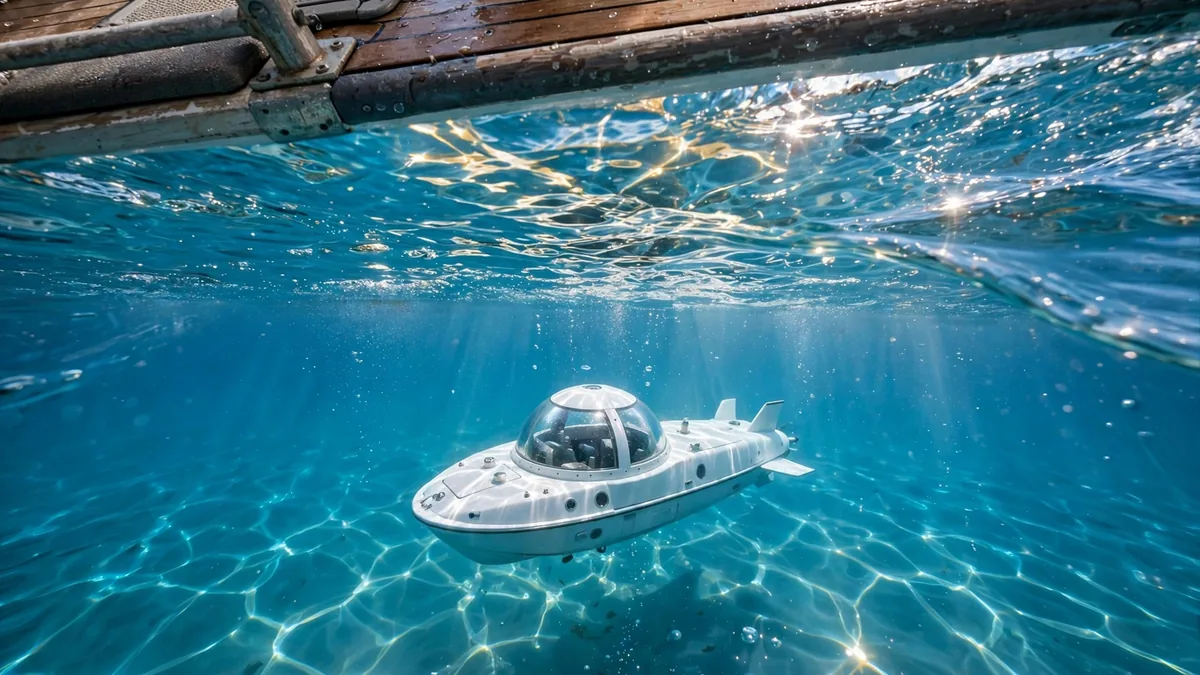
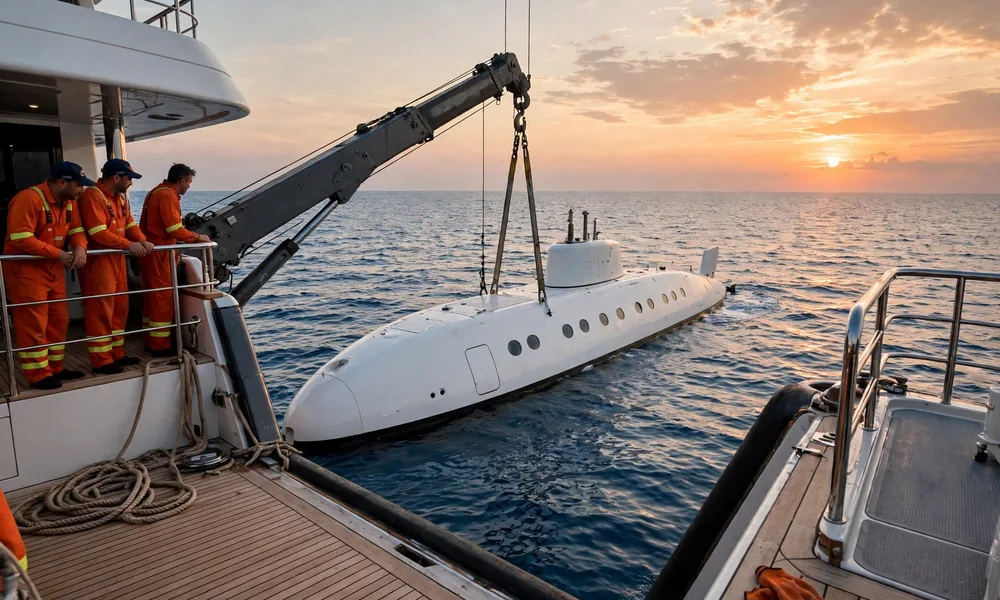
The yacht stopped in the middle of a blue nowhere, the crane swung out over the side, and a small white capsule the size of a minibus slipped down into the water and disappeared. On deck, the guests watched the cable go slack. Below the surface, two people were sitting in leather seats in front of a window the size of a dinner table, watching the light fade from turquoise to deep blue, and then to a darkness lit only by the submarine’s own lamps.
A luxury expedition submarine is the strangest machine in the luxury world, because it is a vehicle that takes you somewhere you cannot survive on your own, and it does it in comfort. It is a pressure hull, a viewport, a life-support system and a battery pack, all squeezed into a space smaller than a hotel room, and the spec sheet is where the engineering hides. Every number on it is a promise about safety, depth and time.
This guide translates every number on a luxury expedition submarine spec sheet into plain English, from depth rating and hull to viewports, life support, batteries and the crew who run it all.
How to Read a Luxury Expedition Submarine Spec Sheet
Depth rating: how deep it can safely go
Depth rating is the first number on the sheet, and the most important. A luxury expedition submarine is usually rated to about 300 to 1,000 metres, with most models aimed at about 500 metres, which is deep enough to reach coral reefs, wrecks and the twilight zone where the sunlight fades. How the hull is built to survive that pressure is a craft of its own, as our guide to how a luxury expedition submarine is made explains.
The pressure hull: steel, titanium and a perfect sphere
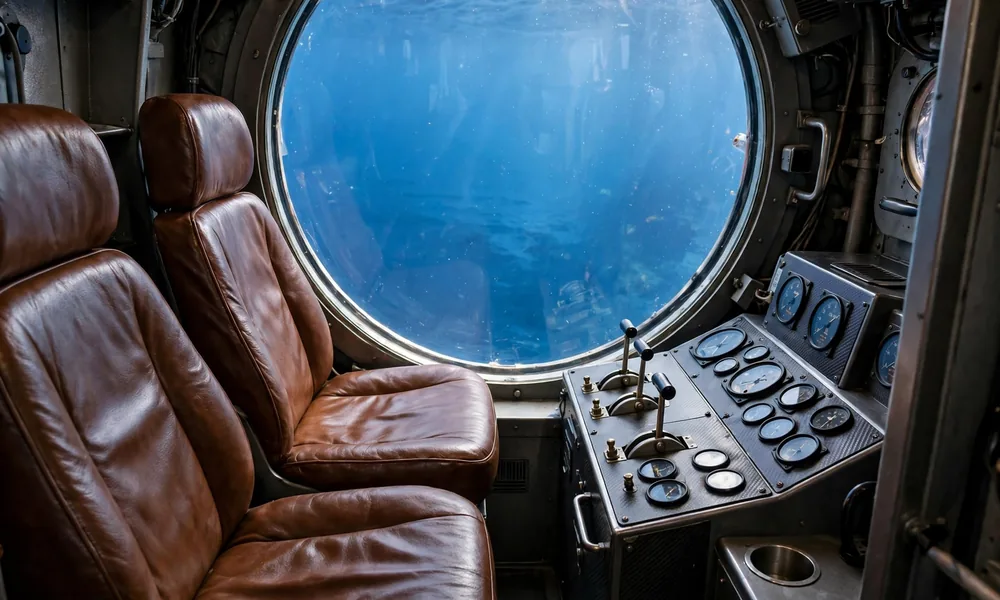
The pressure hull is the strong inner shell that keeps the water out, and it is usually made from high-strength steel or titanium, about 30 to 60 millimetres thick. Many luxury submarines use a spherical hull, because a sphere spreads water pressure evenly in every direction, with no corners for the pressure to concentrate on. The hull is usually about 2 to 3 metres across inside, which is enough room for two to five people to sit comfortably, and everything inside, the seats, the controls and the life-support equipment, is mounted to the hull so it cannot move in rough handling.
The viewport: a window made of acrylic, not glass
The viewport is the huge round window at the front, and it is the reason the whole machine exists. It is not made of glass, but of thick acrylic, usually about 100 to 200 millimetres thick, which is strong, clear and slightly flexible, so it can bend a tiny amount under pressure without cracking. A typical viewport is about 0.8 to 1.2 metres across, which is big enough for two people to look through at once, and it is polished to optical clarity so the view is sharp and undistorted. The viewport is the most expensive single part of many submarines, because it has to be cast, machined and polished as one flawless piece, and a single bubble or scratch inside the acrylic means it is rejected. How the viewport, the hull and the controls work together is a story of its own, as our guide to how a luxury submarine works explains.
Life support: air, oxygen and carbon dioxide
Life support is the system that keeps the people inside alive, and it is measured in hours. A luxury expedition submarine usually carries enough oxygen and carbon-dioxide scrubbing for about 12 to 24 hours of normal diving, though a typical dive lasts about 4 to 8 hours. Oxygen is stored in tanks and released slowly into the cabin, while the carbon dioxide the crew breathe out is removed by chemical scrubbers, usually canisters of a material that absorbs the gas. The cabin air is monitored constantly, and alarms sound long before any level becomes dangerous.
Batteries and propulsion: silent electric power
A luxury expedition submarine runs on batteries, and it is almost completely silent, which is part of its charm. The battery pack is usually about 30 to 60 kWh, similar in size to a small electric car battery, and it powers the electric thrusters, the lights, the life support and the sonar. The thrusters are small electric propellers, usually four to six of them, mounted around the hull, and they let the submarine move in any direction, hover in one place, and turn on the spot. The numbers behind the whole machine are worth a look, as our guide to luxury submarine specs, explained shows for its larger cousins.
Crew, guests and dive time: who goes down, and for how long
A luxury expedition submarine usually carries a pilot and two to four guests, though the largest models carry up to seven people. The pilot is a trained professional who has spent hundreds of hours underwater, and the guests sit beside or behind the pilot, looking out through the viewport.
Luxury Expedition Submarine Specs
| Specification | Typical range |
|---|---|
| Depth rating | About 300 to 1,000 metres |
| Pressure hull | Steel or titanium, about 30 to 60 mm thick |
| Viewport | Acrylic, about 0.8 to 1.2 metres across |
| Life support | About 12 to 24 hours of air |
| Typical dive time | About 4 to 8 hours |
| Battery pack | About 30 to 60 kWh |
| Cruising speed | About 2 to 3 knots |
| Passengers | Pilot plus 2 to 4 guests |
| Weight | About 8 to 15 tonnes |
| Length | About 5 to 8 metres |
What Does a Luxury Expedition Submarine Cost?
A luxury expedition submarine typically costs an estimated 2 million to 6 million dollars to buy, depending on depth rating and size, with the deepest-diving models passing an estimated 10 million dollars. A single dive is usually priced as part of a yacht charter, not sold on its own, because the submarine, the pilot and the support crew all travel with the yacht.
A Rare Fact
The viewport on a luxury expedition submarine is so thick that it changes the way the ocean looks. Acrylic bends light slightly differently from water, so a fish swimming just outside the window appears a little closer and a little larger than it really is, and the effect grows stronger the thicker the window. Pilots learn to judge distances through the viewport the way a driver learns to judge distances through a curved mirror, and guests often reach out towards a creature that is a full arm’s length further away than it seems.
A luxury expedition submarine is a pressure hull, a thick acrylic window, a life-support system and a quiet battery, and the spec sheet is really a description of that balance. The depth rating tells you how deep it goes, the viewport tells you how well you see, the life support tells you how long you can stay, and the battery tells you how quietly it moves. Read those four numbers first, and the rest of the sheet falls into place.


