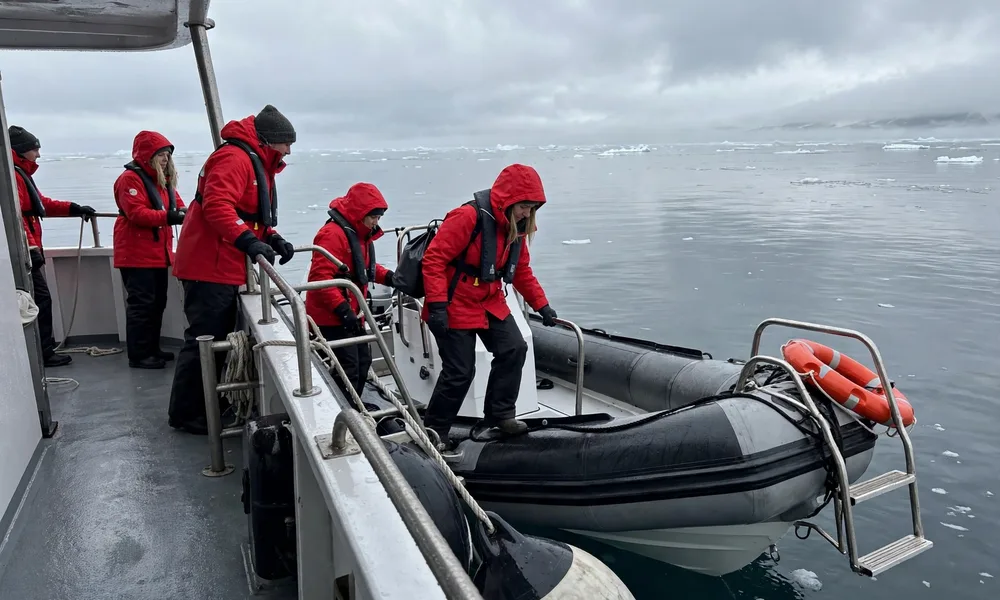
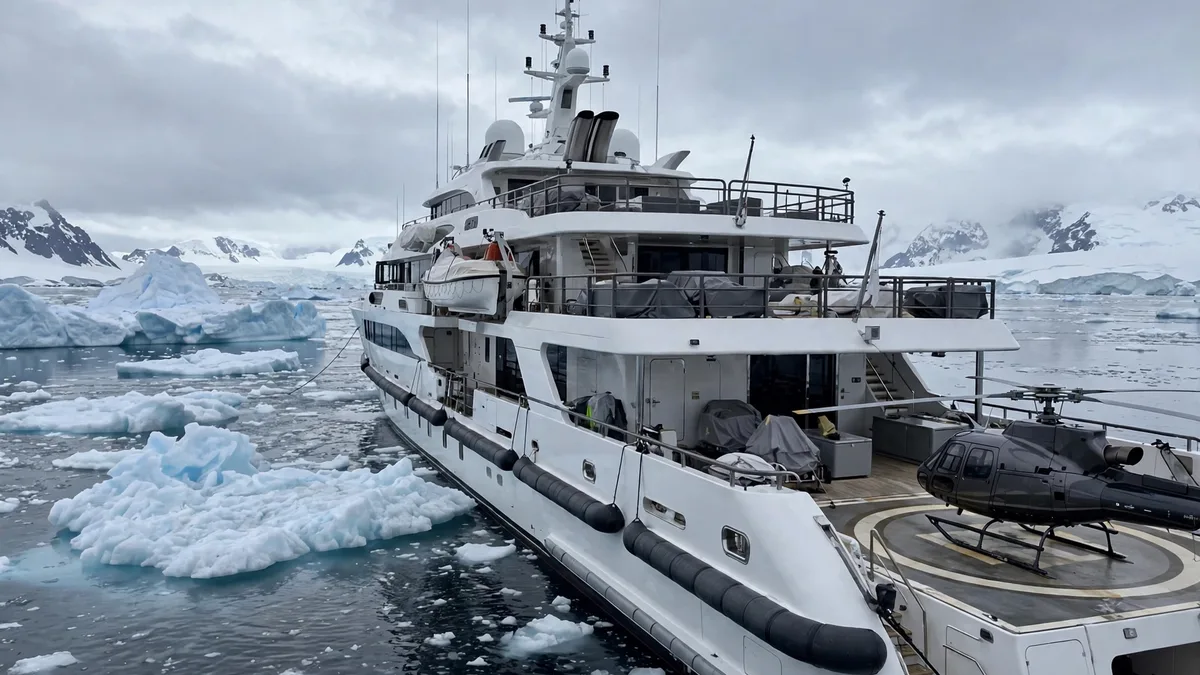
The photograph shows a yacht at anchor in Antarctica, icebergs drifting past her bow, a helicopter on her aft deck, and a dozen guests in red parkas watching penguins from the rail. There is no marina here, no harbour, no fuel dock, and the nearest help is days away by sea. The yacht is a luxury expedition yacht, and she is built to go where other superyachts cannot, and to keep her guests warm, fed and comfortable while she does it. She costs tens of millions more than a yacht of the same size built for the Mediterranean, and the reasons are written into her steel, her tanks and her equipment. Here is where the money goes.
Why it costs so much
The hull is the first fortune. An expedition yacht is built from steel, not aluminium or glass fibre, because steel can take a blow from ice and keep going. The plating is thicker around the waterline, the frames are closer together, and the bow is shaped to ride up onto thin ice and break it with the yacht’s own weight. Many expedition yachts carry an ice class notation, which means the hull has been designed, built and inspected to a standard set by a classification society, and that certification alone adds months and millions to the build. The hull is also a displacement hull, built for heavy seas rather than speed, and it is heavier, stronger and more expensive than the planing hull of a Mediterranean yacht.
Range and self-sufficiency are the second fortune. Fuel tanks sized for 8,000 to 10,000 nautical miles let the yacht cross oceans and operate for weeks away from a fuel dock, and that range needs tanks, piping and stability calculations that a short-range yacht never requires. Water makers, waste treatment, freezers and spare parts are all sized the same way, so the yacht can support a dozen guests and a crew of twenty in a place where the nearest help is days away. The yacht carries her own workshop, her own spare parts, and often her own doctor’s room, because self-sufficiency is not a luxury on an expedition yacht. It is the whole point.
The toys and the tenders are the third fortune. An expedition yacht carries not one tender but several, including landing craft that can drive onto a beach, rigid inflatables for shore landings, and often a helicopter with its own hangar and fuel store. The helicopter alone can cost several million dollars, and the hangar, the landing deck and the certification to carry aviation fuel add millions more. Some expedition yachts also carry a small submarine, a fleet of kayaks, diving gear and snowmobiles, and every toy needs storage, launching gear and a crew member trained to operate it.
The stabilisers and the positioning systems are the fourth fortune. Guests on an expedition yacht spend days in open ocean, so comfort at sea matters more than on a marina yacht. Most expedition yachts carry large fin stabilisers that extend from the hull and counteract the roll, and many add a gyroscopic stabiliser that works at anchor as well. Dynamic positioning, a system that holds the yacht in one place using thrusters and satellite navigation, lets the yacht hover over a dive site or a reef without dropping an anchor, and that system needs its own computers, sensors and backup power. Together these systems keep the dining table level and the cabins quiet in conditions that would have a smaller yacht turning back.
The interior is the fifth fortune, and it is built to a contradiction. It has to feel like a luxury hotel, with warm wood, soft light and quiet cabins, while the hull around it is a working ship built to take a beating. Joiners fit the interior to a steel hull that flexes in a seaway, so every panel, every door and every fitting is designed to move without cracking or rattling. The windows are thicker, the insulation is heavier, and the heating system is sized for polar cold, because the yacht must be warm inside while the sea outside is below freezing.
Rarity and the crew are the sixth fortune. Only a handful of yards in the world build true expedition yachts, and each one is effectively a prototype, designed from a blank page for one owner and one set of voyages. The crew is larger and more specialised than on a normal yacht, including ice pilots, dive masters, helicopter pilots and expedition guides, and their salaries reflect skills that few sailors hold. An expedition yacht is not just a boat. It is a private research station, a hotel and an icebreaker in one hull, and that is why it costs what it does.

The spec sheet at a glance
| Figure | Typical range | What it tells you |
|---|---|---|
| Length overall | Roughly 50 to 110 metres | How long the yacht is |
| Beam | Roughly 10 to 18 metres | How wide, and how much room inside |
| Gross tonnage | Roughly 1,000 to 5,000 GT | How much internal volume it has |
| Ice class | PC5, PC6 or equivalent | How thick the ice it can enter |
| Range | Roughly 8,000 to 10,000 nautical miles | How far it can go without refuelling |
| Cruising speed | Roughly 12 to 14 knots | How fast it travels day to day |
| Guests and crew | Roughly 12 guests, 20 to 30 crew | Who it carries and who runs it |
| Price | Roughly $50 million to $250 million | What the yacht costs, as an estimate |
What it costs
The estimated price of a new luxury expedition yacht is roughly $50 million to $250 million, and that figure is an estimate only, because the cost depends on the length, the ice class, and whether the yacht carries a helicopter and a submarine. The steel hull and the ice strengthening account for a large share, followed by the interior, the tenders and the helicopter, and the stabilisers, positioning systems and long-range tanks add the rest. Annual running costs run at roughly a tenth of the purchase price, and a single Antarctic season needs months of planning, permits and provisioning. What makes it an expedition yacht is the combination of a working ship’s capability with a private yacht’s comfort, as the guide to what is a luxury expedition yacht explains, and the cruise-ship version of the idea shows the same logic at a larger scale, as the guide to luxury expedition cruise ship specs explained shows, carrying a hundred guests where the yacht carries a dozen. The yacht that shadows her, carrying the helicopter and the extra tenders, is a machine in its own right, as the guide to how a luxury support vessel is made shows, and many expedition owners buy one of those too.
A rare fact
Few people know that an expedition yacht can be its own port. With dynamic positioning holding her steady, a crane lowering a tender, and a helicopter lifting guests ashore, she can put people on a beach that has no dock, no road and no name on any chart, and then take them home again, all without ever touching land herself. The yacht never needs a harbour. The harbour is whatever stretch of water she chooses.