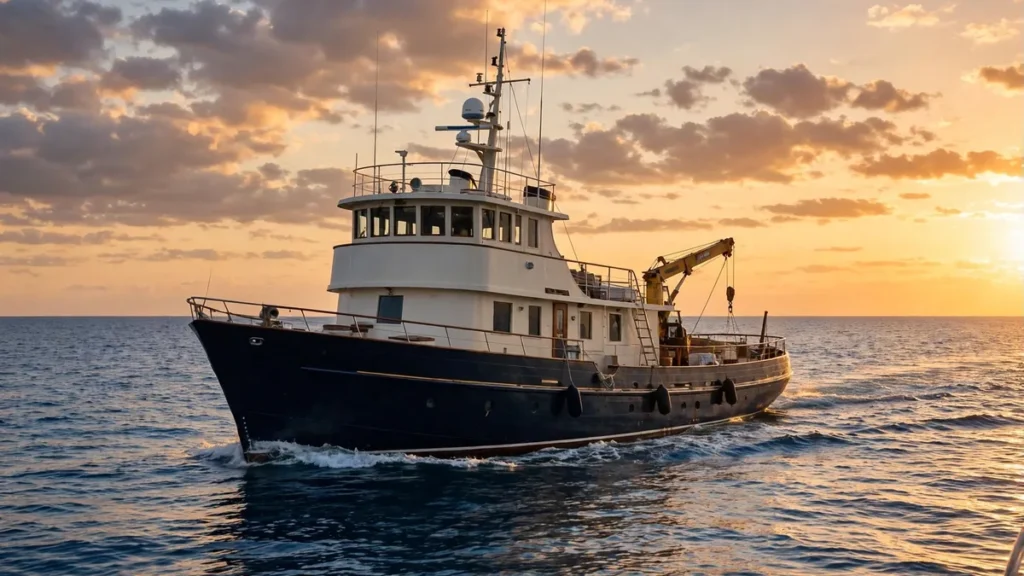
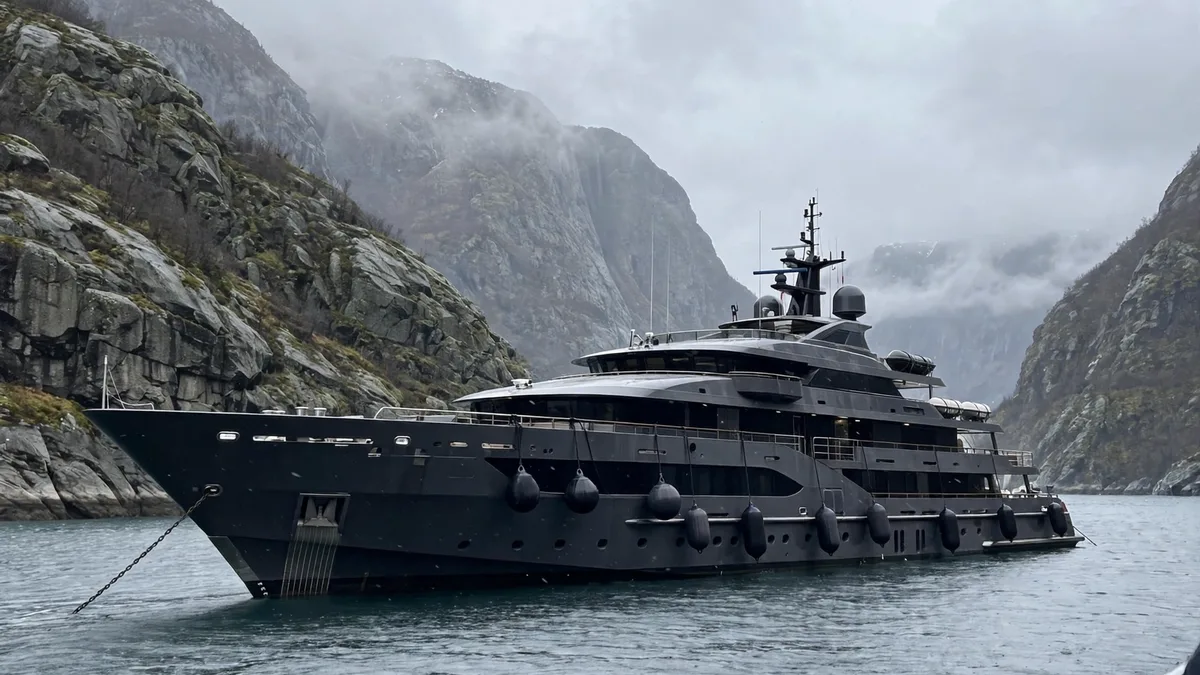
The harbour is grey and cold, the wind is coming off the sea, and the boat at the end of the pontoon looks more like a small ship than a yacht. Its hull is steel, painted dark, with a high bow built to take a wave and keep going. There is no white fibreglass gleam here, no sun pad, no cocktail bar on the aft deck. Instead there is a helicopter pad, a crane, and a tender the size of another boat. A luxury expedition yacht is built to go where other yachts cannot: across oceans, into polar water, and back again, carrying its owners in comfort the whole way. Its spec sheet reads like a ship’s, because that is what it is.
The spec sheet at a glance
| Figure | Typical range | What it tells you |
|---|---|---|
| Length overall | Roughly 40 to 80 metres | How big the boat is, and which ports it can enter |
| Beam | Roughly 9 to 14 metres | How wide it is, and how much living space it holds |
| Gross tonnage | Roughly 500 to 2,500 GT | How much interior volume it has |
| Range | Roughly 5,000 to 10,000 nautical miles | How far it can go without refuelling |
| Cruising speed | Roughly 12 to 15 knots | How fast it crosses an ocean comfortably |
| Guests and crew | Roughly 10 to 16 guests, 12 to 20 crew | How many people it carries, and who looks after them |
| Hull | Steel, often ice class | How tough it is, and where it can safely go |
| Price | Roughly $30 million to $150 million | What a luxury expedition yacht costs, as an estimate |
Length and beam: size is capability
Length overall on a luxury expedition yacht usually runs from 40 to 80 metres, and every extra metre buys capability, not just space. A longer hull crosses an ocean more comfortably, because it bridges the waves instead of pitching over each one, and it carries more fuel, more water and more stores. Beam, the width, usually runs from 9 to 14 metres, and it decides how much living space the boat holds: a wide beam means a full-width owner’s suite, a proper saloon, and cabins that feel like hotel rooms rather than bunks.
The hull: steel, and often ice class
The hull of a luxury expedition yacht is usually steel, not the fibreglass or aluminium of a normal superyacht, and the reason is simple: steel takes a knock. It can hit floating ice, scrape a reef, or nudge a quay without cracking, and it can be repaired in almost any shipyard in the world. Steel is heavy, which costs speed, but an expedition yacht is not trying to be fast. It is trying to be safe, and steel is the safest material a yacht can be built from. The guide to expedition yacht specs covers the same steel-hull logic on a non-luxury vessel, and the numbers are close, because the hull does not care how nice the carpets are.
Range: crossing oceans without stopping
Range is the number that defines an expedition yacht, and it usually runs from 5,000 to 10,000 nautical miles at cruising speed. That is enough to cross the Atlantic twice without refuelling, or to cruise the South Pacific for weeks between fuel stops. Range comes from big fuel tanks, often holding hundreds of thousands of litres, and from engines tuned for efficiency rather than speed. A yacht that cruises at 12 knots uses far less fuel than one pushing 20 knots, and on a long crossing, that difference is the difference between arriving and stopping halfway.
Stabilisation: comfort in a rough sea
An expedition yacht spends its life in open ocean, where the sea is rarely flat, so stabilisation is one of its most important systems. Most luxury expedition yachts use a combination of fin stabilisers, which extend from the hull underwater and counteract rolling, and gyroscopic stabilisers, which spin a heavy flywheel inside the boat to resist motion. Together they can cut rolling by most of its force, turning a sea that would send guests to their cabins into a gentle sway.

Tenders and toys: the boats within the boat
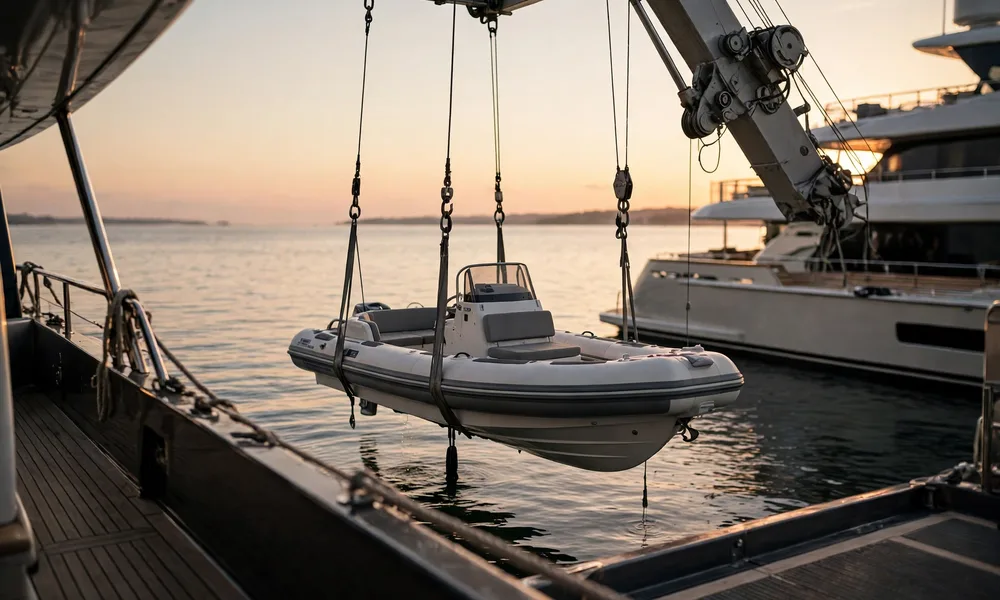
An expedition yacht carries its own fleet. The main tender is often 8 to 10 metres long, big enough to carry a dozen guests ashore in rough water, and there may be a second, smaller tender, a couple of jet skis, kayaks, paddleboards and diving equipment as well. Some yachts carry a submarine, a small two-person craft that can dive to a few hundred metres, and a helicopter, which needs a certified landing deck, a hangar and fuel of its own. The guide to the best superyacht tenders ranks the boats that do this job, and the expedition versions are the toughest of them, built to land on a rocky beach rather than a marina pontoon.
Life aboard: a hotel that moves
Inside, a luxury expedition yacht is a hotel, with an owner’s suite, guest cabins, a saloon, a dining room, a gym and sometimes a cinema or a spa. The difference from a hotel is that everything must work while the boat is rolling, so the furniture is fixed down, the doors are heavy, and the galley is built like a ship’s kitchen. The crew, usually 12 to 20 people for 10 to 16 guests, includes a captain, engineers, deckhands, a chef and stewards, and they live aboard for months at a time. The same hard-working diesel heart beats in a simpler yacht too, as the guide to how a luxury diesel yacht is made shows, but on an expedition yacht the engines are bigger, there are usually two of them, and each one can drive the boat alone if the other fails.
What it costs
The estimated price of a luxury expedition yacht is around 30 million to 150 million dollars, and that figure is an estimate only, because the cost depends on the length, the ice class and the equipment aboard. A 40-metre yacht with a modest fit-out sits at the lower end, while an 80-metre yacht with a helicopter, a submarine and a full ice-class hull sits at the top. Running costs add roughly a tenth of the purchase price every year, in crew, fuel, maintenance and berthing, which is why an expedition yacht is bought by people who intend to use it, not just own it.
A rare fact
Few people know that the first expedition yachts were not built as yachts at all: they were converted from working ships, trawlers and research vessels, bought cheap by owners who wanted to go further than any yacht could. The conversions were rough, but they proved the idea, and today’s purpose-built expedition yachts are their direct descendants, with the same steel hulls and the same long range, but with the comfort of a five-star hotel. The working ship is still in there, under the paint, and that is exactly why it can go where other yachts cannot.