Walk through a yacht yard on a quiet morning and you will see a flybridge yacht in pieces, which is a strange sight if you only know the finished boat. The hull sits in one shed, gleaming white and empty. In another, a whole upper deck waits on trestles, its wheel and sofas already in place. It looks like two boats that have not met yet, and in a way that is exactly what they are.
A luxury flybridge yacht is made by building the hull and the upper deck as separate structures, fitting each one out on its own, and then joining them into a single boat. Here is how it happens, from the first mould to the first sea trial.

How It Is Made
Step 1: The hull is moulded first
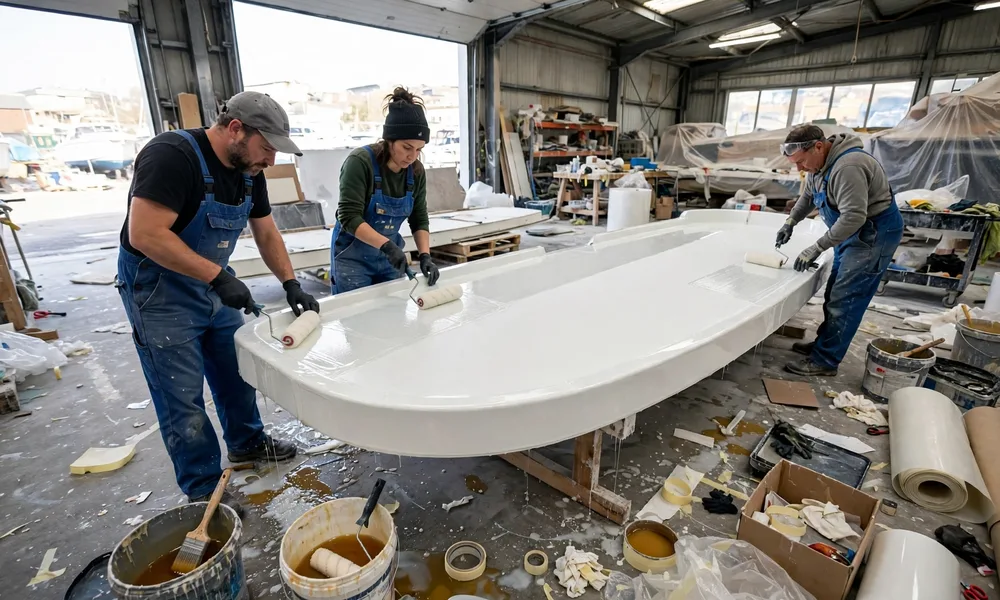
Every flybridge yacht starts in a mould, a huge female form shaped exactly like the outside of the hull. Workers paint gelcoat into the mould, then lay in sheets of fibreglass matting and brush them with resin, layer after layer, until the shell is thick enough to take the sea. Bulkheads and stringers are bonded in while the hull is still in the mould, giving it the stiffness it will need for the weight carried high above it. The hull is left to cure, then lifted out, turned over, and moved to the fitting shed. At this point it is a strong empty shell, and it will spend months becoming a boat.
Step 2: The flybridge deck is built as its own structure
While the hull cures, a second team builds the flybridge itself, and it is built like a small boat of its own. A separate mould shapes the upper deck, with cut-outs for the helm, the stairs, and the seating, and the same fibreglass and resin process gives it a light, stiff shell. Because the flybridge sits high on the boat, weight matters more here than anywhere else, so builders use foam cores and sometimes carbon fibre to keep the deck light. The underside is finished too, since it becomes the ceiling of the main cabin below, and every cable and pipe that will run through it is planned before the deck leaves the mould.
Step 3: The two parts are joined and sealed
Joining the flybridge to the hull is the moment the yacht starts to look like itself. A crane lifts the upper deck over the hull and lowers it onto a prepared joint, where the two shells meet along a wide flange. Workers bolt the joint together and seal it with adhesive and fibreglass tape, so the deck and hull become one rigid structure rather than two parts sitting on each other. The staircase is fitted through the opening between the decks, and the joint is checked for leaks with water and light, because a drip from the flybridge would land in the main cabin. Once the join is sound, the yacht has its tall, unmistakable profile.
Step 4: Engines, tanks and wiring go in
With the decks joined, the heavy work begins below. The twin diesel engines are lowered through a hatch in the cockpit and bolted to their beds, with shafts or pods connecting them to the propellers. Fuel tanks, water tanks, and batteries are fitted around them, placed so the boat floats level despite the weight of the flybridge above. Miles of cable run through the boat, linking the upper helm to the engines, the navigation screens, and the stabilisers, and pipes carry fuel, water, and air conditioning through channels built into the structure. This is slow, fiddly work, done by hand in tight spaces, and it takes longer than any other stage of the build.
Step 5: The helm and electronics are fitted
The flybridge helm is fitted next, and it is the most visible part of the build. The steering wheel, throttles, and engine controls are mounted on a console that is often finished in polished wood, and the navigation screens are set into the dashboard so the captain can see the charts, the depth, and the engine readings at a glance. A second, lower helm is fitted inside the main cabin with the same controls, for use in bad weather. Speakers, lights, and the Wi-Fi antenna are wired in, and every screen and switch on the open upper deck is sealed against spray and rain. The helm has to work in a storm, so it is tested again and again before the boat ever leaves the shed.

Step 6: The upper deck is furnished and finished
Once the systems work, the flybridge is furnished like an outdoor living room. The dining table and seating are bolted down, the sun pads are laid forward, and the wet bar with its fridge and ice maker is fitted aft of the helm. The cushions are made from foam that drains and dries quickly, the tables are fixed so they cannot slide in a swell, and the fittings are stainless steel or teak that can stand salt and sun. A hardtop or canvas bimini is fitted above the seating to give shade without blocking the breeze, and the stairs down to the main deck are finished with handrails on both sides. The boat is starting to feel like a place to spend a summer, not a building site.
Step 7: Sea trials test everything
The finished yacht goes to sea for trials, and this is where the build is proved. The captain runs the boat up to full speed, turns hard in both directions, and checks that the flybridge does not flex or creak under load. The stabilisers are tested at anchor and underway, the engines are run for hours at cruising speed, and every system from the air conditioning to the anchor windlass is worked through its paces. Any fault found at sea goes back to the yard for fixing, and the boat only leaves for its owner when the trials are clean. From first mould to handover, a yacht of this size takes about a year to build.
Luxury Flybridge Yacht Specifications
The figures below describe a typical luxury flybridge yacht of about 60 feet. Larger and smaller yachts differ in size and power, but the way they are built is the same.
| Specification | Typical value |
|---|---|
| Length overall | About 18 to 20 metres |
| Beam | About 5 metres |
| Engines | Twin diesels, about 1,200 hp total |
| Top speed | About 25 to 30 knots |
| Guests | About 8 overnight, 12 by day |
| Build time | About 12 months |
What It Costs
A luxury flybridge yacht of this size costs an estimated $2 million to $5 million, depending on the builder, the engines, and the interior, with larger yachts costing far more. Those are estimates, not quotes, and they reflect a year of hand building, twin diesels, and a finished upper deck. The way the finished boat behaves at sea is another story, as how a luxury flybridge yacht works explains.
A Rare Fact
Here is a detail most people never guess. On some flybridge yachts the upper deck is built from carbon fibre even when the rest of the boat is fibreglass, simply to save weight where it matters most. A heavy flybridge raises the boat’s centre of gravity and makes it roll more, so builders spend heavily to keep the top light, and a few hundred kilos saved up there can matter more than a tonne saved down below. The full figures are laid out in the luxury flybridge yacht specifications, and the hull underneath it all is a feat of its own, as how a luxury carbon-fibre yacht hull works shows.


