Stand on the dock and look at a flybridge yacht, and the first thing you notice is the extra floor. Above the main cabin, open to the sky, sits a second deck with its own steering wheel, its own sofas and its own view, as if someone had lifted the bridge of the yacht up a storey and turned it into a terrace. It looks like a luxury, and it is, but the flybridge is also the hardest-working part of the boat.
A flybridge yacht works by putting the captain where the view is best and the guests where the breeze is best, all while keeping the engines, tanks and systems below out of sight. Here is how it all works, from the helm to the sun pad.

How It Works
Step 1: The captain steers from the highest point on the boat
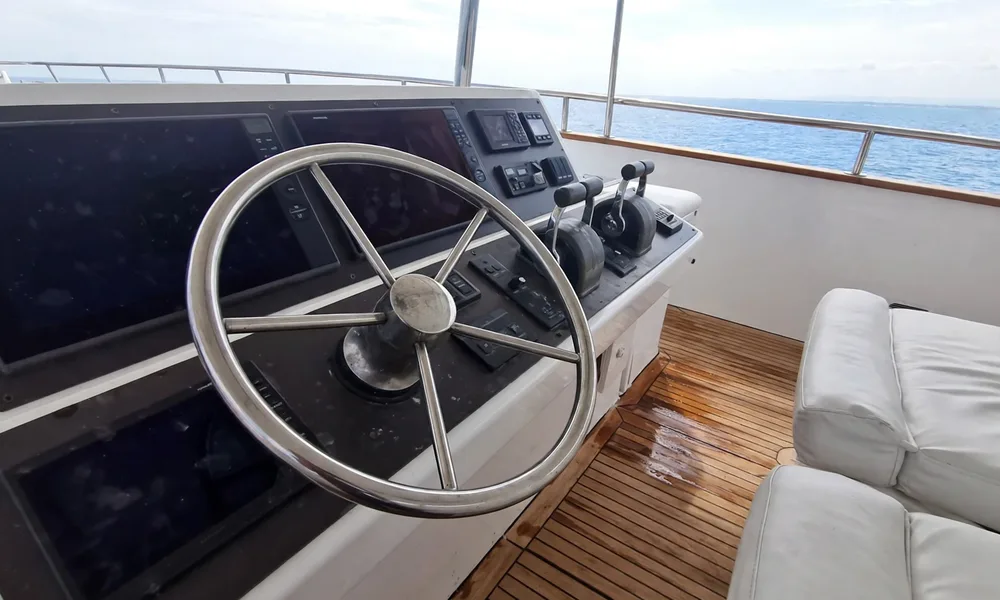
The flybridge is the yacht’s upper helm, and the captain drives from there because the view is unmatched. From the raised wheel, the captain can see over the bow to the water ahead, down both sides of the hull to the dock when manoeuvring, and across the whole boat to the stern when backing into a berth. The steering wheel connects to the rudders below through hydraulic lines or electronic controls, and the throttles sit beside it, controlling the engines with a push of a lever. Screens show the charts, the depth, the speed and the engine readings, and a second, lower helm inside the main cabin repeats the same controls for bad weather. In fine weather, though, the flybridge is where the boat is driven, and the captain would not have it any other way.
Step 2: The engines below push the hull through the water
Under the flybridge, deep in the hull, sit the engines, and they do the heavy work. Most flybridge yachts use two diesel engines, each driving its own propeller shaft or pod, and the pair gives the boat both speed and control, since the captain can push one engine forward and the other back to turn the boat in its own length. Fuel tanks, water tanks and batteries sit around them, balanced so the boat floats level, and the whole engine room is reached through a hatch in the cockpit, out of the way of the guests.
Step 3: Stabilisers keep the upper deck calm in a swell
A tall upper deck is a wonderful place to sit, but it is also the part of the boat that moves most when the sea gets up, so a flybridge yacht relies on stabilisers to keep it comfortable. Fins under the hull, or a gyroscope spinning deep inside the boat, push back against the roll, cutting the side-to-side motion by more than half. The effect is most obvious on the flybridge, where a roll that would spill a drink on an unstabilised boat becomes a gentle sway. At anchor, the stabilisers work even harder, because there is no forward motion to help, and the gyroscope keeps spinning to hold the boat level while the guests swim or eat on deck. Without them, the flybridge would be a fair-weather room only; with them, it is used from morning coffee to evening drinks.
Step 4: The upper deck is a living room, a dining room and a sun deck
The flybridge is not just a helm; it is the yacht’s main outdoor living space, and it is arranged like one. Aft of the helm sits a dining table with seating for the whole party, shaded by a hardtop or a canvas bimini that keeps the sun off without blocking the breeze. Forward, sun pads and loungers face the sky, and a wet bar with a fridge and an ice maker sits within reach of the seating. Everything is built for the sea: the cushions drain and dry quickly, the tables are fixed down, and the fittings are stainless steel or teak that can take salt and sun. The stairs down to the main deck are wide and safe, with handrails on both sides, because guests carry drinks up and down them all day long.
Step 5: The electronics link the helm, the engines and the guests
Behind the polished wood and the white upholstery, the flybridge is a web of electronics. The navigation screens at the helm talk to the engines, the autopilot and the anchor windlass, so the captain can hold a course, set a speed and drop the anchor without leaving the wheel. Speakers are set into the ceiling and the seating, wired to the same system that plays music in the cabins below, and lights around the deck can be dimmed for the evening. Wi-Fi reaches the flybridge from an antenna on the mast, and the same network runs the air conditioning and the water systems below. It is a lot of technology for an open deck, and it is all sealed against spray and rain, because a flybridge that cannot get wet is no flybridge at all.

Step 6: The hull, the tender and the crew keep the whole boat moving
The flybridge could not work without everything below it. The hull is shaped to lift the boat onto the plane at speed, so it rides on top of the water rather than pushing through it, which keeps the fuel use down and the ride smooth. The tender, the small boat carried on the back of the yacht, is launched from the swim platform for trips ashore, and it is recovered with a crane or a lift that hides under the aft deck. The crew work from cabins below the main deck, keeping the engines, the water maker and the generators running while the guests stay upstairs. The galley sits on the main deck, close enough to serve the flybridge quickly, and the whole boat is arranged so that the guests live upstairs and the work happens below, out of sight and out of mind.
Luxury Flybridge Yacht Specifications
The figures below describe a typical luxury flybridge yacht of about 60 feet. Larger and smaller yachts differ in size and power, but the way they work is the same.
| Specification | Typical value |
|---|---|
| Length overall | About 18 to 20 metres |
| Engines | Twin diesels, about 1,200 hp total |
| Top speed | About 25 to 30 knots |
| Cruising speed | About 20 to 24 knots |
| Guests | About 8 overnight, 12 by day |
| Fuel capacity | About 3,000 to 4,000 litres |
What It Costs
A luxury flybridge yacht of this size costs an estimated $2 million to $5 million, depending on the builder, the engines and the interior, with larger yachts costing far more. Those are estimates, not quotes, and they reflect the twin diesels, the stabilisers and the finished upper deck that make the boat what it is. The hull beneath it all is a feat of engineering in its own right, as how a luxury carbon-fibre yacht hull works explains.
A Rare Fact
Here is a detail most people never guess. The flybridge was once the working bridge of a fishing boat, a bare open platform where the captain stood to spot fish, and it only became a place for guests when yacht builders realised the best seat on the boat was the one with the best view. The name stuck even as the platform grew sofas, a bar and a sun deck. The full figures are laid out in the luxury flybridge yacht specifications, and a different kind of twin-hulled yacht works on the same idea of living upstairs, as how a luxury catamaran yacht works shows.


