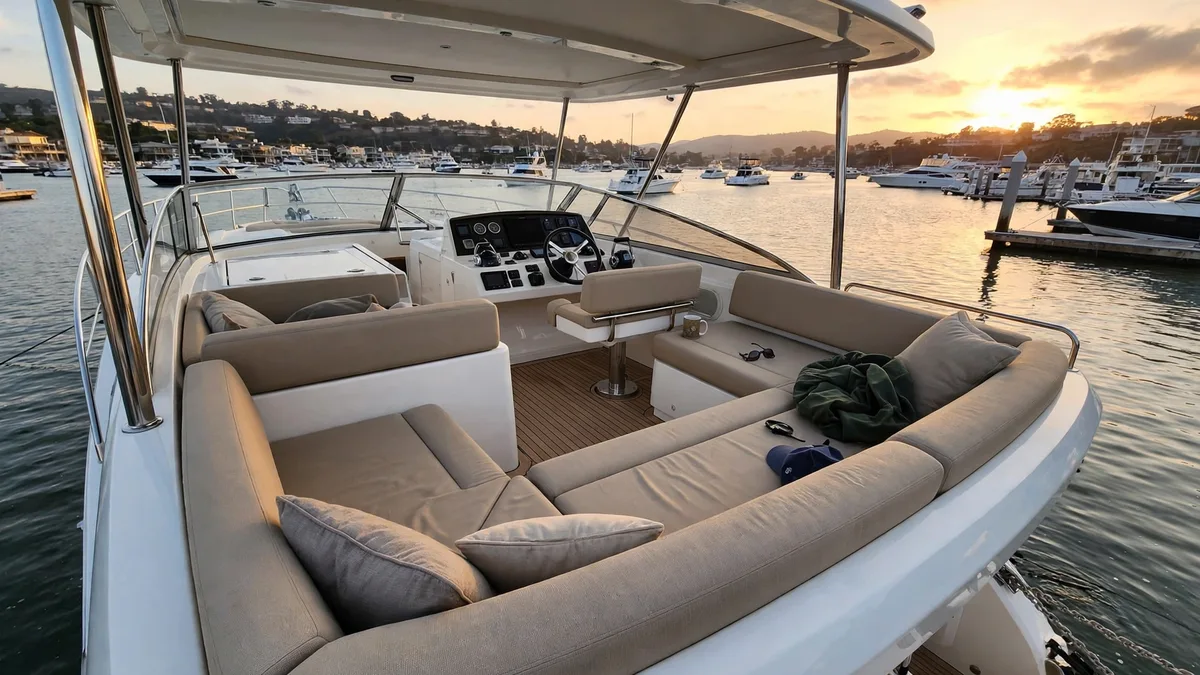
Picture a marina at golden hour, the pontoons lined with white hulls, and one yacht standing out because of the extra deck riding on top of its roof. Up there, behind a low windscreen, is a second helm, a sunpad, and a small bar, and a family is eating dinner in the open air while the crew below prepares the cabins for the night. That upper deck is the flybridge, and it is the reason this yacht costs more, weighs more, and needs more power than a yacht of the same length without one.
A flybridge yacht is a motor yacht with a full second open deck above the main saloon, reached by an outside staircase, and everything about it is a trade: the view and the space are wonderful, but the extra height raises the centre of gravity, catches more wind, and adds tonnes of structure that the engines must push through the water. The spec sheet is where that trade is written down in numbers, and once you know how to read it, a brochure stops being a sales pitch and starts being a plan of the boat.
The Numbers That Matter First
Start at the top of the sheet, where the dimensions sit. Length overall, or LOA, is the length from the tip of the bow to the back of the swim platform, and on a flybridge yacht it usually runs from about 15 metres on the smallest models to more than 40 metres on the largest. Beam is the width at the widest point, and a 24-metre flybridge yacht is typically around 6 metres wide, which is what gives the saloon and the cabins their room. Draught is how deep the hull sits in the water, usually between 1.5 and 2.5 metres, and it decides which harbours and anchorages the yacht can enter.
Displacement is the weight of the yacht, and it is the number that explains most of the rest of the sheet. A 24-metre flybridge yacht displaces roughly 60 to 80 tonnes, and a good part of that is the flybridge itself: the deck, its furniture, the second helm station, and the structure that holds it all up. More weight means more fuel, more engine, and a slower response to the helm, which is why builders work so hard to keep the flybridge light, using aluminium and composite panels instead of solid fibreglass wherever they can.
What the Spec Table Really Says
| Specification | Typical 24-metre flybridge yacht | What it means |
|---|---|---|
| Length overall | 24 metres | Berthing fees and marina space |
| Beam | 6.1 metres | Interior space and stability |
| Draught | 1.9 metres | Shallow anchorages it can reach |
| Displacement | 68 tonnes | Weight, fuel use and handling |
| Engines | 2 x 1,200 hp diesels | Power to push the weight |
| Top speed | 28 knots | Flat water, light load |
| Cruising speed | 22 knots | Comfortable all-day pace |
| Range at cruise | 300 nautical miles | How far between fuel stops |
| Fuel capacity | 7,000 litres | Tank size, not range |
| Guests and crew | 8 guests, 2 crew | Cabins and berths aboard |
Speed, Range and the Fuel Bill
Top speed is the number buyers quote and captains rarely use. It is measured on flat water with light tanks and a clean hull, and it tells you what the yacht can do, not what it should do every day. Cruising speed is the honest number, usually 20 to 24 knots on a yacht like this, and it is where the engines run at their most efficient load, the ride stays comfortable, and the fuel burn is predictable. Push past cruising speed and fuel consumption climbs steeply, because the power needed to go faster rises much faster than the speed itself.

The Flybridge Itself, in Numbers
The flybridge deck is usually listed separately on the sheet, and its numbers are worth reading closely. Its area on a 24-metre yacht is often 25 to 30 square metres, enough for a helm, an L-shaped sofa, a sunpad, and a wet bar, and the sheet may list the seating capacity, often eight to ten people. What the sheet rarely states plainly is the weight of that deck and everything on it, yet it is the single biggest reason the yacht’s centre of gravity sits high, and why the yacht rolls a little more at anchor than a lower yacht of the same size.
Engines, Generators and the Quiet Numbers
Engine power is listed in horsepower or kilowatts, and a 24-metre flybridge yacht typically carries two diesel engines of 1,000 to 1,500 horsepower each. But the number that matters for daily life aboard is the generator: the yacht needs electricity for air conditioning, cooking, water-making, and charging, and a generator of 15 to 20 kilowatts is normal at this size. The sheet will also list the fresh-water capacity, often 1,000 litres or more, and whether a water-maker is fitted, which turns seawater into drinking water and frees the yacht from marina taps. A motor yacht spec sheet follows the same logic, and reading one teaches you to read them all.

What a Flybridge Yacht Costs
Price is the one number the spec sheet usually leaves out, so here are estimates, labelled as such. A new 24-metre flybridge yacht from a well-known European builder costs roughly $4 million to $7 million, with the flybridge layout, the stabilisers, and the interior finish pushing the price toward the top of that range. A larger 30-metre flybridge yacht starts around $10 million and climbs quickly with custom interiors. Used, a ten-year-old 24-metre flybridge yacht in good condition can be found for roughly $2 million to $3.5 million, though the refit budget for electronics and soft furnishings can add several hundred thousand dollars.
One Rare Fact Worth Knowing
Here is the rare fact that surprises even experienced boaters: on some flybridge yachts, the upper helm is not a copy of the lower one but the primary one, and the lower helm is the backup. The flybridge gives the captain a better view over the bow, which matters most when docking, threading through a crowded anchorage, or spotting a swimmer in the water, and many captains drive from up top in all but the worst weather. That is why the flybridge helm carries the full set of engine controls, thruster controls, and navigation screens, while the inside helm is sometimes simpler. The deck that looks like a sunbathing platform is, in practice, the bridge of the ship. A motor yacht works as a whole system, and the flybridge is its highest, busiest room.
Read the sheet in this order and it will not fool you: dimensions first, displacement second, speed and range third, and the flybridge and stabiliser details last. Compare two yachts of the same length and the numbers will show you which one is genuinely bigger inside, which one will go further on a tank, and which one was built for a calm bay rather than an open sea. The flybridge is the most visible part of the yacht, but the spec sheet is where its real character lives, and a trawler yacht’s spec sheet shows the same trade-offs made in the opposite direction, slow and heavy instead of fast and tall. Choose the numbers that match the water you will actually sail, and the yacht will take care of the rest.


