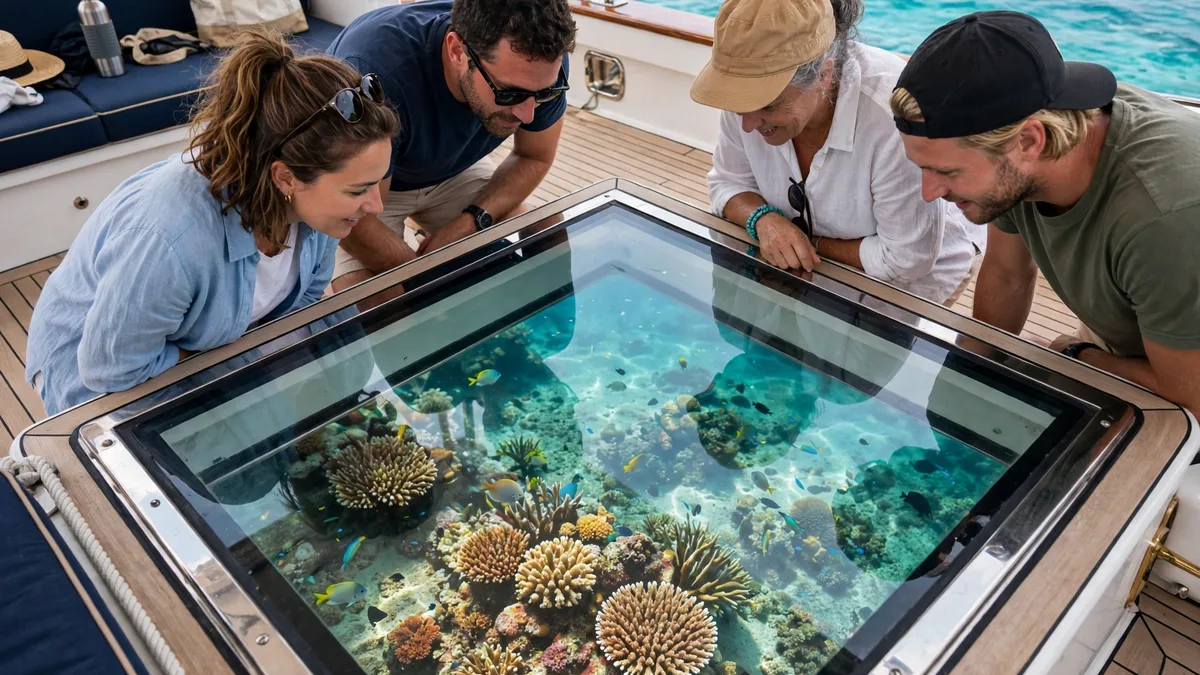
The water below the boat is so clear it hardly looks real. A reef drifts past under your feet — a turtle, a school of silver fish, a coral head the colour of rust — and nobody on board has to get wet to see it. The passengers lean on the rails, pointing down through the floor, while the boat putters along at the speed of a stroll.
A luxury glass-bottom boat turns the hull into a window. Instead of a solid floor, the centre of the boat holds panels of thick, clear glass or acrylic, set into a frame strong enough to walk on and sealed so tightly that the sea never gets in. Below, the reef does the entertaining.
It sounds simple, and the idea is. This is how a luxury glass-bottom boat works, from the window in the floor to the engine that keeps it drifting over the reef.
How a Luxury Glass-Bottom Boat Works
Step 1: The window in the hull
The heart of the boat is its viewing window, usually one large panel or several smaller ones set into the centre of the hull. The panels are made of laminated tempered glass or thick cast acrylic, often 25 to 50 millimetres thick, and they are bonded into a steel or aluminium frame with marine sealant and bolted down. Laminated glass is favoured because it holds together if it cracks, in layers, like a car windscreen. The window is the reason the boat exists, and everything else is built around it. A boat built for looking down needs a hull built for the job, and our guide to how a luxury dive boat works shows a similar hull put to a different use.
Step 2: A hull shaped for slow water
A glass-bottom boat does not need speed. It needs stability, a shallow draft and a flat, steady ride, so the hull is wide and flat-bottomed, more like a barge than a speedboat. The wide beam stops the boat rolling when passengers crowd to one side to look at a turtle, and the shallow draft lets it drift over reefs that would ground a deeper boat. Ballast low in the hull keeps the centre of gravity down, and the viewing panels sit low in the water, close to the reef, so the view is bright and clear.
Step 3: Keeping the glass clear
Clear water is useless if the glass is not clear too. The panels are coated to resist scratches and marine growth, and crews clean them daily, because algae, salt and sun can cloud a panel in a week. Light matters as well: the viewing well is shaded from direct sun so there is no glare on the glass, and the waterline is kept free of bubbles from the engine exhaust, which would fog the view. A clean panel can show a reef thirty metres down; a dirty one shows nothing at all.
Step 4: The engine and the drift
Most luxury glass-bottom boats use a quiet diesel inboard or a pair of electric outboards, chosen for silence rather than speed. The boat cruises out to the reef at a gentle pace, then idles or drifts while passengers watch, because engine vibration and exhaust bubbles spoil the view. Some boats use a small electric motor for the viewing drift itself, silent and clean, saving the diesel for the run home. The same quiet-electric idea powers other slow boats, and the build of a close cousin is shown in our guide to how a luxury centre console boat is made.

Step 5: Seats, shade and the viewing well
The inside of a glass-bottom boat is arranged like a small theatre. Seats face inward toward the viewing panels, often in rows around a central well, so every passenger gets a view without crowding. A canopy or hardtop shades the deck, cutting glare and keeping the sun off the glass, and the floor around the panels is non-slip so wet feet stay safe. The layout is simple, but it is the difference between a boat with a window and a boat built for watching.
Step 6: Safety below the waterline
A hole in the bottom of a boat is a serious matter, so a glass-bottom boat is built with safety in layers. The hull is divided into watertight compartments, so a leak in one section cannot sink the boat, and bilge pumps run on separate circuits with alarms on the helm. The viewing panels are inspected regularly for chips, cracks and seal wear, and any damaged panel is replaced before the boat goes out again. The glass is strong, but the boat is designed as if it might one day fail.
Step 7: A day over the reef
Put it together and the day runs like this: the boat leaves the dock in the morning, cruises to the reef, and spends an hour or two drifting slowly over coral gardens while the guide talks and the passengers watch. The captain holds the boat over the best ground, the glass stays clear, and the reef does the rest. It is a gentle machine for a gentle job, and it earns its keep not by going fast but by going slow in exactly the right place. The houseboat shares the same slow-water philosophy, as our guide to how a luxury houseboat works shows.
Luxury Glass-Bottom Boat Specs
| Specification | Typical range |
|---|---|
| Length overall | About 10 to 20 metres |
| Viewing panels | Laminated glass or acrylic, 25 to 50 mm thick |
| Hull material | Fibreglass or aluminium, flat-bottomed |
| Engine | Diesel inboard or electric outboards, about 100 to 300 hp |
| Cruising speed | About 8 to 12 knots |
| Passengers | About 20 to 60 passengers |
| Draft | About 0.5 to 1 metre |
| Viewing depth | Clear view to about 30 metres in good water |
What Does a Luxury Glass-Bottom Boat Cost?
A luxury glass-bottom boat of around 12 to 15 metres is estimated to cost roughly $200,000 to $500,000, while a larger custom boat with multiple panels and luxury seating is estimated at $500,000 to $1 million or more. A replacement viewing panel is estimated at $5,000 to $20,000. Prices are estimates only and vary by size, builder, materials and fit-out.
A Rare Fact
The first glass-bottom boat was built in California in the late 1800s, when a fisherman fitted a glass panel into the bottom of a rowing boat so tourists could watch the kelp forests of Santa Catalina Island. The idea was so popular that glass-bottom boats were running regular tours within a few years, and the same design — a window in the floor, a slow drift over the reef — is still in use today, more than a century later.

A luxury glass-bottom boat is proof that a machine does not need to be fast or complicated to be clever. A thick piece of glass, a steady hull, a quiet engine and a shaded deck are enough to open up a world most people never see. The reef is doing the show; the boat just holds still, keeps the water out, and lets everyone look down.


