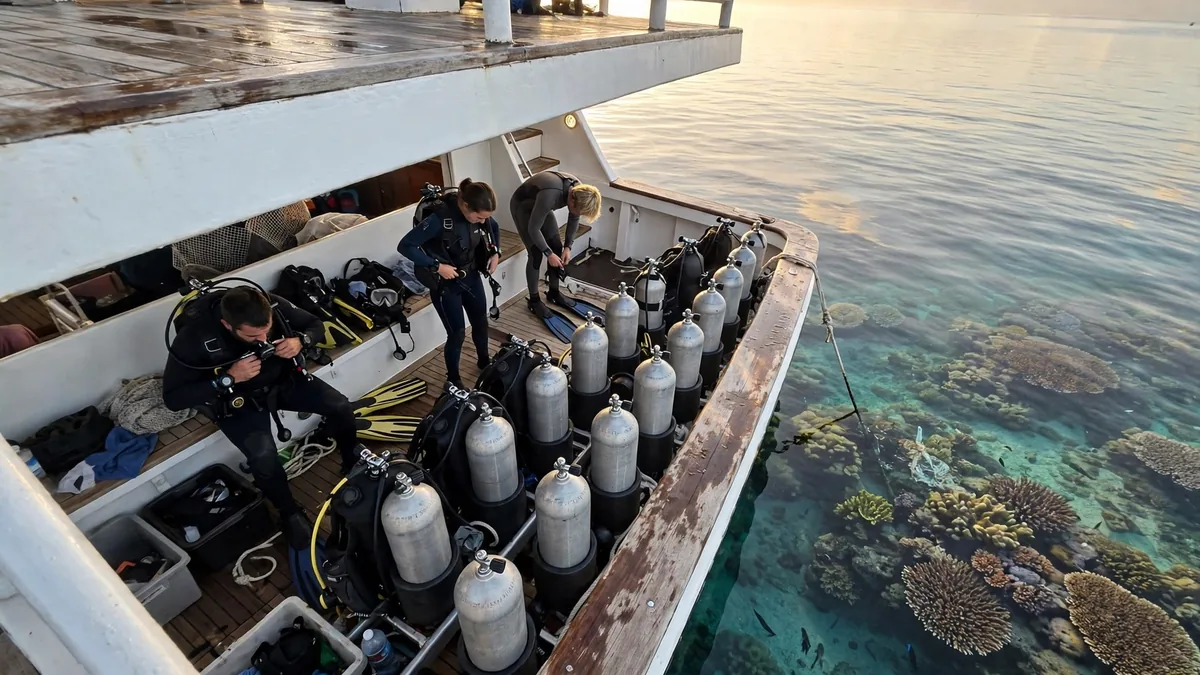
The dive boat is already busy before the sun is properly up. On the aft deck, tanks stand in neat rows, compressors hum below, and the divemaster is laying out fins, masks and weight belts with the practised calm of someone who has done this a thousand times.
What sets a luxury dive boat apart from a plain charter boat is not size alone. It is the completeness of the operation: a proper compressor room that fills tanks all day, a camera room with charging stations and rinse tanks, a shaded dive deck with room for every diver to kit up without tripping over their neighbour, cabins quiet enough to sleep in between dives, and a galley that serves real food to people who have burned a thousand calories before lunch.
How a Luxury Dive Boat Works
Step 1: The hull, the platform and the dive deck
Everything on a dive boat starts with the hull and the working deck, because the dive deck is where the boat earns her living. Luxury dive boats are usually built on wide, stable hulls, often catamarans, whose broad beam and shallow draught give a steady platform at anchor and a huge flat aft deck for diving operations. Stability matters more than speed here, because a rolling deck makes kitting up miserable and recovering divers dangerous.
Step 2: Engines, generators and the power to keep diving
Below deck, the machinery spaces keep the whole operation running. Twin diesel engines drive the boat at a comfortable cruising speed, but the real workhorses are the generators, which power everything from the air compressors to the air conditioning, the watermaker and the galley. The compressors deserve a mention of their own: high-pressure machines that draw in ordinary air, filter it, dry it and squeeze it into tanks at over 200 bar, filling a diver’s tank in minutes. The support yacht shares much of this philosophy, built as a floating base that keeps a larger operation supplied and running, and the dive boat is the same idea at the scale of a single reef.
Step 3: Air, nitrox and the gas systems
The gas system is the heart of a dive boat, and on a luxury vessel it goes well beyond plain compressed air. Many boats carry a nitrox membrane system, which enriches the air with extra oxygen, letting divers stay down longer and surface with less nitrogen in their tissues. The nitrox is blended and analysed on board, every tank labelled with its oxygen percentage and maximum depth, and the divemaster checks each one before it goes on a diver’s back.

Step 4: Navigation, anchoring and finding the reef
Finding the dive site is a science in itself. The bridge carries chart plotters, sonar and GPS, and the captain uses them to navigate to a reef, a wreck or a wall that may be nothing more than a set of coordinates and a mark on a chart. The tender is the boat’s eyes and hands during a dive, shadowing the divers’ bubbles, ready to pick up anyone who surfaces early or far away. The research submarine may explore the same reefs from below, but the dive boat’s job is to put people safely into that world and bring them back, and the navigation and boat-handling skills that make it possible are learned over years of working the same waters.
Step 5: The dive day, from briefing to debrief
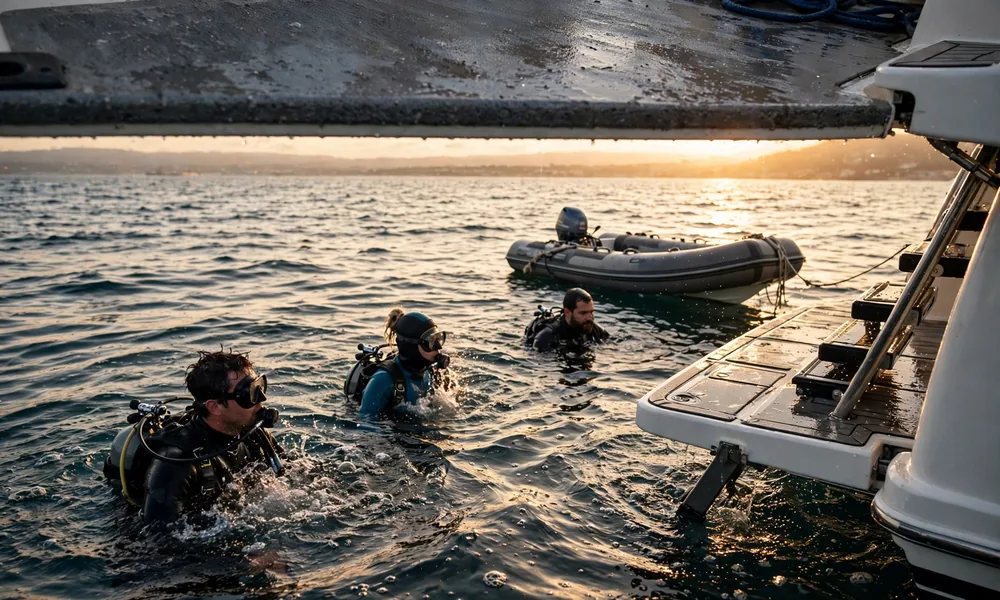
A dive day runs to a rhythm the crew could set their watches by. It starts with a briefing: the site, the depth, the current, the expected wildlife, the plan for the dive and the plan if something goes wrong. Divers kit up on the deck, do their buddy checks, and enter the water in pairs from the swim platform while the tender watches from nearby. Underwater, the boat’s job is to stay put and stay ready, with a crew member on lookout, the engines on standby and the oxygen kit on deck. As divers surface, they are recovered by the platform or the tender, their tanks are swapped for full ones, and the deck crew logs each dive. The yacht tender garage may seem a world away from a working dive boat, but the tender itself is the same essential tool: a small boat that extends what the big boat can do, and on a dive boat it is used harder than on any yacht.
Step 6: Safety, medicine and the end of the day
Safety is not a section of the dive boat’s operation; it is the whole operation. The vessel carries oxygen, a first aid kit, a defibrillator and a radio link to shore medical advice, and the crew are trained in dive first aid and rescue. The captain keeps a record of every diver in the water and every diver back aboard, and nobody is left unaccounted for, ever. Dinner is served in the saloon, the day’s photographs are shared on a screen, and the boat settles into the quiet of the anchorage, her generators humming softly, ready to do it all again at dawn.
Luxury Dive Boat Specifications
| Specification | Typical figure |
|---|---|
| Length overall | 25 to 45 metres |
| Beam | 7 to 12 metres |
| Hull type | Monohull or catamaran |
| Engines | 2 diesel engines |
| Cruising speed | 10 to 14 knots |
| Guests | 12 to 24 divers |
| Crew | 8 to 14 people |
| Dive tanks aboard | 30 to 60 tanks |
| Compressors | 2 high-pressure compressors |
| Nitrox | Membrane system aboard |
| Range | 1,000 to 2,500 nautical miles |
How Much Does a Luxury Dive Boat Cost?
A luxury dive boat is priced by her size and her diving systems. A 25-metre boat with cabins for 12 divers, twin compressors and a nitrox system carries an estimated price of $2 million to $4 million. A 35-metre vessel with cabins for 20 divers, a camera room, a large dive deck and a proper tender carries an estimated price of $6 million to $10 million. At the top end, a 45-metre flagship liveaboard with 24 guest cabins, a spa deck, a full photo studio and a submersible tender is estimated at $12 million to $20 million. Owners accept the numbers because a well-run dive boat books out months ahead: there are only so many reefs in the world, and divers will pay to reach them in comfort.
A Rare Fact About Luxury Dive Boats
Here is a detail few guests ever notice: the best luxury dive boats carry a recompression chamber plan, and some of the largest actually carry a small portable chamber on board. Decompression sickness, the bends, is the diver’s nightmare, and the treatment is to return the diver to pressure and breathe pure oxygen, which is exactly what a chamber does. It is a sobering piece of equipment to carry on a holiday boat, and it is also the reason the best dive boats can work the farthest reefs in the world with confidence. The luxury is not the chamber. The luxury is knowing it is there.
A luxury dive boat works because a hundred small systems, from the compressor filters to the tender’s outboard, all do their jobs at the same time, day after day, in places where the nearest help may be hours away. That is how a luxury dive boat works, and it is why the best of them are booked solid a year ahead.


