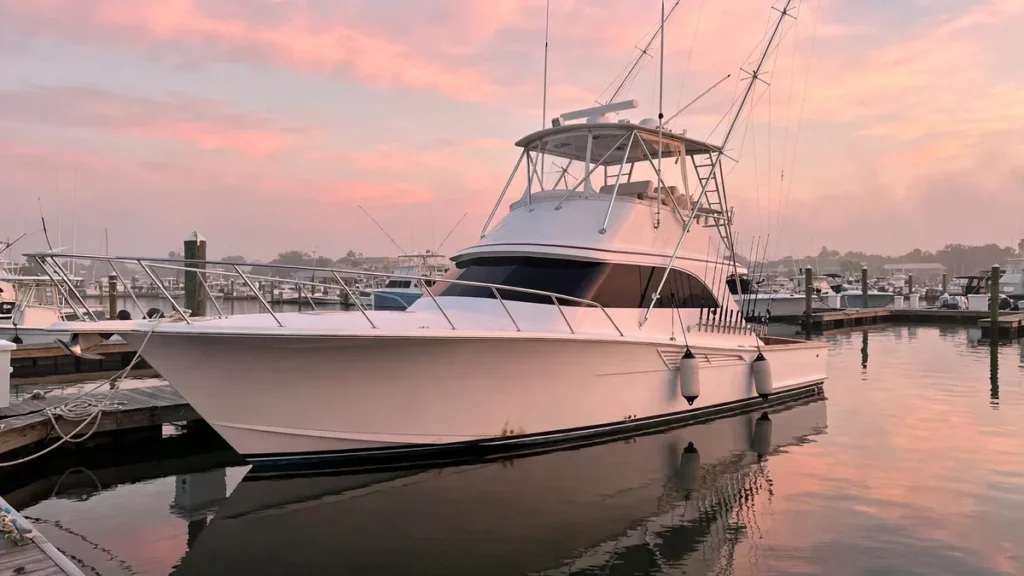
Sixty miles offshore, the horizon is empty in every direction, the sea is running three feet, and the fish are biting. The boat that got the crew here is not a yacht and not a fishing trawler. It is a centre console: one open deck, one console in the middle, and nothing in the way of the work. When a fish is on, four anglers can move around it without tripping over furniture.
A luxury centre console is built to be both a serious fishing machine and a comfortable day boat. The hull must be fast and dry in rough water, the deck washable and uncluttered, and the finish good enough to sit beside a superyacht. Building one means combining a performance hull with commercial-grade fishing gear and yacht-level detailing.

How a Luxury Centre Console Boat Is Made
The design starts with the sea it will fish. A centre console for offshore work needs a deep-V hull with a sharp entry to cut through chop, a wide beam for stability at rest, and enough freeboard to keep the deck dry. Designers test the hull shape for speed, fuel use and how it lands off waves, because a boat that pounds in a head sea tires its crew fast. Once the shape is settled, a plug is milled and a female mould is made, so every hull comes out identical.
Step 1: Building the Hull
The hull is laid up by hand in the mould, layer by layer, with fibreglass mat and woven roving wetted with resin. Luxury builders add a foam core in the hull sides for stiffness without much weight, and they reinforce the transom heavily, because it carries the outboards and all their thrust. The laminate is often vacuum-infused, which pulls resin evenly through the fibres and squeezes out air, leaving a hull that is light, strong and consistent. Once cured, the hull is lifted from the mould and inspected for voids and thickness.
Step 2: Stringers, Deck and Fish Boxes
Inside the hull, the builder bonds in a grid of fibreglass stringers and a structural floor, turning the shell into a rigid box. This is also when the fishing hardware goes in. Large insulated fish boxes are built into the deck, with pumps that empty them at the push of a button, and a live bait well is fitted with a recirculating pump that keeps bait frisky all day. Rod holders are set into the gunwales and the transom, and the deck is finished with a non-slip surface that can be hosed clean. Every hatch is fitted flush so lines and feet never catch.
Step 3: Outboards, Fuel and Steering
Power usually comes from two or three large outboards on the transom, chosen for their power-to-weight ratio and for the way they can be tilted clear of the water. A 35 to 40 foot boat might carry 900 to 1,200 horsepower in total, giving a top speed of 50 knots or more. The engines are rigged with digital controls, so throttles, trim and steering are managed from one helm station, and a joystick system can hold the boat steady over a reef or ease it sideways into a slip. Fuel tanks are fitted low and central, often holding 1,500 to 3,000 litres for long offshore runs, with shut-offs that can be reached in seconds.

Step 4: Console, Helm and Electronics
The console is the heart of the boat. It holds the helm, twin navigation screens, engine displays and the radio, all protected by a windscreen and a hard top. Inside the console there is usually a small head and storage, and on bigger boats a berth or a changing area. The electronics package is serious: radar, chart plotter, sonar with side-scan and VHF radio, all wired through sealed conduits and labelled at both ends. The helm is set so the driver can see over the bow at speed and reach the throttles without stretching, and shock-absorbing helm seating protects the crew’s backs when the boat lands off a wave.
Step 5: Seating, Shade and Guest Comfort
A luxury centre console must also be pleasant for a family day, not just a fishing trip. Forward seating wraps around the bow with removable backrests, and the stern gets a fold-away bench. The hard top gives shade and carries rod holders, outriggers and sometimes a second station up top. A fridge, a freshwater shower and a sink at the transom are common, and the upholstery is marine vinyl that survives salt and sun. The finish is kept tough and simple, with stainless fittings and no soft furnishings that cannot be hosed down.
Step 6: Finishing, Testing and Handover
The final stage is fairing and painting, often in a colour matched to the owner’s yacht, with the hull sides polished to a mirror finish. Then the boat goes to sea trials, where it is run at full speed, tested for handling in turns, checked for spray and vibration, and loaded to its full weight to make sure the performance holds up. The builder tests the live well, the fish boxes, the electronics and the joystick docking under real conditions, fixing anything that rattles or leaks. Only then is the boat handed over, with a run offshore so the owner can learn the systems.
Key Specifications
| Feature | Typical Range |
|---|---|
| Length overall | 10 to 13 metres (33 to 43 feet) |
| Beam | 3.2 to 4 metres |
| Engines | Two or three outboards, 900 to 1,200 hp total |
| Top speed | 45 to 55 knots |
| Cruising speed | 30 to 40 knots |
| Fuel capacity | 1,500 to 3,000 litres |
| Construction | Fibreglass composite, foam core, vacuum infused |
| Passengers | 10 to 14 people |
These are typical ranges, not a single model. A smaller boat will be easier to trailer and cheaper to run, while a larger one fishes further offshore in worse weather. The way a luxury centre console boat works explains how the hull, outboards and electronics come together on the water.
What a Luxury Centre Console Boat Costs
As with any custom boat, prices vary widely, so treat these as estimates. A production luxury centre console of around 33 to 35 feet typically starts at roughly $400,000 to $700,000. A larger 38 to 42 foot model with triple outboards, a full electronics package, a hard top with a second station and a custom paint job can cost an estimated $800,000 to $1.5 million, and a fully bespoke boat with every option can pass $2 million. Running costs can add an estimated $40,000 to $100,000 a year for fuel, servicing, berthing and insurance. The systems on a luxury chase boat share much of the same engineering, from big outboards to open working decks.
Owners rarely buy on length alone. The right boat is the one that fishes the waters they actually visit, carries the crew they actually bring, and runs home comfortably in a building sea. A well-built one will fish hard for decades and still look sharp at the dock.
A Rare Fact
Some of the largest luxury centre consoles now carry more horsepower than a small locomotive, and their outriggers can spread a trolling pattern wider than the boat is long. Tournament crews have been known to run more than 100 miles offshore before dawn, fish all day, and run home the same evening, a round trip unthinkable for a boat this size a generation ago.

When the build is done, the boat slips into a life of dawn departures, long runs and full fish boxes. Its hull and deck share the composite construction that makes luxury chase boats so expensive, where the same carbon and fibreglass skills keep a fast boat light and stiff.