A helicopter does something no fixed-wing aeroplane can: it hangs in the air, motionless, and then moves in any direction the pilot chooses. It can lift off a yacht deck, hover over a cliff edge, and set down on a patch of ground barely bigger than itself. The secret is a spinning wing above the cabin, and a second, smaller rotor at the tail that stops the whole machine spinning the other way.
The trick looks simple from the ground, but the physics is a balancing act that never stops. The main rotor must produce exactly enough lift to hold the machine up, the tail rotor must cancel exactly the torque the main rotor creates, and the pilot must adjust both, constantly, as wind, weight and speed change. A luxury helicopter wraps that balancing act in a quiet cabin, leather seats and a view through wide windows, but the machine underneath is working hard every second it is in the air.
Most luxury helicopters carry four to eight people, cruise at around 250 kilometres per hour, and fly far enough to hop between a yacht and the shore, or between cities, without refuelling. They are the tenders of the sky for the yachting world, and the reason a helicopter pad is now as common on a large yacht as a swimming pool.

How a Luxury Helicopter Works
Step 1: The main rotor makes lift
The main rotor is a wing that spins. Each blade is shaped like an aeroplane wing, and as it slices through the air it generates lift, just as a fixed wing does in forward flight. The blades are long, thin and carefully balanced, and they are attached to a hub that lets each blade flap up and down and twist slightly as it goes around. That twisting, called changing the pitch, is how the pilot controls how much lift each blade makes at each point in its circle.
Step 2: The swashplate steers the rotor
The pilot does not push the blades directly. Instead, the controls move a swashplate, a pair of tilted discs sitting under the rotor hub, and the swashplate changes the pitch of each blade as it passes around the circle. Tilt the swashplate forward and the blades make more lift at the back than the front, so the rotor disc tilts forward and the helicopter moves forward. Raise the whole swashplate and every blade makes more lift at once, so the helicopter climbs. It is a mechanical computer made of steel, and it works without a single line of code.
Step 3: The tail rotor cancels the torque
Spinning the main rotor one way tries to spin the fuselage the other way, a reaction called torque. The tail rotor exists to stop that happening: it is a small propeller on the side of the tail that pushes sideways, holding the nose straight. The pilot’s feet control it through pedals, adding more thrust to turn one way and less to turn the other. Some modern helicopters replace the tail rotor with a fan inside the tail boom, which does the same job more quietly and safely.
Step 4: The engine and transmission
A turbine engine, small and light for its power, drives the rotor through a gearbox called the transmission. The gearbox slows the engine’s furious spin down to the few hundred revolutions per minute the rotor needs, and it does so while carrying the entire weight of the helicopter hanging from the rotor above. Oil cools and lubricates the gears, and sensors watch temperature and vibration constantly. If an engine fails, the transmission can keep the rotor turning by itself for a while, which is what makes the next step possible.

Step 5: Autorotation, the built-in parachute
A helicopter with a dead engine does not fall out of the sky. The pilot lowers the pitch of the blades, and air rushing up through the rotor as the machine descends keeps the blades spinning, like a sycamore seed falling. Near the ground, the pilot pulls the stored energy out of the spinning rotor in one last flare, trading rotor speed for a soft landing. Every helicopter pilot practises this manoeuvre again and again, because it is the safety net that makes single-engine helicopters acceptable over water and cities.
Step 6: The controls and the cockpit
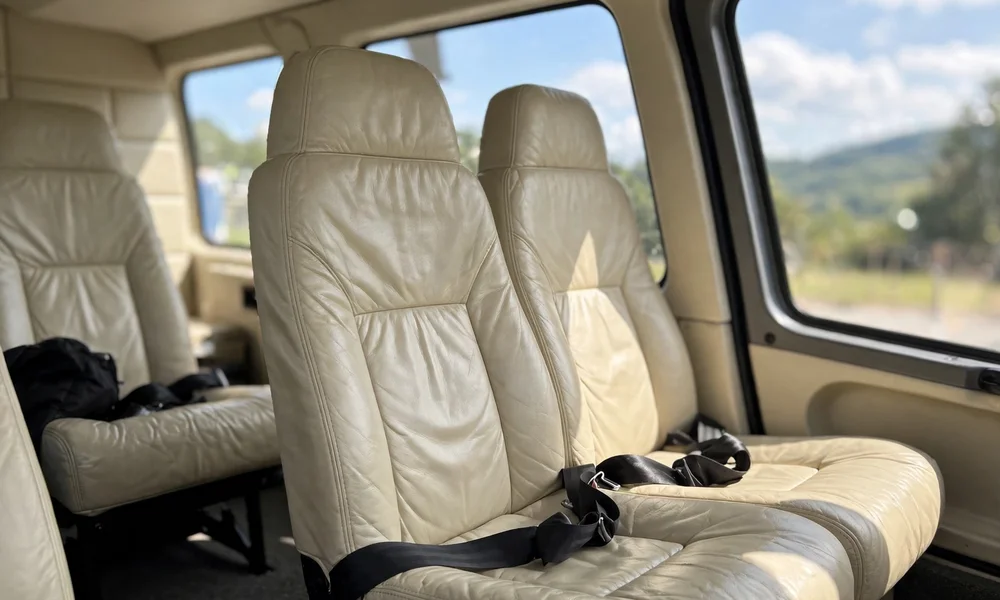
The pilot flies with three main controls: a cyclic stick that tilts the rotor disc, a collective lever that raises or lowers all the blades together, and the anti-torque pedals. Modern luxury helicopters add glass displays, autopilots that can hold a hover hands-free, and stability systems that smooth out gusts before the pilot even feels them. The cabin behind the cockpit is trimmed like a small private jet, with leather, wood and soundproofing, so passengers hear a soft hum rather than the roar of the rotor.
Step 7: Landing on a yacht
Landing on a yacht is the hardest routine job a helicopter pilot does. The deck moves with the sea, the wind curls around the superstructure, and the margin for error is measured in metres. The yacht slows and turns into the wind, the crew clears the deck, and the pilot descends in a steady hover, watching a deck officer’s signals. Once the skids touch, the helicopter is lashed down within minutes, and the rotor is stopped before anyone walks near it. It is a careful dance, and it is rehearsed until it feels routine.
The rotor blades themselves are works of engineering. Each one is built around a spar of metal or composite, skinned in a smooth surface, and balanced so precisely that a blade can be swapped without upsetting the whole rotor. Ice protection, built into many luxury blades, heats the leading edge so the rotor keeps working in cold cloud, and the blades are inspected for the smallest crack after every few dozen hours in the air.
Specifications
| Detail | Typical figure |
|---|---|
| Seating | 4 to 8 passengers |
| Cruise speed | Around 240 to 280 km/h |
| Range | Roughly 600 to 900 km |
| Main rotor diameter | About 10 to 12 metres |
| Engines | One or two turbines |
| Maximum take-off weight | Around 3,000 to 4,500 kg |
What It Costs
A new luxury helicopter costs an estimated $3 million to $10 million, depending on size, engines and cabin finish, with twin-engine models at the top of that range. Those are estimates, and a bespoke interior can add hundreds of thousands more. Running one costs an estimated $300,000 to $800,000 a year, covering fuel, a pilot, hangarage, insurance and maintenance. Many owners charter their helicopter out when they are not using it, which softens the bill and keeps the machine flying regularly, which is good for it.
The helicopter does not work alone: it needs a helicopter pad to land on, a yacht garage to shelter the toys it flies alongside, and a sundeck where passengers wait for their flight. Together they form the small airport that a large yacht carries with it wherever it goes.
A Rare Fact
A helicopter’s rotor blades are not fixed rigidly to the hub: each blade is free to flap, twist and drag slightly as it spins, and those small movements are what keep the machine stable. The first successful helicopters only flew once engineers accepted that the rotor had to be allowed to move, rather than bolted solid.


