A luxury helicopter does not roll off a line the way a car does. It is built slowly, by hand, in a clean, bright hall where a bare metal frame gradually becomes a machine that can lift five people off a yacht deck and set them down on a mountain ledge. The whole process takes months, and at every stage a technician signs their name to the work.
Building one starts long before any metal is cut. Engineers agree the cabin layout, the paint scheme, the avionics and the interior with the buyer, then the factory orders the airframe sections, the turbine engines, the rotor system and the leather, wood and carpet that will turn a working aircraft into a flying living room. This is how a luxury helicopter is made, from the first frame to the first flight.
How It’s Made
Step 1: The airframe takes shape
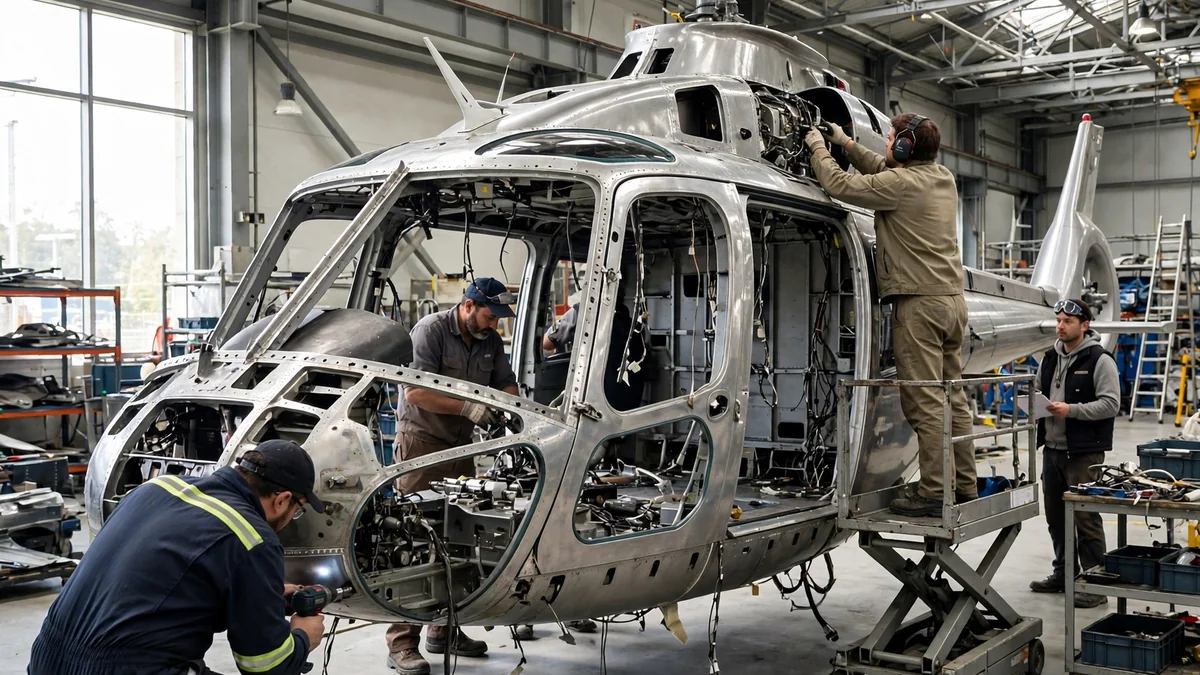
Everything starts with the airframe, the skeleton that holds the whole machine together. Sheets of aluminium alloy and panels of carbon fibre are cut, formed and riveted into the cabin shell, the tail boom and the engine deck. Carbon fibre is used where weight matters most, because every kilogram saved is a kilogram of fuel or luggage the helicopter can carry instead. The frame is built on a jig, a steel cradle that holds each part in exactly the right place while it is joined, so the finished airframe is straight to within a fraction of a millimetre. Once the shell is complete, workers check every rivet and bond by hand and with ultrasound, looking for the smallest flaw before anything else is fitted.
Step 2: The engines and transmission are fitted
Next come the turbine engines, usually two of them in a luxury machine, mounted on the deck above the cabin. A turbine is a small jet engine that spins a shaft instead of pushing air backwards, and it is the reason a modern helicopter is so smooth and reliable. The engines drive a main gearbox, a heavy box of precision gears that slows the turbine’s furious spin down to the steady speed of the main rotor. Fitting the gearbox is one of the most careful jobs in the factory: the gears must mesh perfectly, the oil system must be spotless, and the whole assembly is tested on a bench before it ever meets the airframe. The way a helicopter flies depends entirely on this drivetrain working flawlessly, so nothing here is rushed.
Step 3: The rotor system is built and balanced
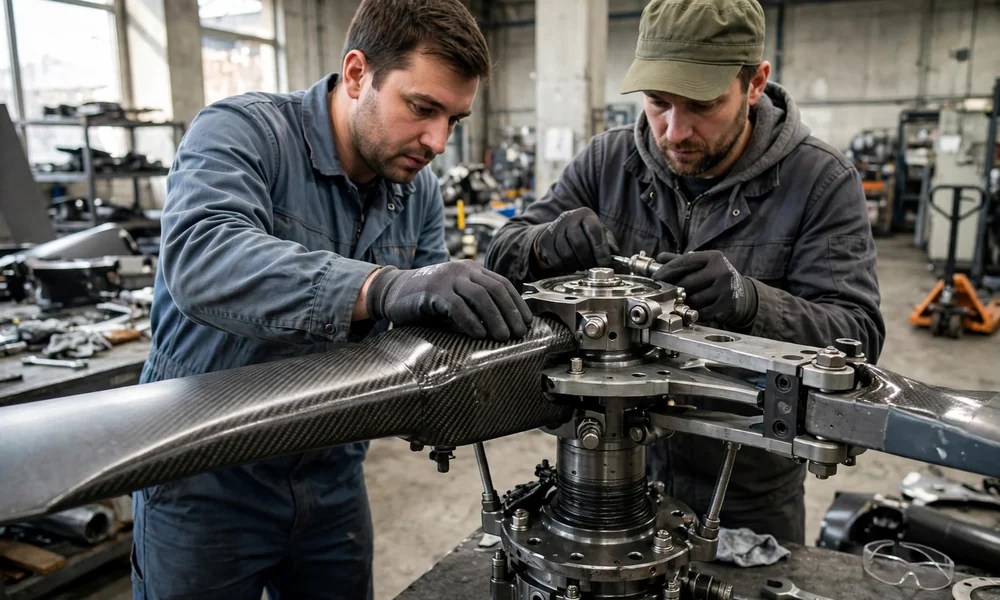
The main rotor is the helicopter’s wing, and building it is a craft of its own. Each blade is laid up from carbon fibre and foam, cured in an oven, then sanded and painted until its surface is perfectly smooth. The blades are bolted to a rotor head, a complex hub of hinges and bearings that lets each blade flap, twist and tilt as it spins. Then comes balancing: the rotor is spun up on a rig and tiny weights are added or moved until the whole assembly turns without the slightest shake. A rotor that is even slightly out of balance would vibrate the whole cabin, so the technicians keep adjusting until the instruments read almost nothing. The tail rotor, a smaller fan at the end of the boom, gets the same treatment.
Step 4: The wiring and avionics go in
With the structure and drivetrain in place, the helicopter is wired like a small flying computer centre. Kilometres of cable run through the airframe, connecting the engines, the rotor controls, the radios, the navigation screens and the autopilot. The cockpit gets glass displays that show the pilot speed, height, engine health and a moving map, while the cabin gets its own quieter systems: lighting, air conditioning and entertainment. Every wire is labelled, clipped and tested, and the whole electrical system is powered up on the ground and checked circuit by circuit. A fault found now costs an hour; a fault found in the air could cost far more.
Step 5: The luxury cabin is finished
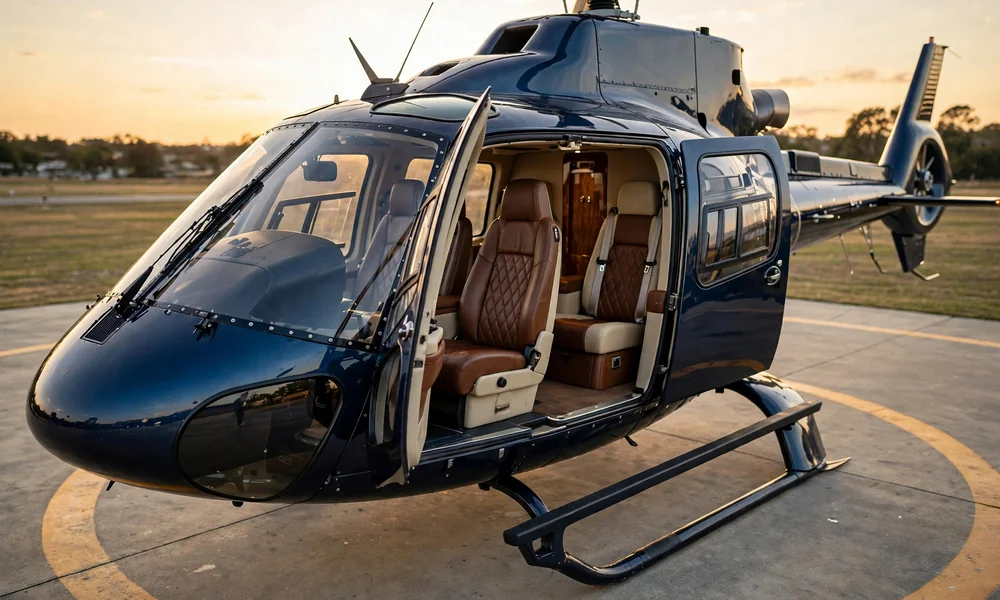
Only when the machine works does it become luxurious. Craftspeople fit hand-stitched leather seats, real wood veneer, thick carpet and soundproofing panels that hush the turbine to a distant hum. The cabin of a top luxury helicopter is quieter than many cars at motorway speed, and that quiet is engineered in: layers of insulation, tuned mounts and careful sealing around every door. The buyer chooses the colours, the stitching and the trim, and the interior team builds it to match, down to the cup holders and the reading lights. Even the headsets are chosen to fit the cabin’s acoustics, so passengers can talk normally while the rotor turns overhead.
Step 6: Paint, testing and the first flight
The helicopter is painted in a sealed booth, layer by layer, until the finish is deep and flawless, then the rotor blades are fitted for the last time and the machine is rolled out for ground testing. Engineers run the engines, spin the rotor and check every gauge, then a test pilot lifts off for the first flight, hovering, climbing and turning while the ground crew watches the telemetry. The helicopter then flies a series of acceptance flights, including a long cross-country leg, before the buyer takes delivery. Only after every test is signed off does the factory hand over the keys, along with a logbook that records every hour of the build. A yacht helicopter pad is often where the new machine lands first, flown straight from the factory to the owner’s ship.
| Specification | Typical luxury light twin |
|---|---|
| Engines | Two turboshaft turbines |
| Passengers | 5 to 6, plus pilot |
| Cruise speed | Around 250 km/h (155 mph) |
| Range | Around 700 km (435 miles) |
| Main rotor diameter | Around 10 metres (33 ft) |
| Build time | Several months, largely by hand |
A new luxury light twin helicopter typically costs an estimated $6 million to $12 million, depending on the model, the engines and the interior, and that is before the cost of the hangar, the pilot and the maintenance programme. The price is an estimate, and a fully bespoke cabin with rare materials can push it higher still. The engineering explains much of the cost: the private jet engine in a small jet is built to similar standards, but a helicopter adds a rotor system, a gearbox and a tail rotor that all have to be perfect at once.
Here is a rare fact: the main rotor blades of a helicopter flex so much in flight that their tips can rise and fall by more than a metre as they spin, and the rotor head is designed to let them do it. The blades are not rigid wings; they bend, twist and flap with every turn, and the helicopter only flies because the hub allows that movement while keeping everything in balance.
When the finished helicopter finally lifts off, it carries the work of hundreds of people: the engineers who shaped the airframe, the technicians who balanced the rotor, and the craftspeople who stitched the seats. It is a machine built one careful step at a time, and that is exactly why it can do what no other aircraft can, which is to rise straight up, hover, and land almost anywhere.