A catamaran already cheats the sea. Two slim hulls slice through the water instead of pushing it aside, so the boat is faster and steadier than a single-hulled yacht of the same size. A hydrofoil catamaran cheats further still. At speed, curved blades under the hulls lift the whole boat clear of the waves, and suddenly there is almost nothing left in the water at all, just two thin wings and a pair of rudders. The ride turns silent, the spray disappears, and a boat that weighs as much as a small house seems to fly.
Building one is a different kind of boatbuilding. A normal yacht is shaped from fibreglass or aluminium and judged by how it sits in the water. A hydrofoil catamaran is judged by how it leaves the water, and every gram matters. Here is how a luxury hydrofoil catamaran is made, from carbon cloth to first flight.
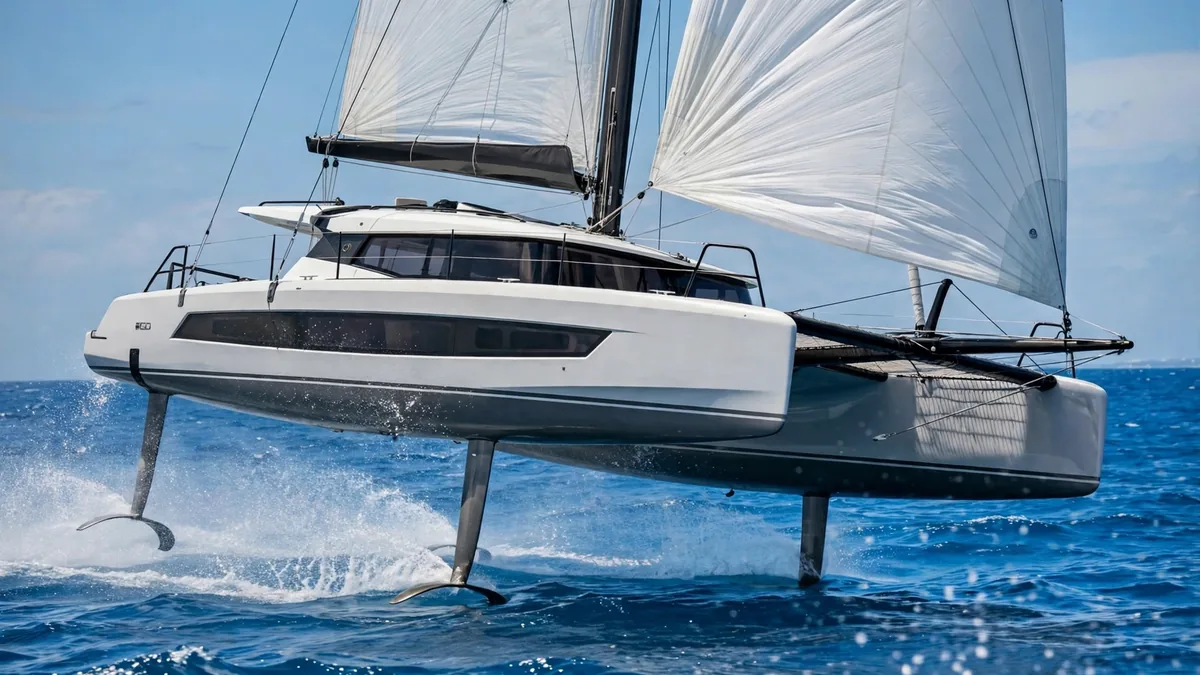
How It Is Made
Step 1: Designing the flying shape
Long before any material is cut, naval architects design the boat twice over. First they design the hulls, long and needle-slim so they cut cleanly through the water at low speed, before the foils take over. Then they design the foils themselves, curved carbon blades whose shape is worked out in computer simulations and tested in towing tanks with scale models. The angle of each foil, the span of the wings and the position of the daggerboards must all agree, because a foil that lifts too early will drag the boat, and one that lifts too late will never fly at all. Only when the numbers balance does the build begin.
Step 2: Laying up the carbon hulls
The two hulls are built from carbon fibre, layer upon layer of black cloth laid into female moulds by hand. Foam cores are sandwiched between the carbon skins to keep the hulls stiff without adding weight. Once the layers are complete, the mould is sealed in a vacuum bag and baked in an oven, curing the resin into a single rigid shell. The finished hull is light enough for two people to lift at the bow, yet strong enough to carry the whole boat on two thin blades.
Step 3: Shaping the foils
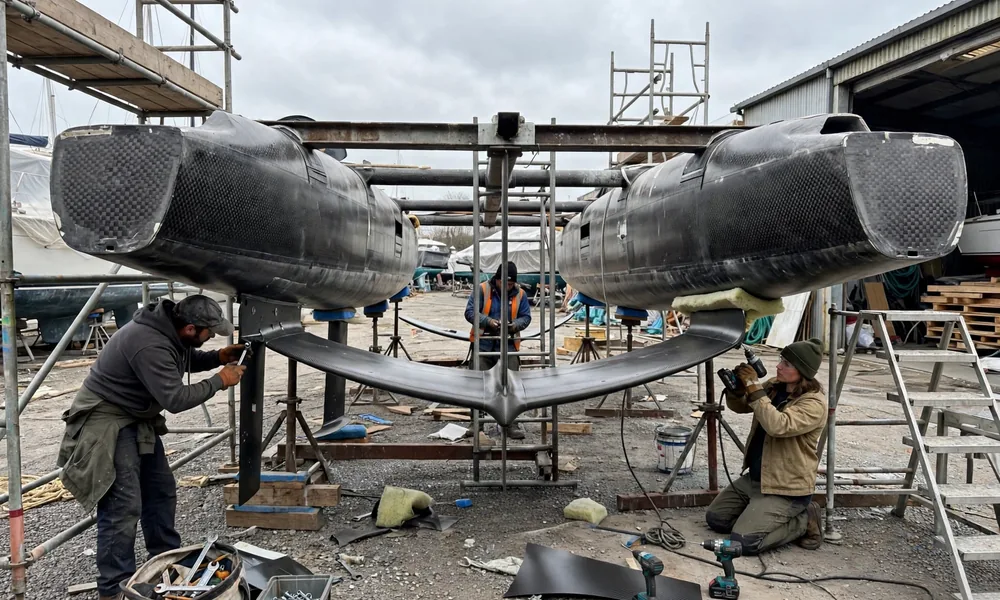
The foils are the most exacting parts of the whole build. Each one is machined from a solid carbon blank, then sanded and polished until its surface is smooth to the touch, because even a rough patch creates drag that can cost a knot of speed. Every foil is weighed, measured against the design with laser scanners, and tested under load in a rig that bends it the way the sea will. A foil that fails the test is scrapped, however expensive it was to make, because a foil that breaks at speed is the one failure a builder will never risk.
Step 4: Joining hulls, beams and deck
The two hulls are set upright in a cradle, exactly parallel and exactly level, and the crossbeams that join them are lowered into place. These beams carry the mast, the trampoline deck between the hulls, and the loads from the sails, so they are bolted and bonded with the same care as the hulls themselves. The deck, the cockpit and the cabin top are fitted next, along with the daggerboard cases that the foils slide through.
Step 5: Rig, sails and the electric heart
The carbon mast is stepped, the rigging is tensioned, and the sails are bent on, cut flat and stiff so they hold their shape in a breeze rather than billowing like a cruising sail. Below deck, the electric heart of the boat is fitted. Batteries sit low in the hulls for balance, driving a quiet electric motor that pushes the boat up to take-off speed when there is no wind, and charging again from the spinning propeller when the boat is sailing.
Step 6: The luxury cabin
With the structure complete, the interior is fitted out by hand. Cabins are lined in pale wood and white leather, the galley is given stone worktops and a proper stove, and the saloon is built around a wide table with a view through the windows across both bows. The helm station gets its flight instruments, small displays that show foil load, boat speed and ride height, so the crew can feel the boat rise and settle as it flies.
Step 7: Launch, tuning and first flight
The finished catamaran is lifted into the water and sailed gently at first, while the builders check for leaks, listen for creaks, and trim the rig. Then the tuning begins. The foils are adjusted a fraction at a time, the rudders are balanced, and the boat is pushed faster on each run until the hulls lift clear and the ride goes quiet. Test sailors watch the instruments and the wake, and the foil angles are shimmed until the boat flies level and steady. Only when the catamaran lifts cleanly, holds its height, and lands softly does the yard sign it off and hand the keys to its owner.
Key Specifications
The figures below describe a typical current luxury hydrofoil catamaran; individual builds vary.
| Specification | Typical figure |
|---|---|
| Length overall | 15 to 20 metres |
| Beam | 7 to 9 metres |
| Displacement | 8 to 14 tonnes |
| Take-off speed | Around 12 to 15 knots |
| Top speed under sail | 25 to 35 knots |
| Electric motor | 10 to 20 kW per hull |
| Cabins | Three or four double cabins |
| Hull material | Carbon fibre with foam core |
How Much Does It Cost?
A luxury hydrofoil catamaran typically costs from around $3 million to $8 million, depending on the size, the builder and the finish. That is an estimate based on current flagship builds, and the price can rise further with custom interiors, larger foils or a full hybrid power system. Most of the cost sits in the carbon fibre structure, the hand-finished foils and the long tuning process, because no two foiling boats behave exactly alike. To see the boat in action, read how a luxury foiling catamaran works once it is flying. For the closest single-hull cousin, how a luxury foiling yacht is made follows a similar build in one hull. And the luxury foiling catamaran specs explained breaks down the numbers in plain language.

A Rare Fact
Here is something few sailors ever learn: a foiling catamaran can sail faster than the wind that drives it. When the hulls lift clear of the water, the drag falls so far that the boat accelerates past the true wind speed, and the apparent wind swings forward until it feels as if the boat is sailing into its own breeze. Racing foilers have been recorded at more than twice the speed of the wind behind them, which is why their crews wear helmets and harnesses more like racing drivers than holiday sailors. It is the closest thing to flying a sailboat, and it is only possible because the boat stops being a boat and starts being a wing.
A luxury hydrofoil catamaran is two machines in one: a comfortable cruising home with four cabins and a proper galley, and a flying machine that leaves the sea behind at the touch of the wind. From the first layer of carbon cloth to the first quiet flight, hundreds of hands shape a boat that weighs less than a truck yet carries a family across oceans. When the hulls rise and the spray stops, the build disappears and only the flying remains, and that is exactly what the builders were aiming for all along.


