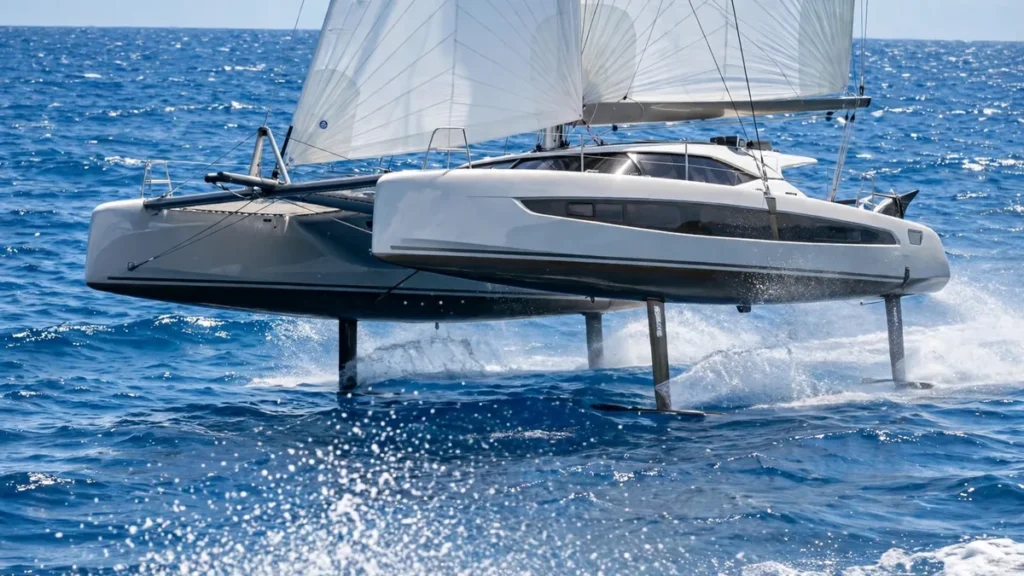
The catamaran was doing something a boat is not supposed to do. It was flying. The two hulls were clear of the water, the only things touching the sea were two thin black blades, and the boat was moving faster than the wind that was pushing it, leaving a fine white trail behind it like a jet leaving a contrail in the sky.
A luxury foiling catamaran is a sailing boat that has learned to leave the water behind, and the spec sheet is where that magic is measured.
This guide translates every number on a luxury foiling catamaran spec sheet into plain English, from the foils and the hulls to the sails, the speed, the stability and the crew who fly it.
How to Read a Luxury Foiling Catamaran Spec Sheet
The foils: wings that fly underwater
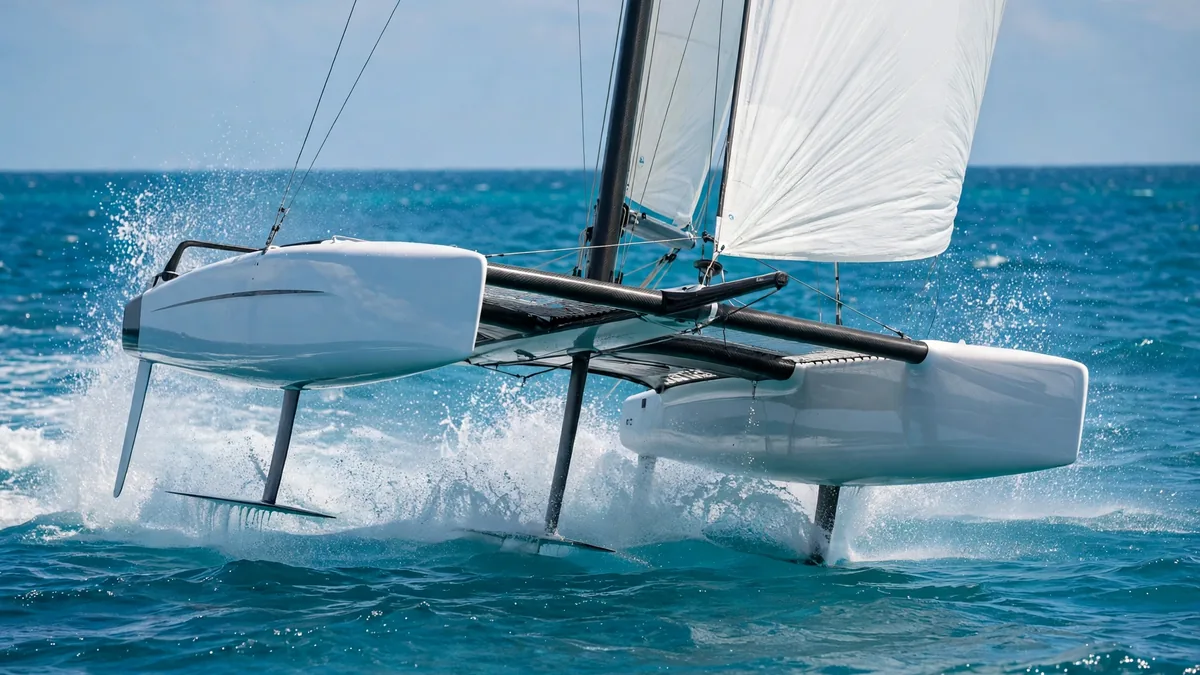
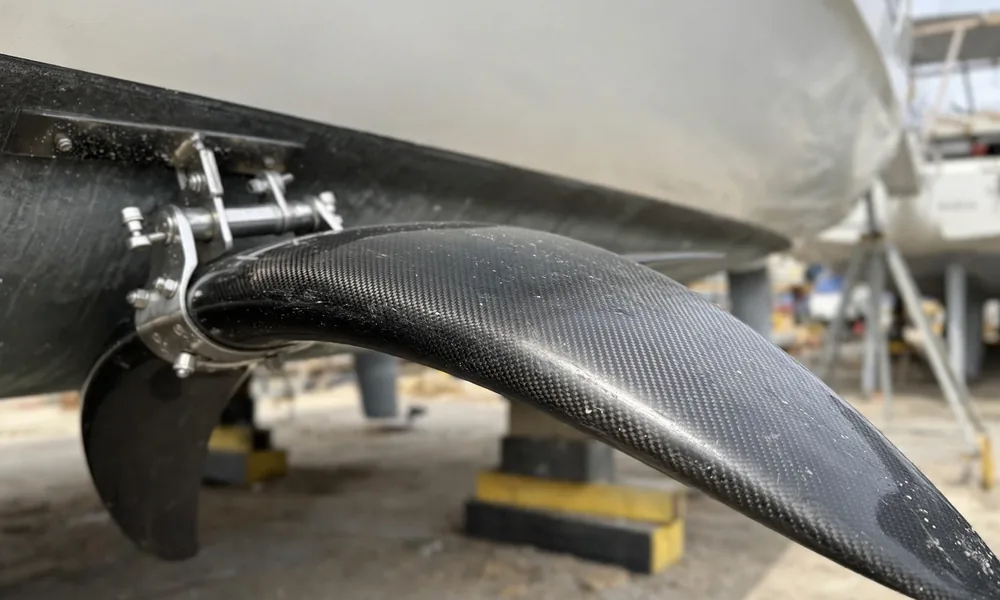
The foils are the first numbers on the sheet, and the most important, because they are what lift the boat out of the water. A luxury foiling catamaran usually carries two main foils, one under each hull, each made from carbon fibre and about 2 to 3 metres long, shaped like the wing of an aeroplane. As the boat gathers speed, the foils generate lift, and at about 12 to 15 knots the hulls rise clear of the water, which cuts the drag by about 40 to 60 percent and lets the boat accelerate hard.
Hull length and beam: two narrow hulls, one wide platform
Hull length and beam are the dimensions that describe the boat, and a luxury foiling catamaran is usually about 15 to 25 metres long, with a beam of about 8 to 12 metres, which is very wide for its length. The two hulls are narrow and sharp, like the blades of a pair of skis, because a narrow hull cuts through the water with less drag, and the wide beam gives the boat stability, so it does not heel over the way a single-hull sailing boat does. The space between the hulls holds the cockpit, the saloon and the cabins, and it is where the crew live, eat and sleep in a space that feels more like a flat than a boat.
Sail area: how much wind it can catch
Sail area is the size of the sails, and a luxury foiling catamaran usually carries about 150 to 300 square metres of sail, including a tall mainsail and a large headsail, with some boats adding a spinnaker of another 200 square metres for running downwind. The sail area decides how fast the boat can go in light wind, and it is the number that separates a cruising catamaran from a racing one.
Speed: faster than the wind itself
Speed is the number that makes people smile, because a luxury foiling catamaran can sail faster than the wind that pushes it. It usually cruises at about 15 to 20 knots, and the fastest models can reach about 30 to 40 knots, which is about 55 to 75 kilometres per hour, in a strong breeze. How the foils, the hulls and the sails work together is a story of its own, as our guide to how a luxury catamaran works explains.
Weight and materials: carbon fibre, and almost nothing else
Weight is the number that decides whether the boat can foil at all, and a luxury foiling catamaran is built almost entirely from carbon fibre, with a weight of about 10 to 20 tonnes, which is remarkably light for a boat of its size. The numbers behind the whole machine are worth a look, as our guide to luxury foiling yacht specs, explained shows for its single-hull cousins.
Crew and guests: who flies the boat
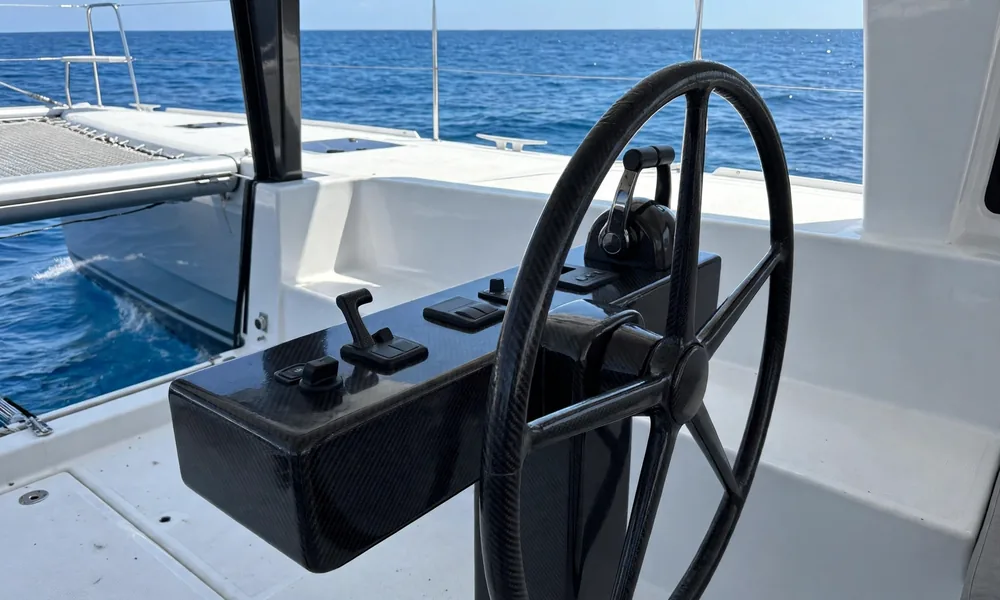
Crew and guests are the last numbers on the sheet, and they show that a foiling catamaran is a machine that needs skill as well as money. A luxury foiling catamaran usually carries a crew of about 2 to 6 people, including a skipper and a foil trimmer, and it can carry about 6 to 12 guests in cabins that are comfortable but compact, with a saloon, a galley and a cockpit that is open to the sky. The crew work constantly while the boat is foiling, adjusting the sails, the foils and the rudders, because a foiling boat is always one small mistake away from dropping back into the water with a thump. How the boat is built around all of this is a craft of its own, as our guide to how a luxury catamaran is made explains.
Luxury Foiling Catamaran Specs
| Specification | Typical range |
|---|---|
| Main foils | 2 carbon fibre foils, about 2 to 3 metres long |
| Take-off speed | About 12 to 15 knots |
| Length | About 15 to 25 metres |
| Beam | About 8 to 12 metres |
| Sail area | About 150 to 300 square metres |
| Mast height | About 25 to 35 metres |
| Cruising speed | About 15 to 20 knots |
| Top speed | About 30 to 40 knots |
| Weight | About 10 to 20 tonnes |
| Crew and guests | About 2 to 6 crew, 6 to 12 guests |
What Does a Luxury Foiling Catamaran Cost?
A luxury foiling catamaran typically costs an estimated 3 million to 12 million dollars to buy, depending on size, materials and the quality of the foils, with the fastest racing models passing an estimated 20 million dollars. Chartering one usually costs an estimated 30,000 to 100,000 dollars per week, depending on the season, the crew and the route, and the foils themselves are one of the most expensive parts to replace, because each foil is a single piece of carbon fibre that has to be made, polished and tested by hand.
A Rare Fact
A foiling catamaran can sail faster than the wind, and the reason is a trick of physics that surprises even experienced sailors. When the boat moves, the wind it feels is a combination of the real wind and the wind created by its own motion, and as the boat goes faster, that apparent wind grows stronger and moves further forward, which fills the sails even harder. The result is a loop: more speed makes more wind, and more wind makes more speed, until the drag of the foils and the strength of the sails set the limit. It is the same reason a foiling boat can sail upwind at an angle that would stall a normal boat, and why the crew on deck feel a strong breeze on a day when the flags on shore are hanging still.
A luxury foiling catamaran is a pair of wings, two narrow hulls, a tall mast and a crew that can fly a boat, and the spec sheet is really a description of that balance. The foils tell you when it takes off, the sail area tells you how much wind it can catch, the weight tells you whether it can fly at all, and the top speed tells you how far the trick can go. Read those four numbers first, and the rest of the sheet falls into place.