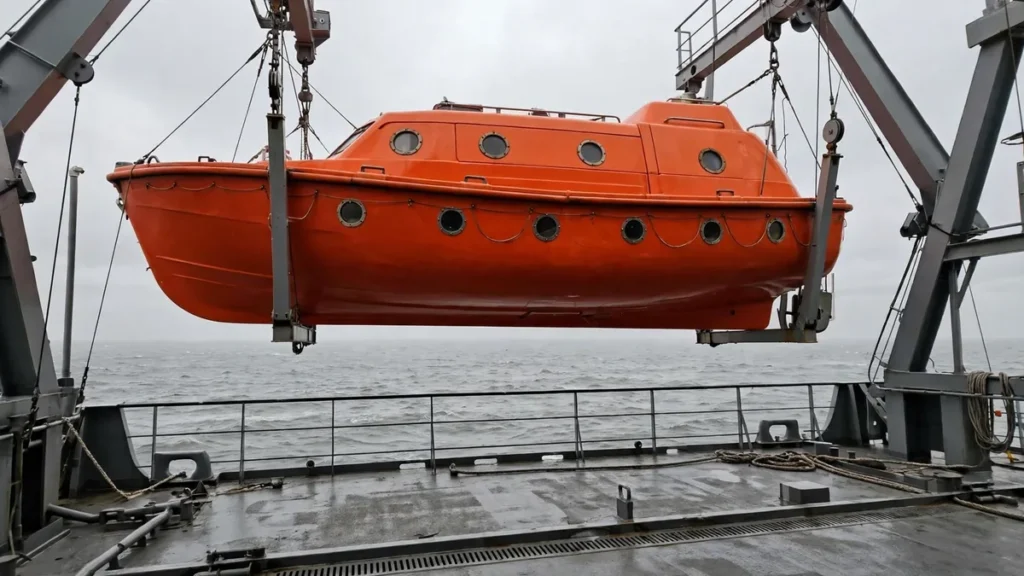
On the side of a superyacht, tucked under a white cover and held by two steel arms, hangs a small orange boat that nobody on board ever wants to use. It is the lifeboat, and for most of a yacht’s life it is the most ignored piece of equipment on the ship. Then, on the worst day a yacht can have, that orange boat becomes the whole ship. A luxury lifeboat is built for that one day, and everything about it, from the colour of its hull to the shape of its seats, is decided by the question of what happens when everything else has gone wrong.

Step 1: A hull that cannot sink is shaped first
A luxury lifeboat begins as a hull designed to stay afloat even when it is full of water. The shell is moulded from glass-reinforced plastic, laid up in layers in a female mould, with foam buoyancy built into the walls and under the floor, so the boat floats high even if it is swamped.
The orange colour is not decoration. The hull is also self-righting, with a low centre of gravity and a rounded top, so if a wave rolls it over, it comes back upright on its own, a trick that depends on the weight of the engine and the buoyancy foam being placed exactly right.
Step 2: The engine and steering are fitted to run without fuss
Inside the hull, a compact diesel engine is bolted low in the centre, where its weight helps the self-righting balance. It is a simple, rugged unit, chosen because it will start after months of sitting still, and it drives a single propeller through a shaft that is protected by a skeg, so a floating rope or a piece of wreckage is less likely to stop it.
Steering is by a small wheel or tiller at the front, with a compass and a few basic instruments, and everything is built to be worked by a frightened person in the dark. The engine controls are large, the labels are simple, and the whole arrangement assumes the person at the helm has never driven a boat before, which is usually true.
Step 3: Seats, belts and a canopy are built for a full load
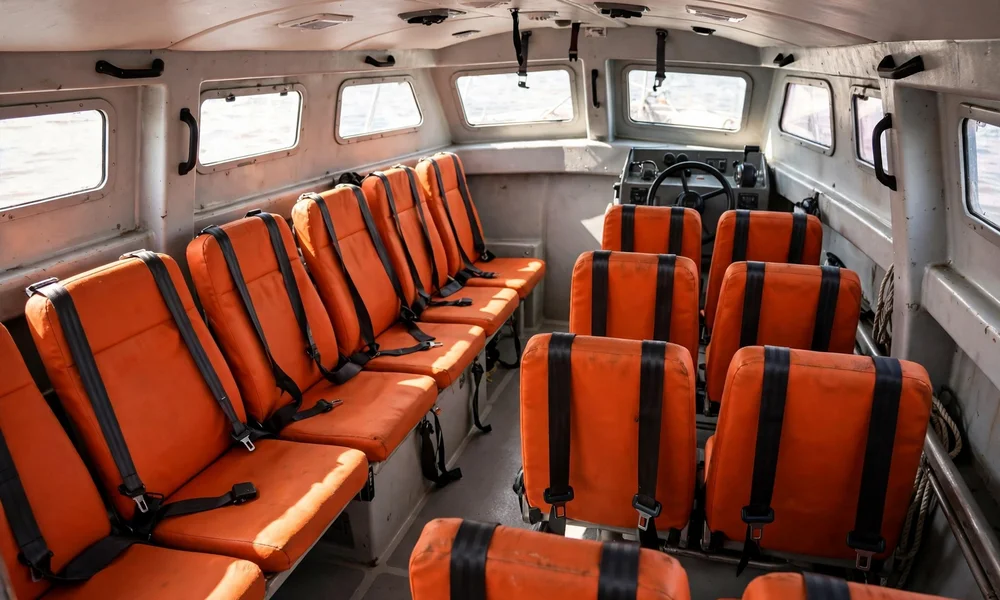
The inside of a lifeboat is all seats, arranged in rows facing forward or inward, each with a seatbelt, because a boat full of people in rough water throws its passengers around. The capacity is marked on the outside, and a luxury yacht’s lifeboat is sized for every person on board, guests and crew together, with a little room to spare.
Overhead, the canopy keeps out spray and rain, and small windows let the coxswain see ahead. It is not comfortable, and it is not meant to be. It is meant to keep a full load of people safe and seated while the sea does its worst outside.
Step 4: Davits, hooks and a release that works in seconds
A lifeboat is only useful if it can get into the water fast, so the davits that hold it are as carefully engineered as the boat itself. The davits are steel arms that swing the boat out over the side of the yacht, and the boat hangs from two falls, wire ropes worked by a winch. The fireboat shows the same urgency from the other side, as the guide to how a luxury fireboat is made describes, arriving to fight a blaze while the lifeboat carries people away from it.
The release gear is the clever part. A single lever frees both hooks at once, so the boat drops evenly instead of tipping, and it is designed so it cannot be tripped by accident while the boat is still hanging. Modern boats use an on-load release that works even while the boat’s weight is on the hooks, and the crew practises the release on every drill, because a hook that sticks is the difference between a launch and a disaster.
Step 5: Supplies, signals and a radio go aboard
Once the structure is finished, the lifeboat is stocked like a small survival station. There are flares and a smoke signal for attracting attention, a radar reflector so ships can see the boat, a first aid kit, drinking water and emergency rations, a bailer and a sea anchor to keep the boat head to wind, and a handheld radio with a spare battery.
The patrol boat works the same waters with far more equipment, as the guide to how a luxury patrol boat works explains, carrying sensors and speed the lifeboat will never have, but the lifeboat’s job is simpler and harder: to keep people alive until someone like that arrives.
Step 6: Tests, drills and a coat of orange paint
Before a lifeboat is accepted, it is tested in ways that would destroy a normal boat. It is launched fully loaded, it is capsized in a test tank to prove it rights itself, and its engine is run until the fuel is gone to prove the range.
Then comes the paint, the reflective tape and the name of the yacht on the side, and the boat is hoisted into its davits and covered against the sun. The ferry carries its passengers across the water every day, as the guide to how a luxury ferry works describes, and its own lifeboats wait in the same way, quiet, orange and ready.
Specifications
| Detail | Specification |
|---|---|
| Length | Around 5 to 9 metres |
| Capacity | Around 20 to 50 people |
| Hull material | Glass-reinforced plastic with foam buoyancy |
| Engine | Compact diesel, around 25 to 50 horsepower |
| Speed | Around 6 knots |
| Range | At least 24 hours at slow speed |
| Self-righting | Yes, returns upright after capsizing |
| Launch | Davit and winch, single-lever release |
What it costs
The estimated price of a new luxury lifeboat, with its davits and release gear, is around 80,000 to 250,000 dollars, and that figure is an estimate only, because the cost depends on the capacity, the engine and the launch system. The hull and the davits account for most of the price, followed by the engine and the survival equipment. A yacht carries at least two, so the real cost of the lifeboat fit is usually double the price of one boat.
A rare fact
Few people know that some lifeboats are tested by being dropped from a height into the water fully loaded with sandbags, because the release gear has to work while the boat is still falling. The test proves the hooks let go cleanly and the hull takes the shock without cracking, and it is the reason the crew is trained to sit down and hold on tight before the lever is pulled, because the drop is the most violent moment of the whole launch.