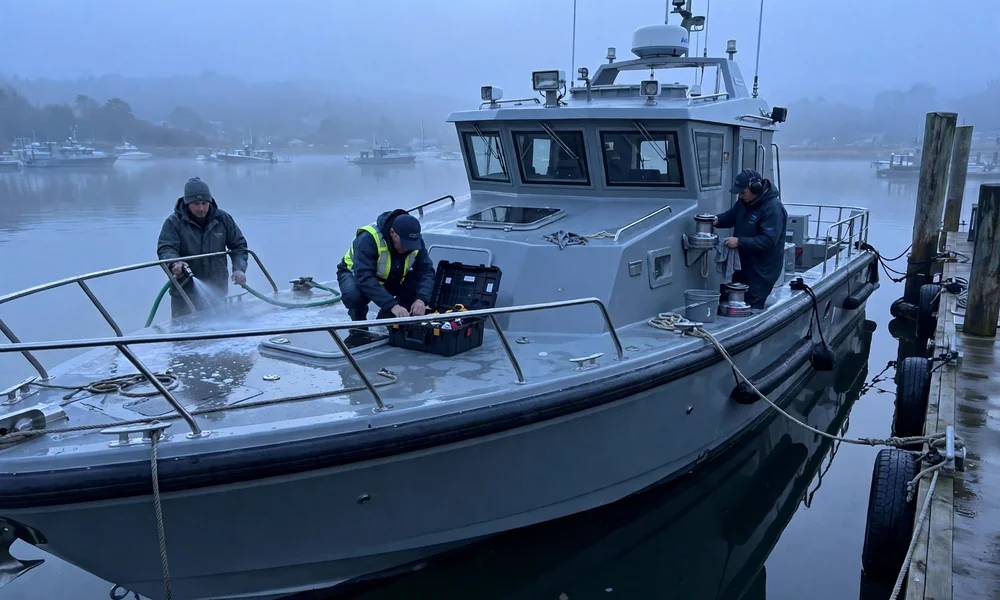
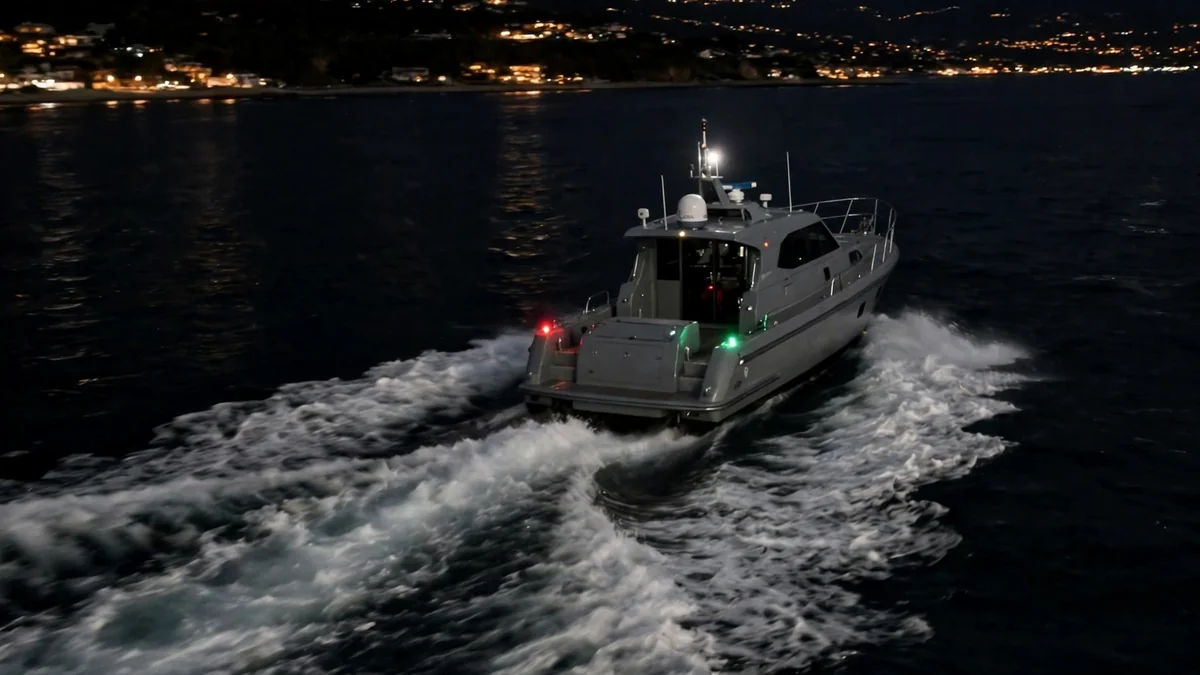
Midnight on a dark coastline, and the radar shows a contact that should not be there: a small boat running without lights, fast, close to the shore, heading for a bay that has no harbour. The patrol boat answers with a quiet change of course, no sirens, no floodlights yet, just a steady increase in speed as the crew takes up their stations. A luxury patrol boat is a police car, a rescue vessel, and a small warship all at once, and its luxury is not in its cabins. It is in its speed, its sensors, and the fact that it can do its job in weather that keeps every other boat in port.
The boat works as a system of eyes, speed, and reach. Radar and cameras find what the naked eye cannot, the engines close the distance before a suspect boat can vanish, and the fast launch boat carried on the stern lets the crew board a vessel or reach a swimmer that the patrol boat itself cannot approach.
This is how that system works, from the first radar contact to the moment the crew returns to port. This is how a luxury patrol boat works, on a night when the coast needs watching.
How a luxury patrol boat works
Step 1: Finding the contact with radar and cameras
A patrol boat’s work starts with seeing, and its eyes are better than any lookout’s. The mast carries radar that can pick up a small wooden boat at several miles, even in rain or darkness, and thermal cameras that show the heat of an engine or a person against the cold sea. The bridge crew watches these screens alongside the electronic chart, building a picture of every vessel in their sector: which ones are fishing where they should be, which ones are crossing a shipping lane, and which ones are running dark. The same patient watchkeeping defines how a luxury pilot boat works, where reading the water correctly matters more than speed.
Step 2: Closing the distance at speed
Once the decision is made, the patrol boat uses the one advantage it always holds: speed. Powerful diesel engines, often driving water jets rather than propellers, push the boat to forty knots or more, fast enough to run down almost anything it is likely to meet. The hull is deep and sharp, built to cut through waves at speed without pounding the crew, and the whole boat is stabilised so the sensors on the mast keep a steady picture even when the sea is rough. The build that creates this speed and strength is told in how a luxury patrol boat is made, from the first aluminium plate to the day the boat first runs at full speed.
Step 3: The approach, the challenge, and the boarding
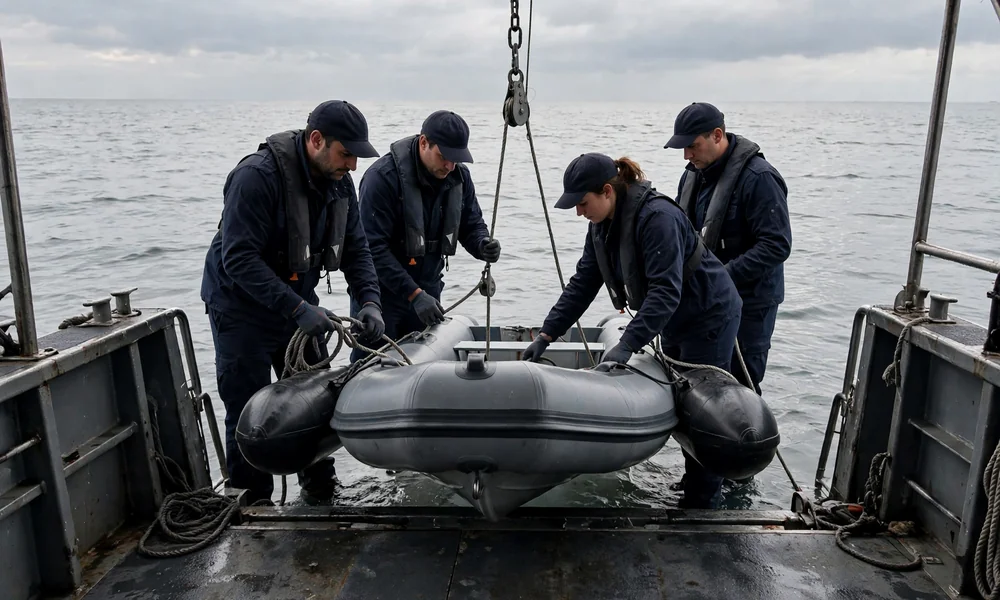
Close alongside, the work becomes careful and human. The crew uses loudhailers and flashing lights to order the other vessel to stop, and the captain positions the patrol boat on the suspect’s quarter, where it can be seen clearly but cannot easily be rammed. If the vessel stops, the boarding team goes across in the fast launch boat carried on the stern, a rigid inflatable that can be launched and recovered in minutes. The boarding team checks the papers, the cargo, and the crew, looking for smuggled goods, unlicensed fishing, or people in distress. The figures behind the speed and the sensors are set out in the luxury patrol boat specs explained guide, which breaks down the engines, the range, and the equipment.
Step 4: Rescue and the fast launch boat
Many patrols end not in an arrest but in a rescue, and the boat is built for that too. The fast launch boat is the patrol boat’s hands, able to reach swimmers, small craft, and rocky shores that the patrol boat itself cannot approach. The crew trains constantly in man-overboard drills, throwing a dummy into the water and recovering it against the clock, because a person in cold water has minutes, not hours. The patrol boat carries first aid equipment, stretchers, and a small medical space, and its crew includes members trained in first aid and sea rescue. They simply do it.
Step 5: Endurance, the crew, and the long patrol
A patrol boat does not sprint and then go home. It stays out for days, covering its sector in a steady pattern, and its luxury is in the endurance that makes that possible. The fuel tanks give it a range of hundreds of miles, the cabins are fitted with proper bunks, a galley, and showers, so a crew of eight or ten can live aboard in reasonable comfort, and the bridge is designed for long watches, with good visibility, quiet engines, and seats that support a watchkeeper through a four-hour watch at night. The crew works in shifts, maintains the engines and the sensors between contacts, and keeps the boat ready to sprint at a moment’s notice.
Step 6: The return, the report, and readiness again
When the patrol ends, the boat returns to its berth, refuels, and the crew writes up everything that happened: every contact, every boarding, every rescue, and every vessel that was warned and let go. The boat is washed down, the engines are checked, the launch boat is inspected, and the fuel and stores are topped up, so the boat is ready to sail again within hours. A patrol boat’s reputation is built not on a single dramatic chase but on being there, night after night, in weather that keeps others ashore, until the coast it watches becomes a place where the wrong boats stop coming.
Specifications
| Specification | Typical figure |
|---|---|
| Length | 15 to 30 metres |
| Hull material | Aluminium, deep-vee hull |
| Propulsion | Diesel engines with water jets |
| Top speed | 35 to 45 knots |
| Crew | 8 to 10 |
| Range | 500 to 1,000 nautical miles |
| Estimated price | From around $8,000,000, an estimate |
The price of a luxury patrol boat is an estimate, because each boat is built to the coast it will watch. A well-equipped luxury patrol boat typically starts from around $8,000,000, and a large offshore patrol boat with the longest range, the best sensors, and a full rescue fit can cost $15,000,000 or more. It is bought not for what it does on a quiet night, but for what it can do on the worst one.
A rare fact
Here is a detail that surprises visitors to a patrol boat: the boat’s water jets can be reversed so precisely that the captain can hold the boat perfectly still beside a drifting vessel, or even move it sideways, without ever touching the wheel. By aiming the jet buckets, the captain can push the stern one way and the bow the other, spinning the boat in its own length or sliding it sideways like a crab.
A finished patrol boat is a machine built for the nights when the coast is dark, the weather is bad, and the radar shows a contact that should not be there.