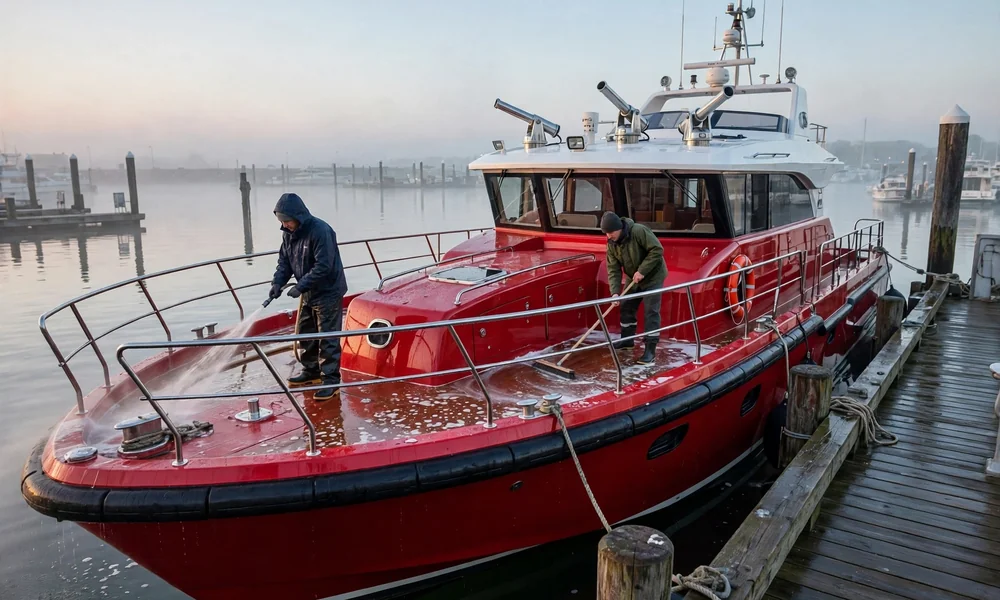
The order starts with a harbour master describing the worst day his port has ever seen: a tanker fire at the fuel berth, a warehouse ablaze on the far quay, and land engines that could not get close enough to either. The shipyard listens, measures the harbour, and then starts building the answer. A luxury fireboat is not ordered from a catalogue. It is designed around one harbour, its tides, its berths, and the fires it might one day have to fight, and every plate, pump, and pipe in it is chosen for that job.
Building one takes months, and most of the work is invisible once the boat is in the water. The hull is welded from steel thick enough to push against a burning ship. The pumps are sized to move more water in a minute than a street of fire hydrants. The wheelhouse is armoured against heat and fitted with joysticks that aim the water monitors from behind glass.
What follows is the full build, from the first steel plate on the slipway to the day the boat throws its first arc of water across the harbour. This is how a luxury fireboat is made, step by step, in the yard where fireboats are born.

How a luxury fireboat is made
Step 1: Designing the hull for the harbour it will serve
Every fireboat build starts on paper, with the harbour it will protect. Naval architects study the depth of the channels, the height of the quays, the size of the largest ships that call, and the speed of the tides, then draw a hull with a wide beam for stability and a shallow enough draft to work close inshore. The hull is usually steel, welded plate by plate on the slipway, with extra reinforcement at the bow so the boat can nudge a burning vessel away from others. The same care over balance and stability shapes how a luxury fireboat works once it leaves the yard and meets its first real fire.
Step 2: Fitting the engines and the propulsion
Once the hull is welded, painted below the waterline, and launched, the engines go in. A luxury fireboat needs two kinds of power at once: speed to reach a fire quickly, and fine control to hold position beside a burning ship in wind and current. Large diesel engines drive propellers or water jets, and many boats carry bow thrusters so the captain can slide sideways against a quay without swinging the stern. The engines are mounted on flexible beds to cut vibration, and the exhausts are routed high so spray never reaches them.
Step 3: Installing the pumps and the water system
The heart of the build is the pumping system, and it is fitted before most of the interior exists. Large centrifugal pumps are bolted low in the hull and connected to the main engines or to dedicated pump engines, drawing water from beneath the boat through sea chests fitted with strainers that keep debris, rope, and weed out of the impellers. Pipework the width of a man’s shoulders runs from the pumps to the deck, with valves at every branch so the crew can feed one monitor, or all of them, at full power. The figures behind this firepower are set out in the luxury fireboat specs explained guide, which breaks down the pumps, the monitors, and the reach.
Step 4: Mounting the monitors and the foam system
With the pumps in place, the yard fits the monitors, the great remotely controlled nozzles that are the visible signature of a fireboat. They are mounted on the foredeck and on the wheelhouse roof, on powered bases that can sweep and elevate at the touch of a joystick, and each one is plumbed to throw a jet over a hundred metres or to fan out into a wide protective spray. Beside them goes the foam system: tanks of foam concentrate, proportioning pumps that mix it into the water at exactly the right ratio, and separate lines for fuel fires that water alone cannot smother.
Step 5: Building the wheelhouse and the crew spaces
A luxury fireboat is a home as well as a machine, because its crew lives aboard on call around the clock. The wheelhouse is built with heat-resistant glass, a water curtain system that sprays a cooling film over the windows and decks, and duplicate controls so the boat can be driven from more than one station. Below, the yard fits bunks, a galley, showers, and a drying room for protective gear, all finished to a standard closer to a small yacht than a workboat. The discipline of keeping a working boat ready between jobs is shared across the harbour, including by the vessel described in how a luxury tugboat works, where a quiet day is still a working day.
Step 6: Testing, trials, and the first jet of water
No fireboat leaves the yard untested. The pumps are run at full power against a measured load, the monitors are fired across the harbour and their range marked, and the foam system is tested with real concentrate to prove the mix is right. The boat runs sea trials at full speed, turns hard, stops hard, and holds position against the current with its monitors running, while surveyors check that it stays level and steady.
Specifications
| Specification | Typical figure |
|---|---|
| Length | 20 to 35 metres |
| Hull material | Welded steel, reinforced bow |
| Pump capacity | Up to 10,000 litres per minute or more |
| Monitor range | Over 100 metres |
| Top speed | 25 to 30 knots |
| Crew | 4 to 8 firefighters |
| Estimated price | From around $5,000,000, an estimate |
The price of a luxury fireboat is an estimate, because each boat is built to the harbour it will serve. A well-equipped luxury fireboat typically starts from around $5,000,000, and a large harbour fireboat with the biggest pumps, a full foam system, and rescue facilities can cost $10,000,000 or more. One fire stopped early can repay the whole boat.
A rare fact
Here is a detail that surprises visitors to a shipyard: a fireboat is often built so it can pump water ashore to land-based fire engines, acting as a floating hydrant for a whole street of fire trucks. The yard fits special shore connections and hose manifolds for exactly that purpose, so a fireboat that cannot reach a fire with its own monitors can still feed its pumps through hoses to engines on the quay.
A finished fireboat leaves the yard as a machine built for the worst day in a harbour’s life, and it will spend most of its life waiting for that day, training, testing its pumps, and patrolling the water it protects. Its luxury is not visible in the way a yacht’s is, but it is real: a warm, protected wheelhouse, powerful engines, and the knowledge that when the alarm sounds, the boat and its crew can do something no one else in the harbour can do.