There is a moment in every luxury watch atelier that never gets old, no matter how many times it happens. A watchmaker lifts a movement out of its tray, no bigger than a coin and made of more than two hundred separate parts, and holds it to the light. With a pair of tweezers she nudges the balance wheel, and the whole tiny machine wakes up: gears turn, the escapement clicks, and the second hand begins its slow, steady sweep.
A mechanical watch is an anachronism that refuses to die. Quartz watches are cheaper and more accurate, and a phone tells the time for free, yet the finest mechanical watches sell for the price of a house and have waiting lists years long.
Making one takes months, and the work is spread across specialists who may spend their whole careers on a single component. This is how a luxury mechanical watch is made, from raw metal to the wrist.
How It Is Made
Step 1: The plates and bridges are cut and finished
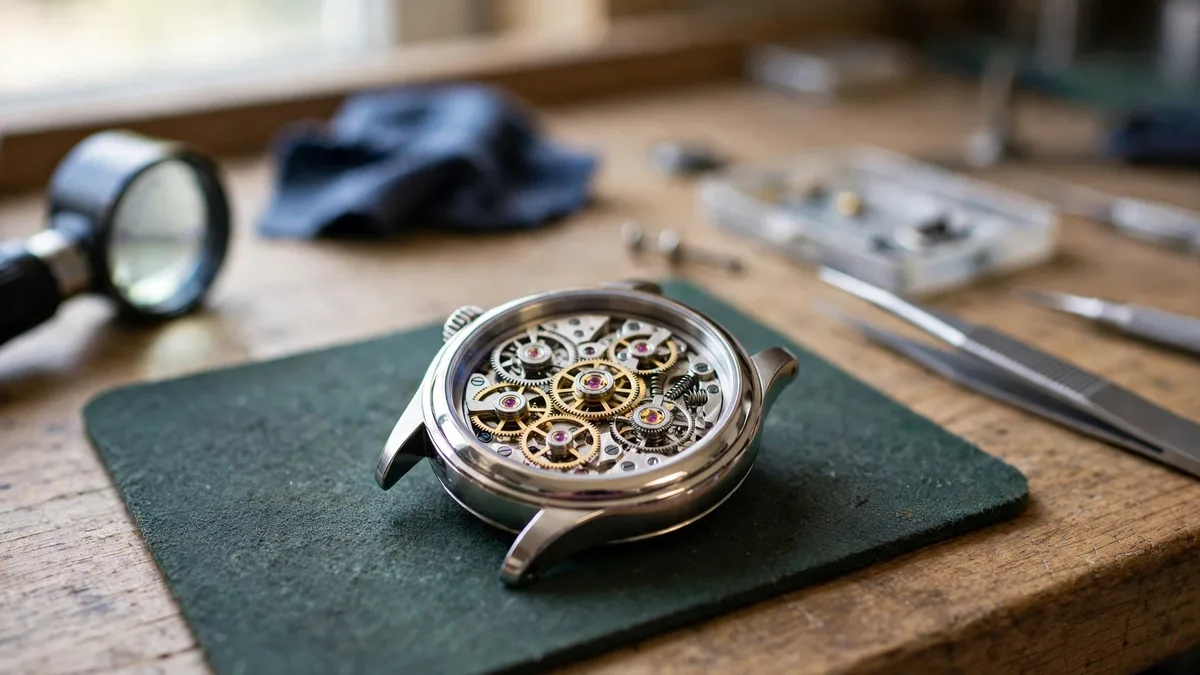
A movement begins as flat plates of brass, cut on computer-controlled mills into the main plate and the bridges that hold the gear train in place. Each plate is drilled with dozens of tiny holes, some less than a millimetre across, that will carry the jewel bearings the pivots spin in. Then the finishing begins, and it is here that luxury separates itself from ordinary watchmaking. The edges of every bridge are bevelled by hand with a file and polished until they catch the light, the flat surfaces are striped with fine Geneva waves, and the screw heads are polished and blued.
Step 2: The gear train is made, tooth by tooth
The gears that carry power from the mainspring to the hands are cut on specialised machines that shape each tooth to a profile designed to lose as little energy as possible. The wheels are made of brass and the pinions of hardened steel, and after cutting they are polished, their spokes bevelled, and their pivots turned down to a fineness that seems impossible: a pivot can be thinner than a human hair and still must spin freely in its jewel for decades. If the wheels do not spin freely, something is wrong, and the search for the fault begins with a loupe and patience.

Step 3: The escapement and balance are fitted
The escapement is the beating heart of the watch, the mechanism that lets the stored energy of the mainspring escape in small, regular steps. In most luxury watches it is a Swiss lever escapement, made of a pallet fork and an escape wheel whose teeth are cut and polished to microscopic precision. It works with the balance wheel, a small ring that swings back and forth several times a second, regulated by a hairspring finer than a strand of hair. The watchmaker adjusts the depth of the escapement, the poise of the balance and the shape of the hairspring until the watch beats evenly in every position, dial up, dial down and on its side.
Step 4: The mainspring is wound and the movement is assembled
Power comes from the mainspring, a long ribbon of hardened steel coiled inside a barrel. It is wound by hand or by the rotor in an automatic watch, and it stores enough energy to run the movement for days. The barrel, the gear train, the escapement and the balance are assembled together on the main plate, the bridges are screwed down, and the movement is oiled. Once assembled, the movement is run for days on a timing machine that listens to its beat and reports its rate in seconds per day, and the watchmaker regulates it until it falls inside a few seconds of perfect.
Step 5: The case, dial and hands are made
While the movement is being regulated, the case is made separately. Luxury cases are machined from gold, platinum, steel or titanium, then polished by hand in stages, with different faces of the case given different finishes: a mirror polish on the bezel, a brushed satin on the case band, a polished bevel between them. The dial is made in its own workshop, where layers of lacquer or enamel are applied and fired, indices are set by hand, and the printing is done so finely it is almost invisible without a loupe. The hands are cut, polished and sometimes blued over a flame, a process that turns steel a deep, even blue at exactly the right temperature.
Step 6: The watch is cased, sealed and tested
Casing is the moment the watch becomes a watch. The movement is lowered into the case, the dial and hands are fitted, the crystal is pressed in and the case back is screwed down with a gasket that seals it against water and dust. Then the testing begins. The watch is pressure-tested for water resistance, run for days on a winder while its rate is checked in several positions, and inspected for dust under the crystal, a misaligned hand or a speck on the dial. Only when it passes every test is the strap fitted, the watch is placed in its box, and its serial number is recorded. From the first cut of brass to the final test, the journey can take six months or more.
| Specification | Typical figure |
|---|---|
| Parts in the movement | 200 to 300, depending on complications |
| Beat rate | 28,800 vibrations per hour (4 Hz) |
| Power reserve | Around 48 to 72 hours |
| Accuracy | Within a few seconds per day |
| Case materials | Gold, platinum, steel, titanium |
| Time to make | Several months from first cut to final test |
What One Costs
A luxury mechanical watch typically costs an estimated $10,000 to well over $100,000, with the most complicated pieces reaching seven figures. It is set by the hours: the bevelling, the polishing, the regulating and the testing, all done by people who trained for years to do work that a machine cannot yet do well. The difference between a mechanical movement and a luxury titanium watch is instructive, because the titanium article is about the case material, while this one is about the machine inside it, and how a luxury titanium watch works shows the same kind of movement running inside a lighter shell.
A Rare Fact
The hairspring, the tiny coil that regulates the balance wheel, is so sensitive that a watchmaker traditionally fitted it while holding her breath, because the warmth of a breath could change its shape. Modern hairsprings are made of silicon or special alloys that resist magnetism and temperature, but the fitting is still done by hand, and the spring is still adjusted by bending it with tweezers under a microscope.
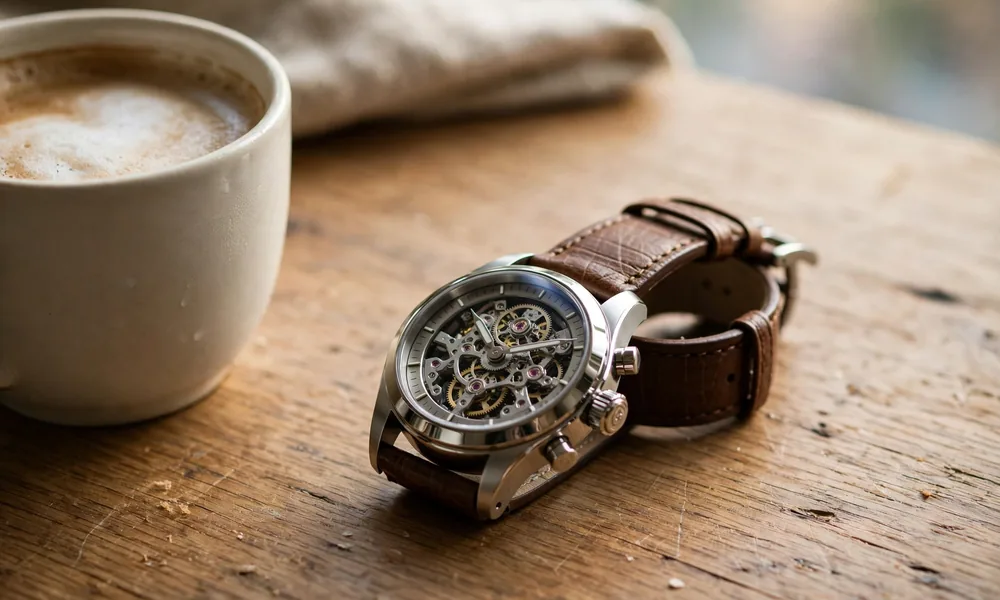
A mechanical watch does not need to exist. It is slower to make, harder to keep accurate and more expensive than any electronic alternative, and yet people wait years for one. The reason is simple enough to hold in your hand: it is a machine you can see working, built by people who cared about parts you will never look at. If you wonder why a luxury titanium watch is so expensive, the answer is the same one this watch gives every time you wind it: hundreds of parts, months of handwork, and a heartbeat you can hear if you hold it to your ear.


