A luxury titanium watch feels wrong the first time you pick it up. It looks like steel, it shines like steel, and it costs far more than steel, yet it weighs almost nothing in the hand. The case is cool to the touch, the bracelet barely registers on the wrist, and the whole watch seems too light for something built to last a lifetime.
That lightness is earned, not given. Titanium is stubborn stuff: hard to cut, hard to polish, and quick to catch fire if a machine runs too hot. Turning a block of it into a watch takes weeks of patient work, and this is how it is done.

How It’s Made
Step 1: The titanium is chosen and cut into blanks
Every titanium watch begins with a grade of the metal chosen for the job. Most luxury cases use grade 5 titanium, an alloy mixed with a little aluminium and vanadium, because pure titanium is too soft for a watch that will be knocked against door frames for decades. The alloy arrives as bars and plates, and the first job is to cut them into small discs and blocks called blanks, one for the case, one for the bezel, one for the case back, and smaller pieces for the crown and the bracelet links. Cutting titanium is slow work. The metal holds heat instead of letting the cutting tool carry it away, so the saw or mill runs slowly, bathed in coolant, and the blanks come off the machine warm rather than hot.
Step 2: The case is machined, drilled and threaded
The case blank goes into a computer-controlled mill, and this is where the watch starts to take shape. The mill carves the round case, the lugs that hold the strap, the recess for the crystal, and the seat where the movement will sit, all to tolerances finer than a human hair. Titanium fights the cutter at every pass, so the tools are changed often and the machine runs at speeds that would seem lazy on steel, yet the result is a case that is true to a few thousandths of a millimetre. Holes are drilled for the crown stem and the pushers, and threads are cut for the case back, which must screw down tight enough to keep water out for years. The case is measured again and again as it is cut, because titanium cannot be filled or patched; a mistake here means starting over with a fresh blank.

Step 3: The case is brushed, polished and finished
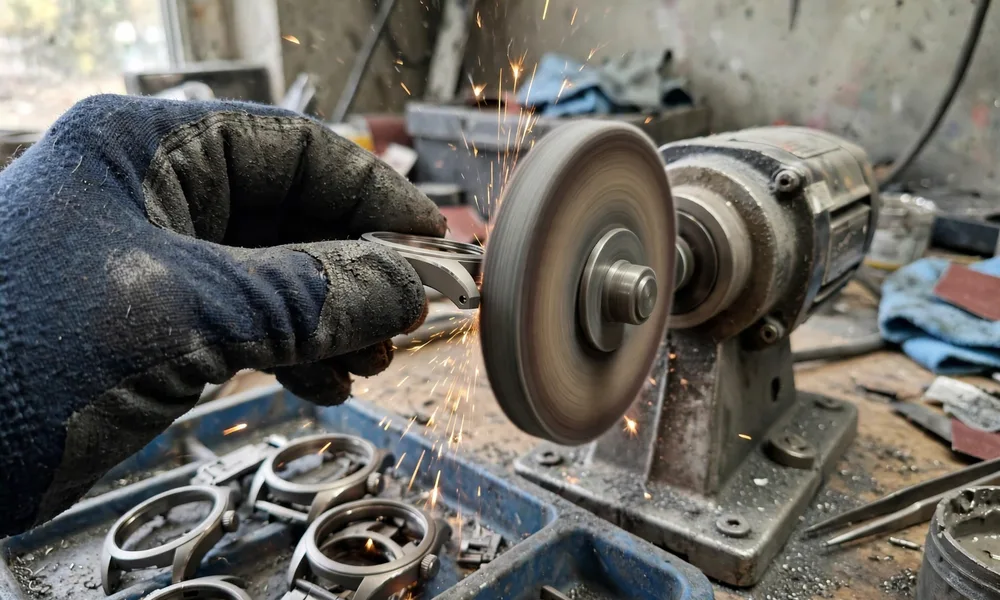
A raw machined case looks dull and grey, and the finish is what turns it into a luxury object. Most of the case is brushed, a process that drags fine abrasive pads across the surface in one direction until the metal takes on a soft, even grain that hides fingerprints and small scratches. The bevels and edges are polished to a mirror shine on a small wheel, a contrast that makes the case look sharper than it is. Polishing titanium is harder than polishing steel, because the metal smears rather than cutting cleanly, so the polisher works slowly, checking the surface under a bright lamp after every pass.
Step 4: The movement is assembled by hand
While the case is being finished, a watchmaker assembles the movement, the tiny engine that drives the hands. A luxury mechanical movement has more than two hundred parts, some of them smaller than a grain of sand, and each one is placed with tweezers under a magnifier. The plates and bridges are screwed down first, then the gear train, the balance wheel that beats several times a second, and the mainspring that stores the watch’s power. Every part is oiled by hand, a single tiny drop in each jewel bearing, because too much oil slows the movement and too little wears it out. The assembled movement is tested for days, running in different positions, and adjusted until it keeps time within a few seconds a day. A movement that passes is a small triumph; one that fails is taken apart and built again.
Step 5: The dial, hands and crystal are fitted
The dial is fitted to the movement first, a thin disc of metal that has been printed, lacquered or enamelled, and the hands are pressed onto their tiny posts with a special tool. The hands must clear the dial by a fraction of a millimetre and never touch each other, so the watchmaker checks the gap under a microscope and bends a hand by hand when it sits too low. The crystal, usually scratch-resistant sapphire, is pressed into the case with a gasket that seals it against water and dust. The movement is then lowered into the case, the crown stem is fitted through the side, and the case back is screwed down with a torque tool so the seal is even all round. The watch is wound, the hands are set, and it is left running on the bench while the watchmaker watches for any hesitation in the sweep of the second hand.
Step 6: The watch is tested, strapped and checked again
The finished watch faces a week of tests before it leaves the workshop. It is pressure-tested in water to prove the seals hold at the depth printed on the dial, then run for days on a timing machine that records how it keeps time face up, face down and on its side. The bracelet, its links individually machined and finished from the same titanium, is fitted and checked for smooth movement and a secure clasp. The watch is worn on a test rig that shakes it gently to prove the automatic winding works, and the power reserve is measured by leaving it unwound until it stops. Only when every test passes is the watch cleaned one last time, boxed, and given its papers. The lightness that surprised you at the start is still there; the difference is that now it has earned it.
Luxury Titanium Watch Specifications
The figures below describe a typical luxury titanium automatic watch. Larger and smaller models differ in size and weight, but the way they are built is the same.
| Specification | Typical value |
|---|---|
| Case material | Grade 5 titanium alloy |
| Case diameter | About 40 to 44 mm |
| Weight, head only | About 55 to 70 grams |
| Movement parts | About 200 to 300 parts |
| Power reserve | About 48 to 72 hours |
| Water resistance | About 100 to 300 metres |
What It Costs
A luxury titanium watch costs an estimated $5,000 to $25,000, depending on the movement, the finishing and the maker, with the most complicated pieces costing far more. Those are estimates, not quotes, and they reflect the slow machining, the hand assembly and the days of testing behind every watch. The movement inside is a machine in its own right, as how a luxury titanium watch works explains.
A Rare Fact
Here is a detail most people never guess. Titanium is so light and so resistant to corrosion that it was first used for jet engines and submarines before watchmakers trusted it, and a titanium case will not rust even after decades in salt water. The metal is also kind to skin, which is why it is used for medical implants, and that is why a titanium watch rarely causes the irritation a steel watch can. The full figures are laid out in the luxury titanium watch specifications, and the same metal keeps far bigger machines light, as the titanium propeller specifications show.