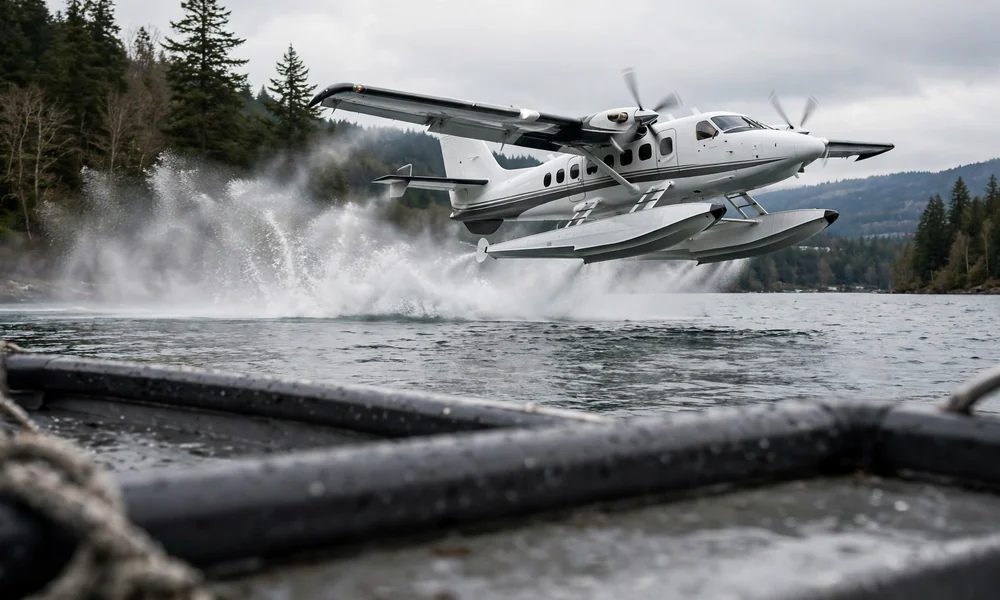
The lake is still in the early morning, mist hanging low over the water, when the sound begins: a low, steady drone, growing louder, and then a white aircraft appears at the far end of the lake, skimming the surface on two floats. Spray fans out behind it as it gathers speed, the floats lifting clear of the water one after the other, and then it is airborne, climbing away over the trees with the lake falling away below. There is no runway, no airport, no queue. The water was the runway.
A luxury seaplane is a small aircraft that can take off and land on water, built to a standard of comfort that would not be out of place in a private jet. It might carry an owner and a few guests from a lakeside house to a remote island, or from a city harbour to a coastal resort, landing where no road reaches and no airstrip exists. The cabin is quiet, the seats are leather, the windows are large, and the view is better than any airliner can offer, because a seaplane flies low and slow, over water, islands and coastline.

How a Luxury Seaplane Works, Step by Step
Step 1: The floats and the hull
Some seaplanes are flying boats, where the fuselage itself is shaped like a boat hull and sits directly in the water, with small floats under the wings for stability. Either way, the parts that touch the water are built from aluminium or composite materials, sealed against corrosion, and fitted with a water rudder, a small blade at the back of one float that steers the aircraft while it taxis on the water. The shaping of a light, strong structure is a familiar problem in aviation and yachting alike, and the guide to how a superyacht aluminium superstructure works covers the same aluminium thinking at sea.
Step 2: The engine and the propeller
A luxury seaplane usually has a single turboprop engine mounted in the nose, or sometimes two, driving a propeller with three or four blades. A turboprop is a small jet engine that turns a propeller instead of pushing the aircraft with exhaust, and it is a good choice for a seaplane because it is powerful, reliable and light for its power. The propeller is often reversible, which lets the pilot slow the aircraft down on the water and manoeuvre it into a dock.
Step 3: Taking off from water
Taking off from water is the part that looks like magic and feels like work. The pilot lines the aircraft up into the wind, opens the throttle, and the seaplane begins to move across the surface, first ploughing through the water, then rising onto the step of the floats, where it skims along on a small patch of hull. The drag falls sharply at this point, the speed builds quickly, and the pilot pulls back gently on the controls. The floats leave the water, and the aircraft climbs away.
Step 4: Flying, navigating and seeing
Seeing is part of the job, and part of the pleasure. The windows are large, the wings are high, mounted above the cabin so they do not block the view, and the flight is low and slow enough that passengers can watch the coastline, the islands and the boats below. The aircraft is fitted with the same kind of sensors that other modern machines use to see the world, and the guide to how a lidar sensor works explains one of the sensing technologies that modern aviation and marine craft share.

Step 5: The cabin and the comfort
The cabin of a luxury seaplane is small, usually seating four to eight people, but it is finished with care. The seats are leather, the walls are lined in soft materials, the floor is carpeted or wood, and there is heating and air conditioning, good lighting, and a sound system that can be heard over the engine. Noise is the hardest problem: a turboprop is loud, so the cabin is lined with sound insulation, and many owners provide noise-cancelling headsets for passengers.
Step 6: Landing on water
Landing on water is a gentle, deliberate process. The pilot flies a normal approach, low and slow, and touches down on the step of the floats, letting the aircraft settle onto the surface rather than dropping onto it. The floats cut through the water, the speed falls, and the aircraft becomes a boat again, taxiing on the water rudder towards the dock. A good water landing is so smooth that passengers sometimes do not realise they have touched down until the spray stops.
Step 7: Mooring, maintenance and care
Maintenance follows the same strict rules as any aircraft, with scheduled inspections, engine overhauls and replacement of parts at set hours. The water adds its own jobs: checking the seals on the floats, looking for corrosion on the struts, and keeping the water rudder working. A seaplane that is looked after lasts for decades, and some of the most loved luxury seaplanes flying today are older than their owners. The stabilising technology that keeps small aircraft steady shares ideas with marine craft, as shown in a guide to how a drone gimbal works.
Specifications at a Glance
| Feature | Typical Luxury Seaplane |
|---|---|
| Passengers | 4 to 8, plus pilot |
| Engine | Single turboprop, 600 to 900 horsepower |
| Cruising speed | 150 to 200 knots |
| Range | 800 to 1,500 kilometres |
| Take-off run | 500 to 1,000 metres of clear water |
| Maximum weight | 3,000 to 5,000 kilograms |
| Floats | Two, watertight compartments, with water rudder |
| Cabin | Leather seats, heating, air conditioning |
What a Luxury Seaplane Costs
A luxury seaplane is a niche aircraft, and its price reflects that. As an estimate, a new single-engine turboprop seaplane with a luxury interior might cost roughly $3 million to $5 million. A larger twin-engine seaplane, or a flying boat with a bigger cabin and longer range, could cost an estimated $6 million to $10 million, and a fully custom interior can push the price higher still.
Those are estimates, and the running costs are significant too. Fuel, insurance, hangarage, maintenance and the pilot’s wages can add up to hundreds of thousands of dollars a year, and the aircraft needs a qualified seaplane pilot, who is rarer and more expensive than an ordinary pilot. For owners who live on a lake or an island, though, the value is in the freedom: the water outside the house is the airport, and the journey starts the moment the door closes.
A Rare Fact
The first regular airline service in the world was flown by a seaplane. In 1914, a small flying boat carried passengers across Tampa Bay in Florida, a flight of just twenty-three minutes that replaced a long journey by road and rail. The aircraft carried one passenger at a time, and the fare was five dollars. More than a century later, luxury seaplanes are still doing the same job: turning a stretch of water into a shortcut.
A luxury seaplane is two machines in one, a boat and an aircraft, and it is happiest where the two meet: on a stretch of open water, with the engine running, the floats on the step, and the sky opening up ahead.