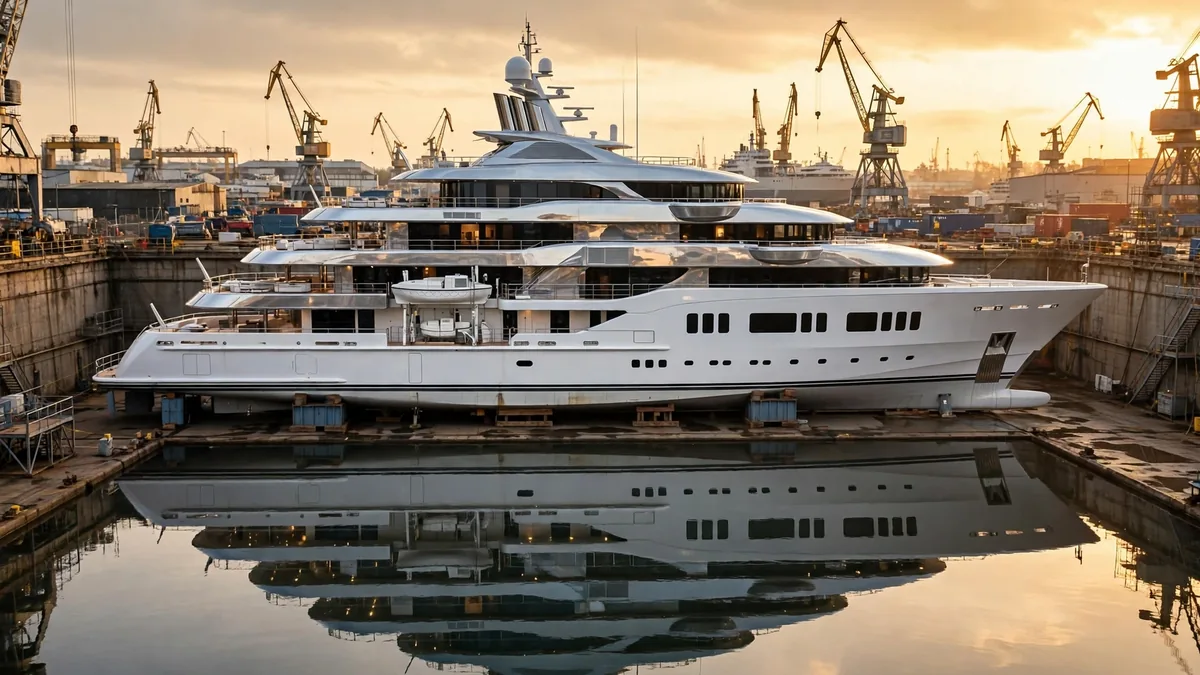
From the waterline up, a superyacht is a contradiction. It has to look like a floating hotel — all glass, pale paint, and sweeping curves — yet it must survive storms, carry tonnes of equipment, and stay perfectly balanced on a hull that is already working hard. The answer to that contradiction sits above the main deck, in a structure most people never think about at all: the superstructure, the yacht’s entire top half, built not from steel but from aluminium.
Step aboard a large yacht and almost everything you touch above the hull is part of it: the bridge where the captain steers, the saloon with its floor-to-ceiling windows, the owner’s suite, the guest cabins, the sun deck, the mast supports, and the stairwells that tie them together. It is a building several storeys high, perched on a ship, and it must be light, stiff, quiet, and beautiful all at once. Aluminium makes that possible. It weighs roughly a third as much as steel, does not rust the way steel does, and can be shaped into the smooth, flowing forms that define a modern yacht.
How It Works
Step 1: Designing for weight and balance
Everything starts on a computer, long before any metal is cut. Naval architects model the superstructure as a three-dimensional puzzle: it must withstand waves and wind pressing against its broad sides, yet stay light enough that the yacht does not become top-heavy. Weight placed high up raises the centre of gravity, which makes a yacht roll more in a swell, so every kilogram saved in the superstructure improves stability. The designers also plan where heavy items go, so the finished yacht sits level in the water. The hull below is the foundation, and superyacht hull construction sets the rules the superstructure must follow.
Step 2: Cutting and forming the panels
The superstructure is built from marine-grade aluminium alloy, most often the 5083 grade, chosen for its strength and its resistance to seawater. Huge flat plates arrive at the yard and are cut by computer-controlled plasma or water-jet machines into precisely shaped panels. Curved sections — the rounded front of the bridge, the sweeping overhang of a deck — are formed by rolling the plates through giant bending machines or pressing them over shaped moulds. Aluminium is softer than steel, so it is easier to shape, but it springs back after bending, so each piece must be over-bent slightly and checked against a template — a panel a few millimetres out would show as a ripple in the finished paint.
Step 3: Welding the structure together
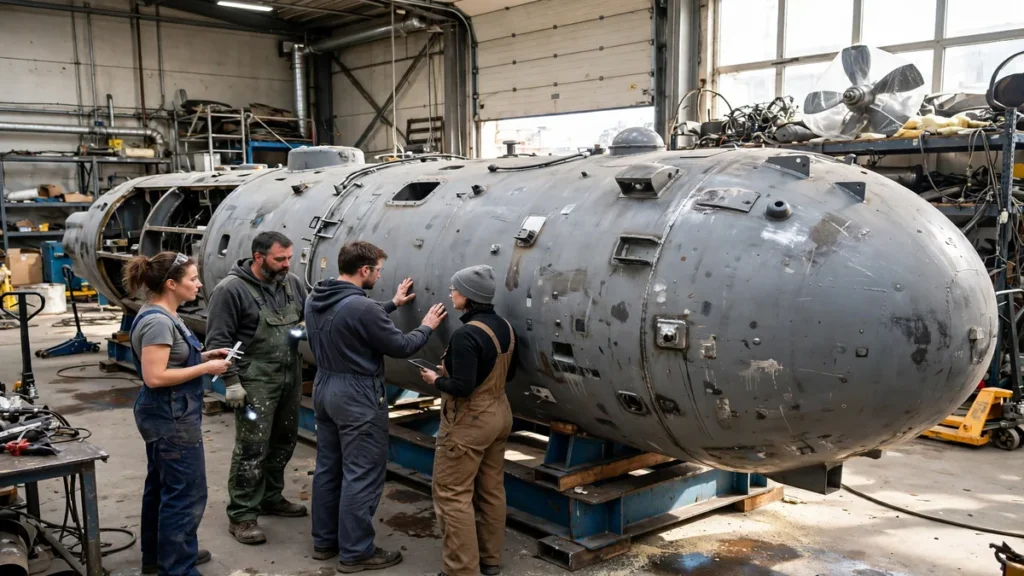
Aluminium welding is a specialist craft. Unlike steel, aluminium conducts heat away quickly, so welders use MIG welding with a shielding gas, working fast and hot to fuse the joint before the heat escapes. The panels are first tacked into large blocks — a bridge deck, a saloon section, a stair tower — built upside down or on their side so welders can reach every seam. Every weld is inspected, and critical joints are tested with ultrasound or dye penetrant to find hidden flaws. The work is slow and skilled: a single superstructure can contain kilometres of weld, and a bad weld in aluminium is harder to repair than one in steel. Inside the yard, the sight of sparks flying from a curved silver shell is the superstructure taking shape.

Step 4: Joining it to the steel hull
Here lies the trickiest problem in the whole build. The hull is usually steel, the superstructure is aluminium, and the two metals cannot simply be welded together — they expand at different rates when they warm up, and in seawater they can corrode each other where they touch. The solution is a special transition joint, a strip of metal that is aluminium on one side and steel on the other, bonded together in an explosion-welding process at the factory. The steel side is welded to the hull, the aluminium side is welded to the superstructure, and the joint flexes just enough to absorb the different rates of expansion. It is what allows a yacht to have a steel hull and an aluminium top without tearing itself apart over years at sea.
Step 5: Fitting out the inside
Once the shell is complete, the superstructure is lifted by crane — sometimes in one piece, sometimes in blocks — and lowered onto the hull. Then the real transformation begins. Insulation is fitted to the inner faces of the aluminium to deaden sound and keep the heat out, followed by wiring, plumbing, and air-conditioning ducts threaded through the structure. Cabins are built as self-contained modules, slid into place and connected up. The bridge is fitted with its consoles and navigation screens, and the vast windows are bonded into place with structural adhesive, sealed so precisely that not a drop of spray can enter at speed.
Step 6: Finishing, fairing, and sea trials
The outside of the superstructure is faired — coated with filler, sanded by hand, and sanded again — until its surface is perfectly smooth, then painted in layer after layer of primer and topcoat, often in a gleaming white or pale grey. This is the longest stage: a flawless paint finish on aluminium can take months. Finally the yacht goes to sea for trials, where engineers check for vibration, noise, and flex in the superstructure at full speed. A well-built aluminium superstructure should feel solid and silent, even in rough water, and the weight saved up top helps its comfort, as do systems like yacht gyroscopic stabilizers, which tame the motion the light structure allows.

Specs
| Specification | Typical figure |
|---|---|
| Material | Marine-grade aluminium alloy, usually 5083 |
| Density | Around 2,660 kg per cubic metre, about a third of steel |
| Plate thickness | Typically 5–12 mm for shell plating |
| Decks above the hull | Usually 2–4, plus a sun deck |
| Joining to steel hull | Explosion-bonded aluminium-steel transition joint |
| Welding method | MIG welding with shielding gas |
| Finish | Faired, primed, and painted in multiple coats |
| Weight saving vs steel | Roughly 50–60% lighter for the same structure |
Price
An aluminium superstructure is not bought off the shelf — it is a large share of a custom yacht’s build cost. As an estimate, the superstructure and its fitting-out typically account for roughly a third of a new superyacht’s price, so on a 50-metre yacht costing around $50 million, the superstructure alone represents on the order of $15 million of work — these are estimates, and the real figure depends on size, complexity, and the standard of interior finish. Aluminium costs more per tonne than steel, but the weight it saves means a smaller engine, less fuel, and a more stable yacht. Large yachts are also increasingly built in sections, and modular ship construction is changing how those sections come together.
A Rare Fact
Aluminium has a strange property that makes it ideal for a yacht’s top half: it has no fatigue limit in the way steel does, yet it is also remarkably good at absorbing a blow without shattering. During the Second World War, shipbuilders found aluminium superstructures could survive fires and impacts that would have buckled steel. On a modern superyacht, that toughness hides under paint so smooth it looks like porcelain — a structure light enough to lift with a crane and strong enough to carry a helicopter deck, all from a metal once more precious than gold.