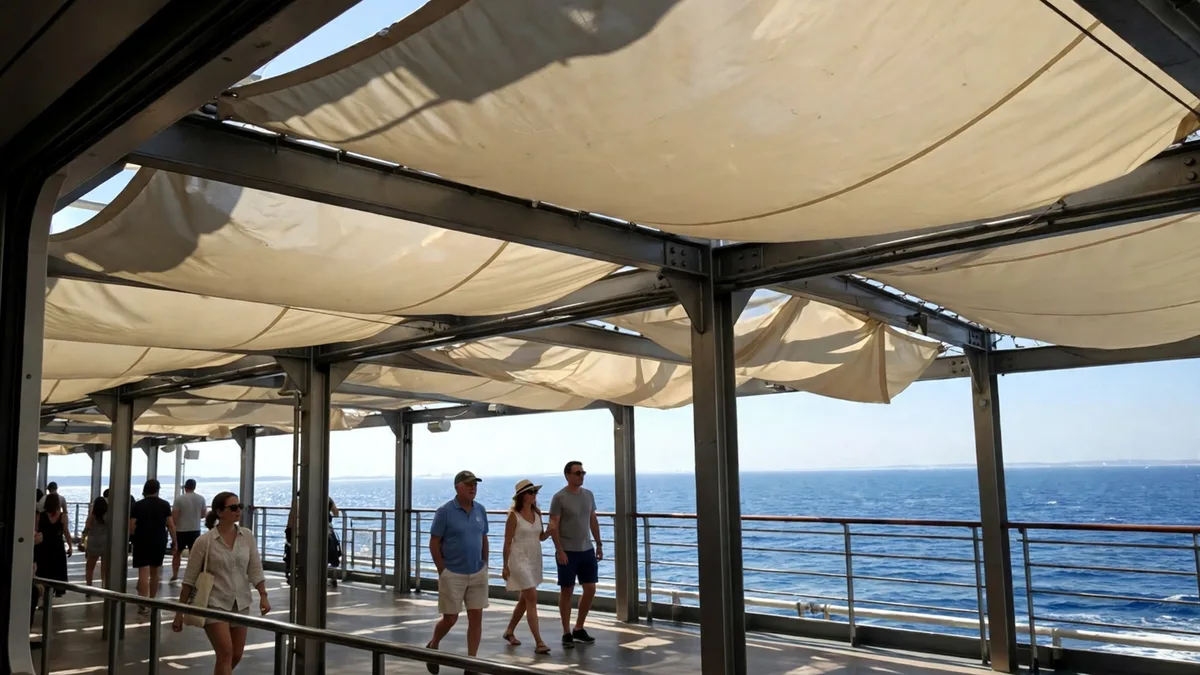
At noon on the open promenade of a cruise ship, the sun beats down on a deck the length of a city block, and the only cool place to walk is under a great cream awning stretched overhead. The awning looks like a simple sheet of cloth, but it is a piece of marine engineering, fixed to the ship with steel and built to stand up to wind, rain, and salt for years.
A luxury ship awning is a fixed fabric sun cover fitted over the open deck of a large ship, usually the promenade or the pool deck, made from heavy marine canvas stretched over a permanent steel frame and bolted to the deck and the superstructure. It is made by choosing a cloth that blocks the sun and sheds rain, cutting it to the shape of the deck, and fixing it to a frame that is engineered for the wind the ship meets at sea. It is not a sunshade, which is a light canopy rigged on poles at anchor and taken down when the boat moves, and it is not a folding canopy, which opens and closes on arms. An awning stays up, in all weathers, for the whole season.
How It’s Made
Step 1: Choosing the cloth that survives the sea
The awning starts as a roll of heavy marine canvas, usually solution-dyed acrylic or a coated polyester fabric, chosen because it blocks the sun without trapping the heat and because salt water does not rot it. The colour is dyed into the fibre itself, so it does not fade after a season in the tropics. The yacht sunshade uses a lighter version of the same cloth, but a ship awning is heavier, because it never comes down to dry out.
Step 2: Measuring the deck and engineering the frame
No two ship decks are the same, so an awning is never bought off the shelf. The makers survey the promenade from rail to rail, marking where the posts will stand, where the frame will bolt to the superstructure, and how the cloth will drain when it rains. The frame is then engineered for wind: a flat sheet of cloth over a long deck catches the wind like a sail, so the steel is sized to hold it in a gale, and the fixings are designed to spread the load into the deck rather than pull out of it. The ship sundeck below it is measured at the same time, so the awning covers the loungers without blocking the walkway to the stern.
Step 3: Welding the steel frame
The frame is made from galvanised or stainless steel tube, cut and welded in the yard into sections that can be lifted aboard and bolted together on deck. Each section is a beam with posts and cross-members, and the joints are plated and bolted rather than welded in place, so a damaged section can be swapped without cutting the whole frame apart. The steel is painted to match the ship, and every bolt is checked against corrosion. The frame is the part nobody looks at, and it carries the whole awning.

Step 4: Cutting and sewing the canvas panels
While the frame is welded, the canvas is cut in the sail loft. The pattern is drawn from the deck survey, and each panel is cut with a hot knife that seals the edge as it cuts, so the weave cannot fray in the wind. The panels are sewn together on a heavy machine with double-stitched seams and UV-resistant thread, and every fixing point gets a patch of extra cloth and a stainless ring, because the points where the cloth meets the frame take all the strain. The seams are then taped and sealed, so rain runs off the surface instead of finding its way through the stitching.
Step 5: Fitting the cloth and tensioning it drum-tight
Fitting is a deck job that takes a team of riggers. The frame sections are bolted up first, then the canvas is hauled up in panels and laced to the frame with rope or stainless fasteners, one panel at a time, until the whole deck is covered. The cloth is tensioned until it is drum-tight, with a slight slope built in so rainwater sheets off to the scuppers instead of pooling in the middle. The ship outdoor shower on the same deck is plumbed to drain the same way, and the tension is what keeps the awning quiet: a loose awning flaps in the breeze and wears itself out in a season.
Step 6: Testing in wind and rain, and the first long voyage
Before the ship sails, the awning is tested in the weather it will face. The crew hose it down to check the drainage, pull at the fixings to check the tension, and inspect every seam after the first rough day at sea. On the first long voyage the passengers forget it is there, which is the point: the deck is cool, the sun is held back, and the sea is all around.
A ship awning earns its place by turning the hottest, most exposed deck on the ship into the most comfortable one. It is cloth, thread, and steel, cut to fit one deck, and it does its job without moving parts, without power, and without anyone having to think about it. It is the simplest luxury on the ship, and on a still afternoon at sea it is the roof over the whole promenade.
Ship Awning Specifications
| Feature | Typical Detail |
|---|---|
| Canvas | Solution-dyed acrylic or coated polyester, cream, UV-stable and water-shedding |
| Frame | Galvanised or stainless steel tube, bolted sections, powder-coated |
| Span | Covers the full promenade or pool deck, posts set to the deck plan |
| Seams | Double-stitched with UV-resistant thread, taped and sealed |
| Fixings | Stainless rings and fasteners, bolted to deck and superstructure |
| Drainage | Slight slope built in, rainwater sheets off to the scuppers |
| Lifespan | Several seasons with a fresh-water wash and fastener checks |
How Much Does a Ship Awning Cost?
Prices are estimates and vary with deck size, cloth and maker. A luxury ship awning typically costs an estimated $40,000 to $180,000, including the canvas, the steel frame, the fixings, and the fitting, with a long promenade awning at the top and a single pool-deck cover lower. A spare set of canvas panels can add an estimated $8,000 to $30,000. It sounds like a lot for a piece of cloth, but a cheap awning fades, sags, and tears in its first season at sea.
A Rare Fact About Ship Awnings
Here is a detail most passengers never notice: a ship awning is built to the same fire standards as the lifeboat canopies. The cloth is treated so it will not catch and spread flame, because a fire on an open deck with hundreds of passengers underneath is the nightmare every ship designer plans against. The crew test the treatment when the awning is fitted, and the certificate travels with the ship. It is the only sunshade on the boat that has to pass a fire test before it can keep anyone cool.
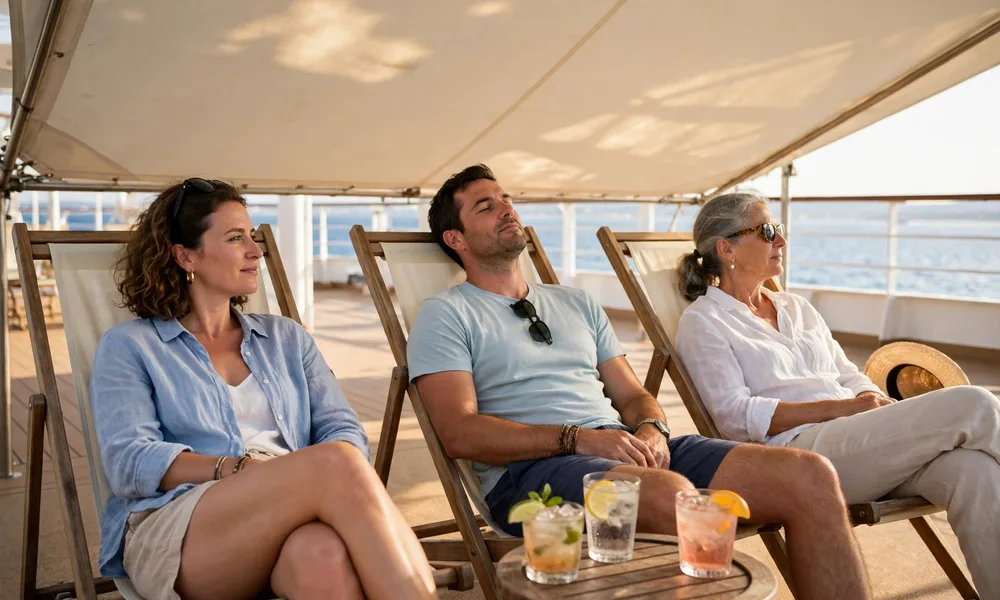
The best ship awnings are the ones nobody notices, because the shade is cool, the cloth is quiet, and the breeze still finds its way through. Lunch is in the shade, the sea is all around, and the sun is somebody else’s problem.


