One moment the cockpit of a yacht is open to the sky, and the next a canopy slides forward on its tracks and the whole seating area is in shade. It is the quietest piece of theatre on the boat, and it is the reason a yacht can be an open boat in the morning and a shaded saloon by lunch.
A luxury yacht canopy is a retractable fabric cover over the cockpit or the aft deck of a yacht, made from UV-stable canvas on folding stainless steel arms that slide along tracks, so it can be opened for shade and folded away in under a minute. It is made by choosing a cloth that blocks the sun, building the folding arms and tracks to fit one cockpit exactly, and sewing the canvas so it folds neatly instead of bunching. It is not a sunshade, which is a flat canopy rigged on poles at anchor and struck before the boat moves, and it is not a ship awning, which is a fixed cover bolted to a steel frame for the whole season. A canopy is the fitting that opens and closes.

How It’s Made
Step 1: Choosing the canvas that folds without creasing
The canopy starts as a roll of solution-dyed acrylic canvas, chosen because it blocks the sun, sheds rain, and folds hundreds of times without cracking along the creases. The colour is dyed into the fibre itself rather than printed on the surface, so it does not fade after a season in the tropics, and the weave is open enough to let the breeze through while stopping most of the ultraviolet light. A stiff cloth would fight the folding arms and wear out at the folds, so the makers test the drape before they cut: the cloth must fall soft and fold flat.
Step 2: Measuring the cockpit and planning the fold
No two yacht cockpits are the same, so a canopy is never bought off the shelf. The maker climbs aboard with a tape and a patterning cloth, measuring the seating area from rail to rail and marking where the tracks will run and where the folded canvas will stow. The fold is planned on paper first, so the arms swing clear of the helm seats and the canvas stacks neatly when folded back. The yacht sunbed below it is measured at the same time, so the shade covers the loungers without blocking the walkway to the stern.
Step 3: Building the folding arms and tracks
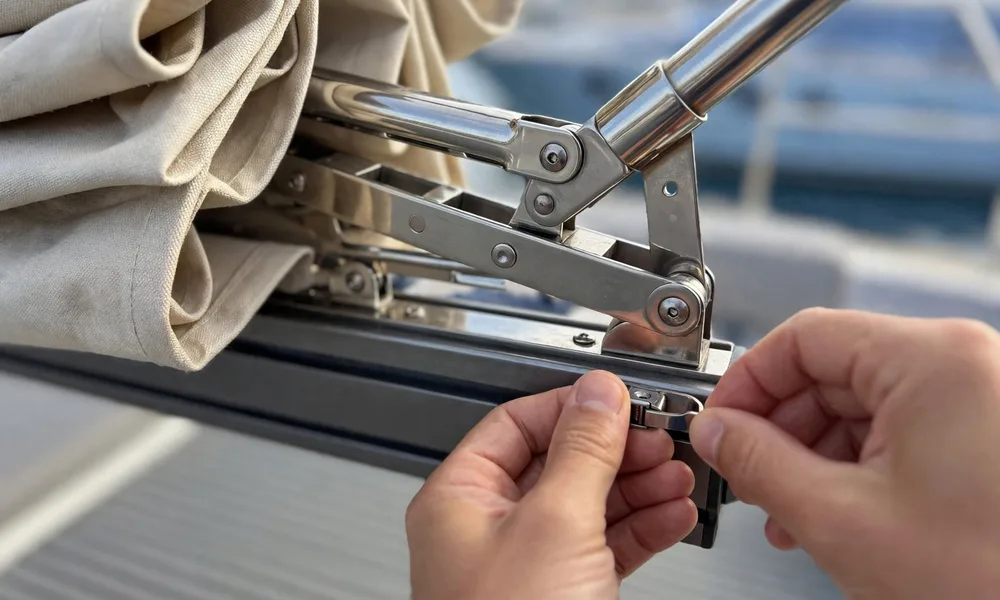
The arms are the heart of the canopy. They are made from 316 marine-grade stainless steel tube, cut, bent, and welded into scissor arms that fold flat and open to a fixed arc, with a gas strut in each arm that takes the weight of the canvas so one person can open it by hand. The tracks are extruded stainless rails bolted to the deck or the arch, with sliders that carry the arms and lock at set points along the run. Every pivot gets a sealed bearing, because a hinge full of salt will seize on the first hot afternoon it is needed.
Step 4: Cutting and sewing the canvas to fold
While the arms are built, the canvas is cut in the sail loft. The pattern is drawn from the cockpit survey, and each panel is cut with a hot knife that seals the edge as it cuts, so the weave cannot fray. The panels are sewn together on a heavy machine with double-stitched seams and UV-resistant thread, and the folds are planned into the sewing: extra cloth is left where the canopy creases, and clear windows or mesh panels are set in where the crew need to see through. The edges are finished with a bolt rope that slides into a track on the arms and spreads the load evenly.
Step 5: Fitting the canopy and setting the tension
Fitting is a two-person job that takes an afternoon. The tracks are bolted down, the arms are pinned to their sliders, and the canvas is laced to the arms and pulled forward along the tracks until it locks open. The tension is set by adjusting the gas struts and the locking latches, so the cloth is taut enough to stay quiet in a breeze but loose enough to fold without a fight. The best yacht sun decks are built with the tracks in mind, and the fold is checked before the owner sees it.
Step 6: The first fold at speed, and the first hot afternoon
Before the yacht sails, the canopy is tested the way it will be used. The crew open it, close it, and open it again, timing the fold and checking that the canvas stacks neatly and the arms lock in both positions. The yacht sunshade on a sister boat is rigged only at anchor, but the canopy earns its keep by working while the yacht moves, and by the next hot afternoon the guests are sitting in its shade with lunch on the table.
A yacht canopy earns its place by giving the cockpit two lives: open to the sky when the weather is kind, and shaded in a minute when the sun turns. It is cloth, thread, and steel, cut to fit one cockpit, and it turns a baking seating area into a cool room with no walls and the sea all around. It is the fitting that makes the cockpit the place everyone gathers.
Yacht Canopy Specifications
| Feature | Typical Detail |
|---|---|
| Canvas | Solution-dyed acrylic, pale, UV-stable, folds without creasing |
| Arms | 316 marine-grade stainless scissor arms with gas struts |
| Tracks | Stainless rails with locking sliders, bolted to deck or arch |
| Seams | Double-stitched with UV-resistant thread, bolt rope edges |
| Operation | Opened and folded by hand in under a minute, locks open and closed |
| Pivots | Sealed bearings at every hinge, built to resist salt |
| Stowage | Canvas stacks neatly against the arch when folded back |
How Much Does a Yacht Canopy Cost?
Prices are estimates and vary with cockpit size, cloth and maker. A luxury yacht canopy typically costs an estimated $12,000 to $45,000, including the canvas, the folding arms, the tracks, and the fitting, with a wide cockpit canopy at the top and a small aft-deck cover lower. A spare canvas and a replacement set of gas struts can add an estimated $2,500 to $8,000. It sounds like a lot for a piece of cloth, but a cheap canopy sticks, sags, and tears in its first season.
A Rare Fact About Yacht Canopies
Here is a detail most guests never notice: a yacht canopy is designed to fold in under sixty seconds, because the crew have to get it down before the weather changes. A canopy left half-open in a rising wind catches the air like a sail, and in a gust it can pull an arm out of its track or heel the yacht at anchor. The gas struts are sized so one crew member can fold the whole canopy alone, even in a breeze, and the latch is made to be found by feel in the dark. It is the only fitting on the boat that is built to be put away in a hurry.

The best yacht canopies are the ones nobody notices, because the shade is cool, the cloth is quiet, and the fold is smooth. Lunch is in the shade, the sea is all around, and the sun is somebody else’s problem.


