A luxury ship would be helpless without its crane. Tenders, jet skis, diving gear and spare parts all have to get on and off the vessel, and most of them are far too heavy to carry by hand, so a single steel arm on the deck does the work of a whole crew, lifting tonnes of equipment over the side and setting it gently down on the water.
On a superyacht it is a piece of engineering jewellery, finished to match the deck and sized to lift a tender that costs more than a house. Building one is a study in strength, balance and patience. This is how a luxury ship crane is made.
How It’s Made
Step 1: The crane is engineered for one ship, not any ship
No two ship cranes are the same, because no two ships are the same. Engineers start by asking what the crane must lift, how far it must reach, and where it will sit on the deck, and those three answers fix almost everything about it. A crane that lifts a twelve-metre tender over the side of a yacht needs a long boom and a wide swing, while a crane on a cruise ship that handles stores and lifeboats needs raw lifting power more than reach. Only when the maths is settled does the steel get ordered.
Step 2: The boom and pedestal are cut and welded
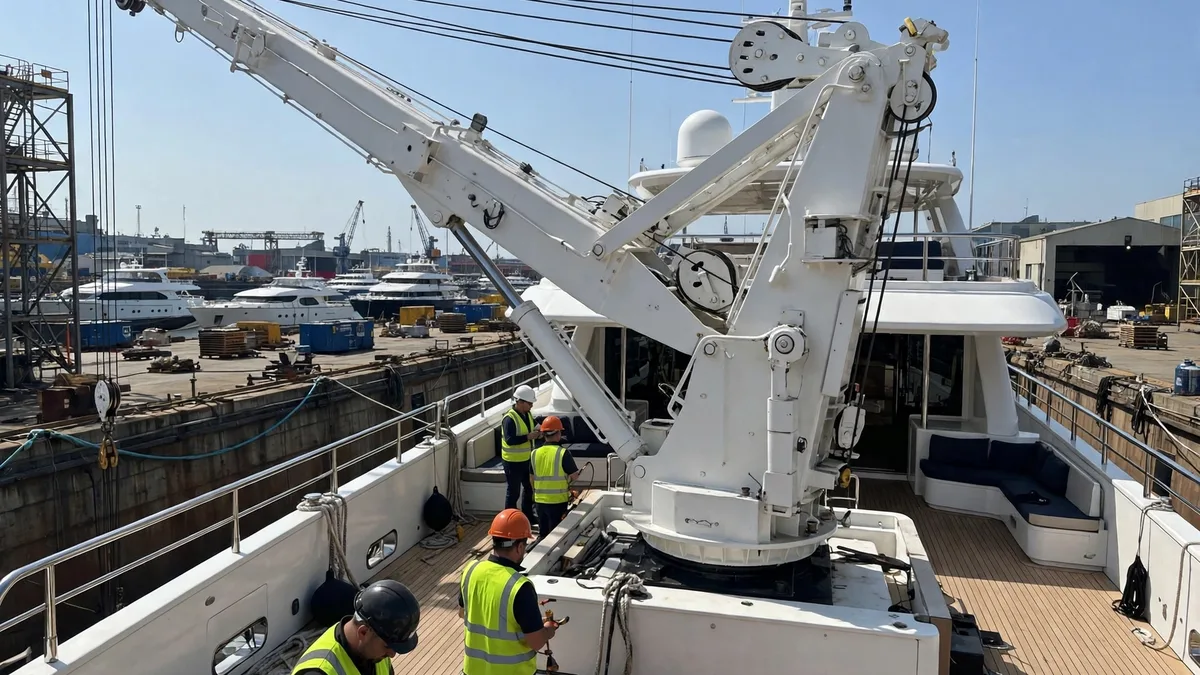
The crane’s skeleton is built from high-strength steel, cut by computer-guided torches and welded into a hollow boom and a round pedestal base. The boom is the long arm that does the lifting, and it is built in sections so it can fold or telescope away when the ship is under way, while the pedestal is a thick steel column that bolts to the deck and carries the whole turning mechanism.
Step 3: Hydraulics and the slewing ring are fitted
With the steelwork finished, the crane’s muscles go in. Hydraulic cylinders, thick as a man’s thigh, are mounted along the boom to raise and lower it, and a winch with a steel wire rope is fitted to do the actual lifting. Underneath the pedestal sits the slewing ring, a huge circular bearing that lets the whole crane turn a full circle, and it is packed with grease and sealed against salt spray.

Step 4: The control cabin and safety systems are installed
The operator’s station comes next, and on a luxury vessel it is usually a small open console rather than a closed cab, so the operator can see the load, the deck and the water at the same time. Joysticks control the boom, the swing and the winch, and a screen shows the weight of the load and the angle of the boom, warning the operator long before the crane approaches its limit. The safety systems are fitted at the same time: overload cut-offs that stop the winch before the wire is strained, limit switches that stop the boom at the end of its travel, and an emergency stop that freezes everything in a fraction of a second. Each one is tested by deliberately trying to overload the crane, with the cut-off proving itself by refusing to lift.
Step 5: The crane is painted and finished for the sea
A ship crane lives in salt air, so its finish is armour as much as decoration. The steel is blasted clean, coated with a zinc-rich primer, then painted in several layers of marine paint, usually white or the ship’s own colour, and the joints are sealed so that no water can creep inside. On a superyacht the finish is taken further: the boom is polished, the pedestal is clad in teak or stainless steel, and the whole crane is made to look like part of the yacht rather than a piece of industrial equipment.
Step 6: The crane is load-tested on the finished ship
The last stage happens with the crane already bolted to the deck of the finished ship. Test weights, usually solid steel blocks, are lifted, swung and lowered again and again, at full reach and at full load, while engineers measure how much the boom bends and how smoothly the hydraulics hold the weight. A ship crane is never trusted on the strength of its drawings alone; it earns its certificate by lifting the heaviest load it will ever carry, in front of the people who built it.
| Spec | Detail |
|---|---|
| Lifting capacity | Usually 2 to 10 tonnes, depending on the ship and the load |
| Boom | High-strength steel, folding or telescoping, in sections |
| Power | Hydraulic cylinders for the boom, winch and wire rope for lifting |
| Swing | Full 360 degrees on a sealed slewing ring bearing |
| Safety | Overload cut-offs, travel limits and an emergency stop |
| Testing | Load-tested with steel weights at full reach before delivery |
The most expensive part of a ship crane is not the steel, but the proof. Every weld is inspected, every safety system is deliberately tripped, and the finished crane is made to lift its heaviest load in front of witnesses, because the day it fails, if it ever fails, will be the day a tender full of guests is hanging over the water. That is why the testing takes days and the paperwork is thick, and why a good crane feels so solid when it swings a load over the side. A crane that passes its tests is a crane the crew can trust with the most precious cargo of all, the tender full of guests.
What One Costs
A luxury ship crane typically costs an estimated $150,000 to $1.5 million, and the price is set mostly by lifting capacity, boom length and the finish rather than the size of the ship. A compact yacht crane that lifts a tender and a jet ski sits at the bottom of the range, while a large cruise ship crane with a long reach and full safety systems costs far more. The price is in the engineering, not the paint, and how a luxury ship anchor is made shows what goes into another piece of heavy deck equipment, while how a luxury yacht dinghy is made explains the boat the crane spends most of its life lifting.
A Rare Fact
Some superyacht cranes are built to disappear completely. When the crane is not in use, its boom folds flat into a hatch in the deck, the pedestal sinks down on a hydraulic lift, and a teak cover slides over the top, leaving nothing but a smooth stretch of deck where a crane used to be. Guests can walk across the spot without ever knowing a machine is hiding under their feet, and the crew can bring it back into service in minutes, which is exactly the point: on a yacht, a crane is allowed to be powerful, but it is not allowed to be ugly.
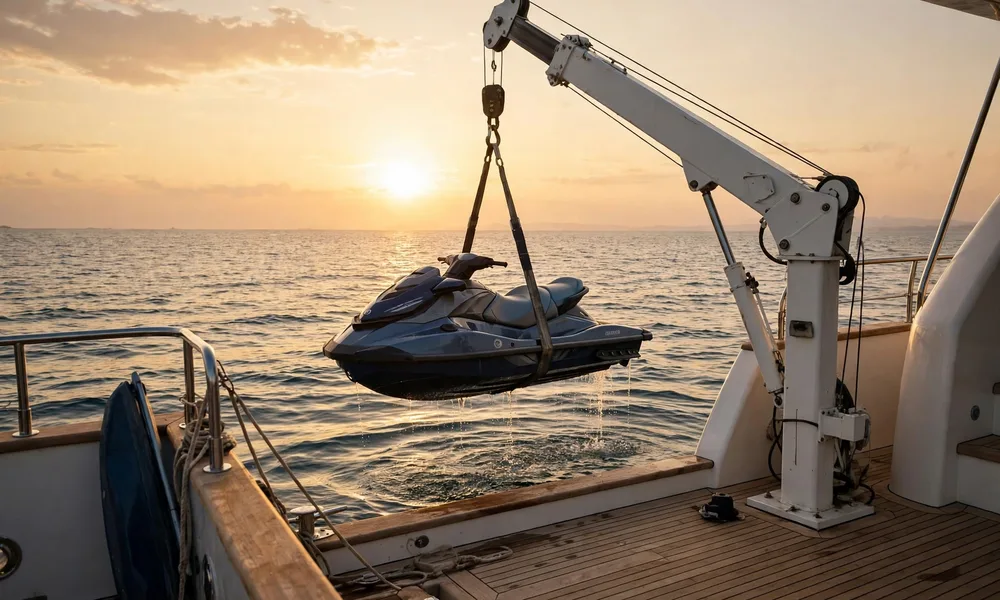
A luxury ship crane is a steel arm, a set of hydraulics and a long list of safety tests, built to lift a boat over the side of a ship and set it on the water without a splash. It is the machine that turns a ship into a base for everything its guests want to do at sea. For the scale of the loads it handles, the specifications of a luxury cargo ship show what the biggest ships on the water are built to carry.


