On a calm morning in a Mediterranean marina, a white yacht the length of a tennis court sits at anchor, and the only thing moving is a small boat buzzing between it and the shore. It carries groceries, a dog, two guests and a crate of champagne, and it does the trip four times before lunch. That little boat is the yacht’s dinghy, and without it the big yacht would be stranded, unable to reach land, unable to ferry anyone anywhere, unable to do the ordinary jobs that make a holiday work.
A dinghy looks like a toy next to its mother ship, but it is a serious piece of engineering in its own right. It has to be light enough to lift, tough enough to be dragged up a beach, stable enough for guests in evening clothes, and fast enough to outrun a squall. Building one means joining a rigid hull to inflatable tubes, fitting an engine, and testing it until it can take a beating. This is how it is done.

How It Is Made
Step 1: The hull is laid up in fibreglass
Everything starts with the hull, the rigid bottom that gives the dinghy its shape and its speed. Builders lay sheets of fibreglass cloth into a polished mould, brushing each layer with resin until the laminate is thick enough to take a knock from a rock or a dock. The mould is shaped with a deep V at the bow to cut through chop and a flatter run aft so the boat planes easily, and the hull is left to cure until it is hard enough to lift out without bending.
Step 2: The tubes are cut and glued
The fat grey tubes around the edge are what make a dinghy a dinghy. They are cut from panels of a tough coated fabric, usually a synthetic rubber or a PVC-based cloth, and each panel is shaped to the curve of the hull before the seams are glued, welded and taped. The tubes are divided into separate air chambers, so a single puncture never sinks the boat, and each chamber gets its own valve. Fitters test every seam by inflating the tubes and brushing them with soapy water, watching for the tiny bubbles that betray a leak, and a seam that fails is cut out and redone.
Step 3: Hull and tubes are joined
Once the hull and the tubes are both ready, they are married together, and this is the step that decides whether the dinghy will last ten years or two. The tubes are bonded to a flange on the hull with a strong adhesive, then clamped and bolted through a rubbing strake that protects the joint from docks and beaches. Workers check the join all the way around, because a gap anywhere would let water into the hull and peel the tubes away under load.
Step 4: The deck, seats and fittings go in
With the shell complete, the inside is fitted out. A flat deck goes in, often with a non-slip surface, and moulded seats, lockers and a steering console are bolted through the hull. Cleats, handles and lifting eyes are fitted for the davit, the crane that hoists the dinghy aboard the yacht, and a fuel tank is plumbed in for the engine. Everything is sealed against salt water, because a dinghy lives wet, and a fitting that rusts or leaks in its first season is a fitting that was never properly installed.
Step 5: The outboard motor is fitted and rigged
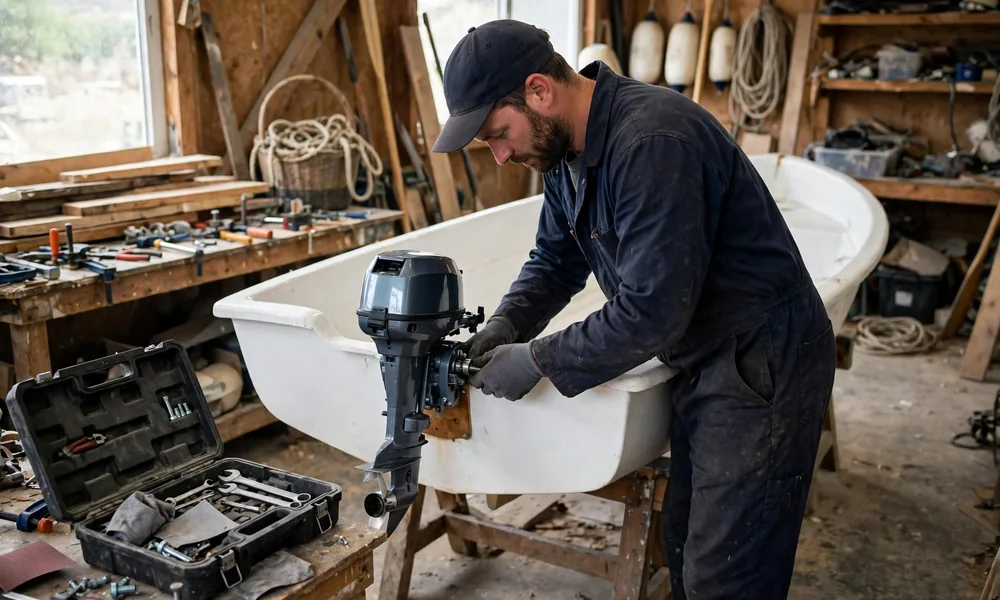
The engine is almost always a small outboard, hung on the transom at the stern, and fitting it is more than bolting it on. The motor’s height is set so the propeller sits just below the hull, the steering cables and throttle are run through the console, and the fuel line is connected and checked for leaks. Builders choose the power carefully, because too little leaves the boat sluggish with a full load, while too much makes it skittish and hard to handle.
Step 6: It is tested on the water
Before it leaves the yard, the dinghy is launched and run hard. Testers load it with sandbags to mimic a full crew, drive it through turns at speed, stop it dead, and check that it stays stable and dry. They test the tubes for pressure loss, the hull for leaks, and the engine for easy starting after a night in the damp. Only when it planes cleanly, turns without cavitating and comes back dry does the dinghy get its final polish, its name, and its place on the yacht’s davit, ready for its first real trip to shore.
| Specification | Typical figure |
|---|---|
| Type | Rigid inflatable boat, with a fibreglass hull and fabric tubes |
| Length | Around 3 to 5 metres, sized to fit the yacht’s davit or garage |
| Weight | An estimated 150 to 400 kg without the engine, depending on size |
| Tube chambers | Usually three to five separate air chambers for safety |
| Engine | Outboard motor, typically 15 to 60 horsepower on a yacht dinghy |
| Capacity | Four to eight people, or around 500 to 900 kg of load |
The clever part of a dinghy is how the tubes do three jobs at once. They add buoyancy, so the boat floats higher and carries more than a hard boat of the same size, and they act as fenders, cushioning every bump against a dock or the side of the yacht. They also make the boat almost impossible to capsize, because the wide ring of air resists rolling in a way a narrow hull never could. That is why yacht crews trust a dinghy with guests who have never been in a small boat before, and why a dinghy that looks flimsy is in fact one of the safest small craft on the water.
What One Costs
A yacht dinghy typically costs an estimated $15,000 to $60,000, and the price is set mostly by its size, the tube fabric and the outboard motor. A small tender for a modest yacht sits at the low end, while a large, fast dinghy with a powerful engine and a steering console can cost as much as a family car. The difference from how a luxury ship lifeboat is made is worth knowing, because a lifeboat is built to survive a disaster, while a dinghy is built to work every single day, and how a luxury ship propeller is made shows the kind of casting work that goes into the bigger boats it serves.
A Rare Fact
Some superyachts carry a dinghy that is worth more than many people’s houses, and the most extreme tenders are not dinghies at all but miniature yachts in their own right, with cabins, air conditioning and engines of several hundred horsepower. The record holders are built to match the mother ship, with the same paint, the same wood and the same styling, so the little boat looks like a scale model of the big one.

A yacht dinghy is the least glamorous boat in the fleet and the one the crew would miss most. It is built from fibreglass, fabric and glue, tested with sandbags and salt water, and then asked to do everything, from school runs to supply runs to sunset trips to a beach bar. For the craft that does the opposite job, waiting quietly for an emergency that may never come, why a luxury lifeboat costs so much explains what a rescue boat is really worth.