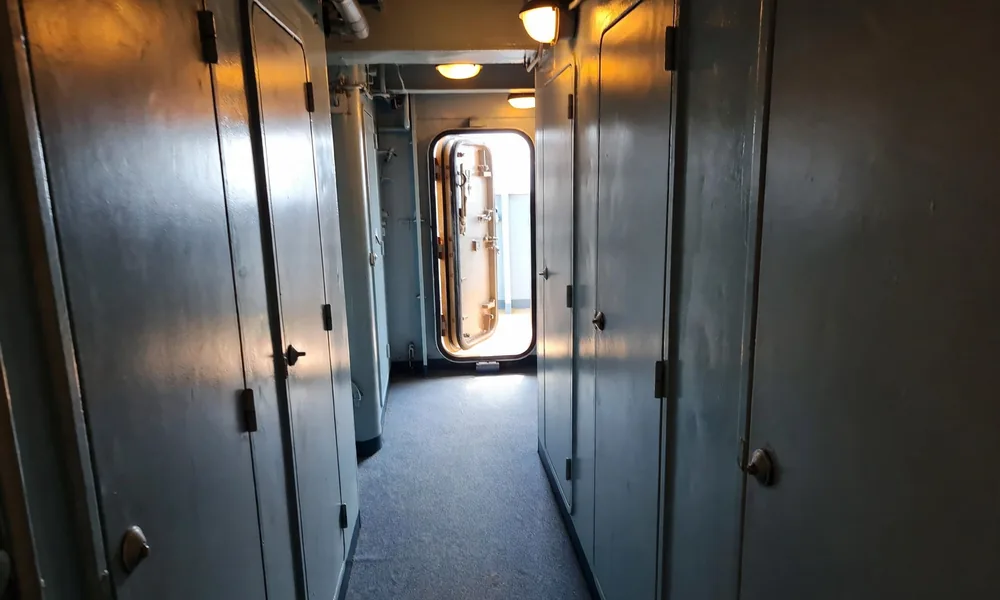
Below the guest decks of a luxury ship, down a quiet corridor with no sea view for most of its length, there is a small door that opens onto a room built for one purpose: sleep.
Luxury ship crew quarters are the hidden homes of the people who keep a ship running. Chefs, engineers, stewards and deckhands work long shifts, often for weeks without a day off, and the quality of their rest decides how well they work. This is how luxury ship crew quarters work, from the watch that sets the rhythm of the day to the small routines that make a tiny cabin feel like home.
How It Works
Step 1: The watch system sets the rhythm
Life in crew quarters runs on the watch system, a rota of shifts that keeps the ship staffed around the clock. A steward may work from early morning until mid-afternoon, an engineer may stand watch through the night, and a deckhand may split the day into two shorter shifts with a rest in between.
Doors are closed softly, conversations happen in the mess rather than the corridor, and the ship runs on an unspoken agreement that sleep is sacred. The rota is pinned up in the mess and on the cabin door, and everyone learns to move quietly past the cabins of people who are sleeping. A crew member who works a night shift needs to sleep through the day while the ship is moving, and that sleep is only possible because the whole deck respects the rota.
Step 2: Sleeping in a moving ship
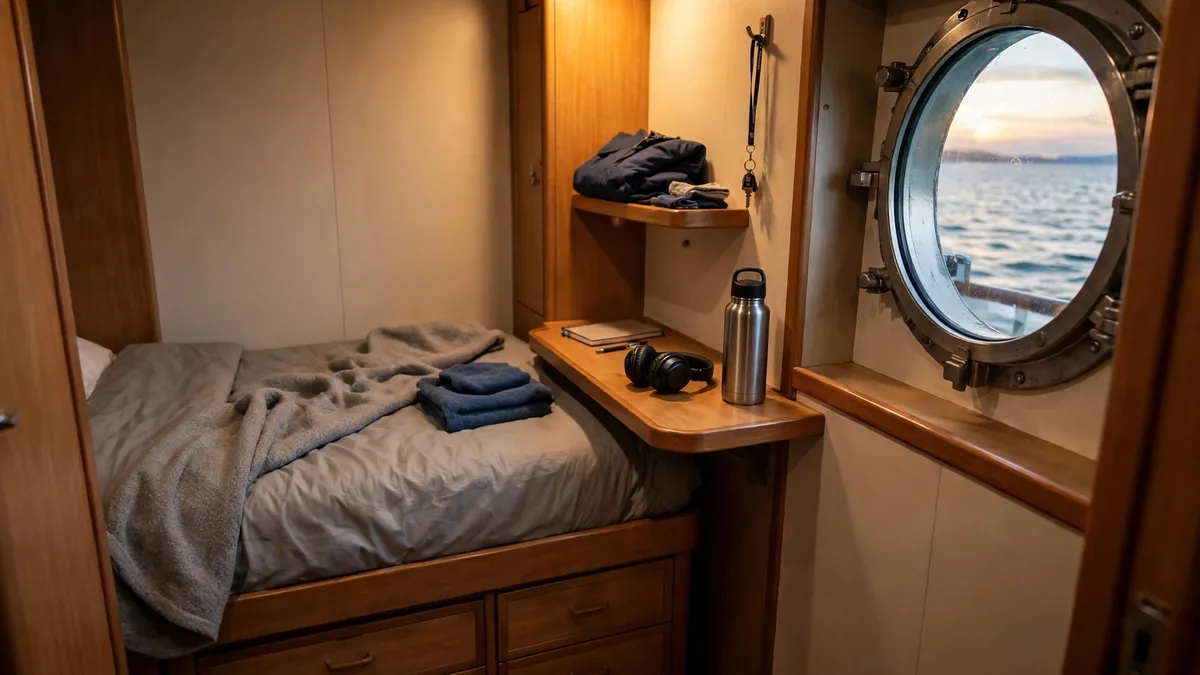
Sleeping at sea is a skill, and the cabin is designed to make it possible. The bed is fixed to the wall so it cannot slide when the ship rolls, and it has a raised lip along the edge so the sleeper does not roll out in a swell.
Most crew members learn to sleep through the ordinary motion of the ship within a week, and the gentle roll becomes a kind of rocking that sends them off faster than a still bed on land. The numbers behind the cabin, its size, its sound level and its air, are written down in a single specification, and the way luxury ship crew quarters are specified shows how those minimums and extras are measured.
Step 3: Fresh air and light, day and night
Each cabin needs fresh air, good light and reliable power, and all three must work even when the ship is far from land. Ventilation ducts bring in cooled, filtered air, and the system is balanced so no cabin is stuffy while another is freezing.
The lights are warm and dimmable, so a crew member can read in bed without waking a cabin mate, and a curtain or blind over the porthole shuts out the daylight for those sleeping during the day. A cabin that is too hot or too stuffy is a cabin nobody can sleep in, so the crew report a faulty vent the way they would report a leak, and it is fixed quickly.
Step 4: Living in a few square metres
A crew member’s whole life on board must fit into a few cubic metres, so every part of the cabin is used. Under the bed there is storage for a suitcase, above it a locker for clothes, and the wardrobe has a mirror on the inside of the door, so the cabin feels larger than it is.
The cabin is kept tidy because there is no room for mess, and because a tidy cabin is quicker to leave in an emergency. The sockets are placed where a phone charger can actually reach them, which matters more than it sounds when the cabin is the only private space a person has for weeks at a time.
Step 5: The mess, the laundry and the shared routines
No crew member lives in their cabin alone all day. Meals are taken in the crew mess, a plain dining room below deck where the food comes from the same galley that feeds the guests, served at set times that follow the watch rota.
The mess is also the social heart of the crew deck, where news is shared, birthdays are marked with a cake, and new crew members learn the unwritten rules of the ship over a coffee. Laundry runs on a rota too, with machines in a small laundry room and a drying line for uniforms that must be ready for the next shift. The galley that feeds both guests and crew is a machine of its own, and the way a luxury yacht galley works shows how a small kitchen feeds a whole ship, day after day, without ever closing.
Step 6: Noise, safety and the muster drill
A ship never sleeps, and neither do its engines, so the cabin must shut out the working ship. The walls are layered panels with dense insulation inside, the floors sit on rubber mounts that absorb vibration, and the doors are sealed so tightly that a conversation in the corridor stays in the corridor.
Safety is built into the daily routine as well. Smoke detectors, emergency lighting and a call button are fitted in every cabin, and the crew practise the muster drill until they can leave their cabin, close the door behind them and reach their muster station in the dark without thinking. The engines that make the noise are a world of their own below deck, and the way a luxury ship engine room is specified shows how engineers keep the most important systems running no matter what fails.
| Spec | Detail |
|---|---|
| Cabin | About 8 to 15 square metres by rank, one person, or two in shared junior cabins |
| Bed | Single bed fixed to the wall with storage below, a reading light and a shelf above |
| Air | Filtered, cooled fresh air, balanced per cabin, adjustable at the vent over the bed |
| Light | Warm, dimmable lights with a bedside reading light and a blind over the porthole |
| Storage | Wardrobe, lockers, drawers and under-bed space for a whole life on board |
| Safety | Smoke detector, emergency light and call button, with regular muster drills |

What One Costs Running luxury ship crew quarters costs an estimated 20,000 to 60,000 dollars per cabin to build and fit out, depending on the size, the rank of the occupant and the quality of the finish, and the daily running cost is the price of fresh air, laundry, food and the quiet that lets a crew sleep.
A Rare Fact On some luxury ships, the crew quarters are built with the same fireproof, soundproof modules used for the guest cabins, and the only difference is the size and the view. A few older ships even had crew cabins with no porthole at all, lit only by electric light for weeks at sea, and modern rules now demand daylight or a porthole wherever possible, because the people who work below deck deserve to see the sea they are sailing on.
A luxury ship crew quarters may be small and plain beside the guest suites above, but it is a home that works: a bed that holds its sleeper through a swell, air that stays fresh through the night, a mess where the crew become a family, and a drill that keeps them safe. The people who sleep there are the people who make the luxury above deck possible, and their rest is the most important system on the ship.