There is a moment on every luxury yacht when the owner steps up to the helm, rests a hand on the wheel and feels the whole boat answer. The wheel turns with a smooth, weighted ease, the throttles sit exactly where the fingers expect them, and the screens glow with the speed, the depth and the course, all in a space no bigger than a desk.
A luxury yacht helm is the steering station of the vessel, where the wheel, the engine controls and the navigation screens meet in one carefully arranged place. Its size, its feel and its electronics are all written into the yacht’s specification, and each number decides how the boat handles in a harbour and at sea. This is what those helm numbers mean, and how they add up to a boat that feels alive in the hands.

How It Works
The wheel: size, weight and feel
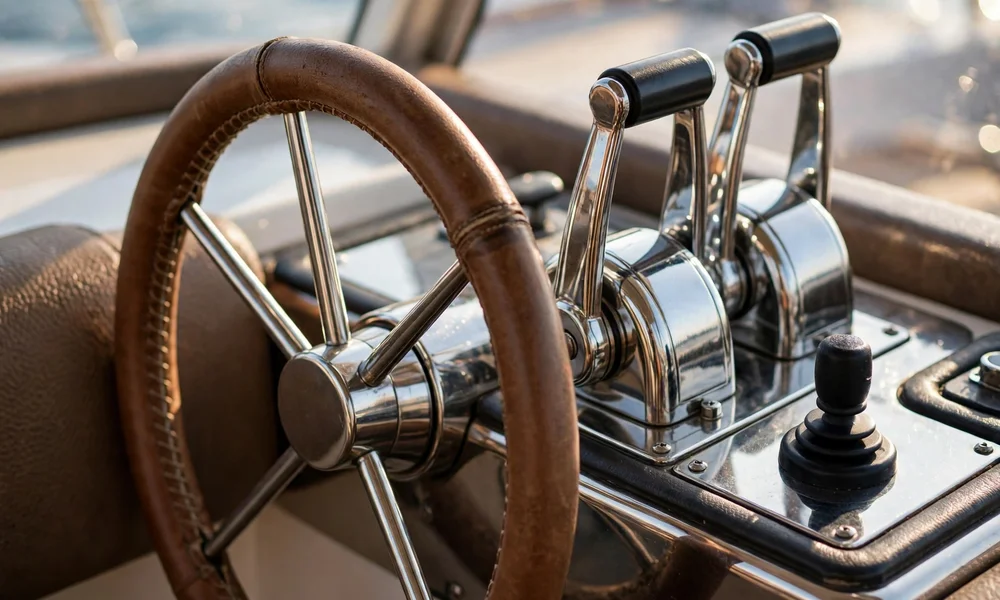
The wheel is the first thing anyone notices at a yacht helm, and its size is chosen with care. On a luxury yacht it is usually 700 to 900 millimetres across, big enough to give fine control with small movements of the hands, but small enough that the helmsman can see over it to the bow. The rim is often wood, polished and varnished, with spokes of stainless steel that catch the light.
The feel of the wheel matters as much as its size, and it is set by the steering system behind it. Hydraulic steering gives a smooth, damped turn with a little resistance, so the wheel never feels loose or twitchy, and the number of turns from lock to lock, usually four to six, decides how quickly the rudder answers. The wheel is also detachable on some yachts, lifting off its hub so the helm station can be cleared for a party or a clear view forward at anchor.
The throttles: power at the fingertips
Beside the wheel sit the throttle levers, and on a modern luxury yacht they are electronic, sending a signal to the engines rather than pulling a cable.
Twin-engine yachts carry a pair of levers, one for each engine, and moving them apart by a fraction lets the captain spin the boat in its own length, a trick that turns a 40-metre yacht in a crowded marina. The levers are shaped to fit the hand, weighted so they stay where they are put, and lit softly at night, and the way a luxury yacht helm works shows how the wheel, the throttles and the rudder answer each other in one smooth chain.
The joystick: docking without drama
The most useful control at a modern yacht helm is often the smallest, a joystick no bigger than a thumb that drives the bow thruster, the stern thruster and the engines together. Push it sideways and the yacht slides sideways; twist it and the yacht turns on the spot; push it forward and the boat glides ahead, all without the helmsman touching the wheel or the throttles at all.
The joystick is run by a computer that works out the thrust each propeller must give, and it has turned docking from the most stressful part of a voyage into the calmest.
The screens: speed, depth and course
Above the wheel, the helm screens gather everything the helmsman needs into one glance. The largest shows the chart plotter, the yacht’s position on a digital chart with its course, its speed and the depth beneath the keel, while smaller screens carry the engine data, the fuel, the wind and the radar, each one readable in bright sunlight and dimmed to a soft glow at night.
The screens are sized to be read at arm’s length, usually 12 to 16 inches across, and they are bonded to the glass so there is no reflection to fight.
The seat and the sightlines: standing watch in comfort
A helm is a place to stand for hours, and its ergonomics are specified as carefully as its electronics. The helm seat is set at exactly the right height for the wheel, with a footrest and a backrest that let the helmsman brace against the roll of the sea, and the whole station is raised so the view over the bow is clear for the full length of the yacht.
The sightlines are measured in degrees, with the rule that the helmsman must see the waterline at the bow and both sides of the boat without leaning. The wheel itself is a piece of fine craftsmanship before it ever meets the boat, and the way a luxury yacht helm is made shows how wood, steel and leather are joined into a wheel that feels as good as it looks.
The autopilot: holding course while you rest
Behind the wheel sits the autopilot, a computer that reads the compass and the GPS and steers the yacht along a chosen course without a hand on the wheel. It makes hundreds of tiny corrections a minute, far more than a human could, and it holds a line so straight that the fuel burn drops and the guests below barely feel the boat move. It can even steer a pattern, a search grid or a slow circle, while the crew work on deck without a hand on the wheel.
The autopilot is not a replacement for a watchkeeper, and it is specified to hand control back the moment anything changes, a ship ahead, a shift in the wind, a tap on the wheel. On a long passage it is the hardest-working system on the boat, and the larger world of steering at sea is measured in the same numbers, as the way a luxury ship helm works shows how the same wheel, rudder and autopilot ideas scale up to vessels a hundred times the size.
| Specification | Typical fit |
|---|---|
| Wheel diameter | Usually 700 to 900 mm, wood-rimmed with stainless spokes, sized for fine control and a clear view over the bow |
| Turns lock to lock | About four to six turns of the wheel, fewer for a sharp sporty feel, more for a calm steady one |
| Throttles | Twin electronic levers with detents at idle and full power, set by feel without looking down |
| Joystick | One small joystick driving bow thruster, stern thruster and engines together for docking |
| Helm screens | Chart plotter and engine displays of 12 to 16 inches, bonded glass, readable in full sunlight |
| Autopilot | Computer steering on compass and GPS, hundreds of small corrections a minute, hands back control instantly |
| Helm seat | Raised seat with footrest and backrest, set so the helmsman sees the bow waterline and both sides |
| Sightlines | Clear view over the bow and down both sides without leaning, from the main helm and the flybridge |

A luxury yacht helm station is an estimated 150,000 to 600,000 dollars to build and fit out, depending on the size of the yacht and the quality of the wheel, the screens and the electronics. The wood and leather are only part of the price, and the steering gear, the joystick system and the autopilot behind the polished surface cost far more than the surface itself.
Here is a rare fact worth knowing. The wooden wheel on a luxury yacht is often made from a single piece of teak or mahogany, bent and laminated rather than cut, because a bent rim is stronger than a sawn one and keeps its shape for decades.


