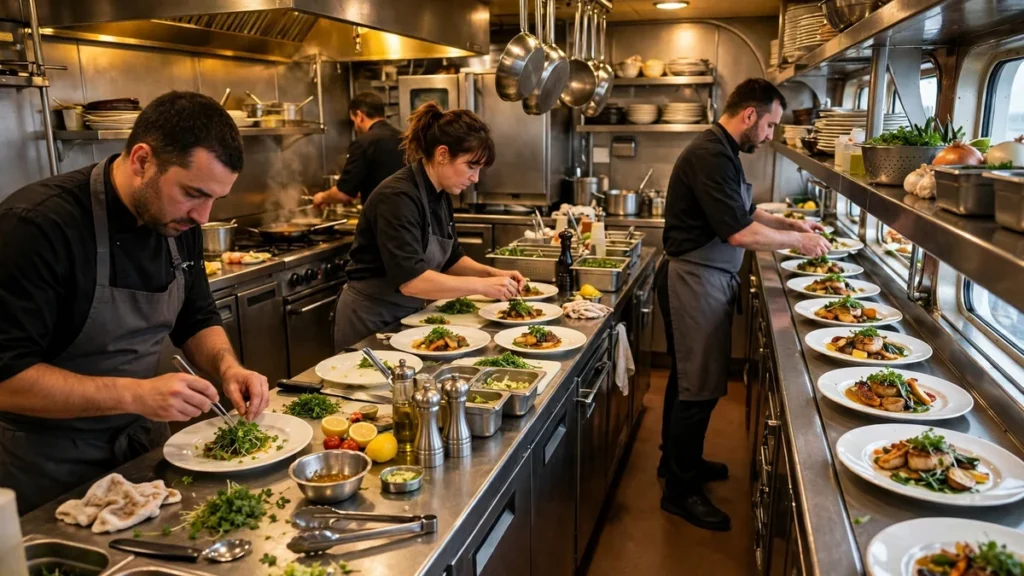
At six in the morning, in a kitchen deep inside a cruise ship, the day starts with a sound like a small factory waking up. Ovens roar, mixers spin, and a crew of cooks begins preparing breakfast for three thousand people, none of whom will ever see this room. By dinner, the same kitchen will have served ten thousand meals.
A luxury ship galley is one of the largest kitchens on earth, and it has to work in a space that rolls, pitches and never stops moving. It stores weeks of food, cooks for thousands at fixed times, and does it all in a room smaller than a restaurant kitchen that serves a hundred. This is how a luxury ship galley works, from the stores below the waterline to the plates that reach the dining room.

How It Works
Step 1: The stores are loaded before sailing
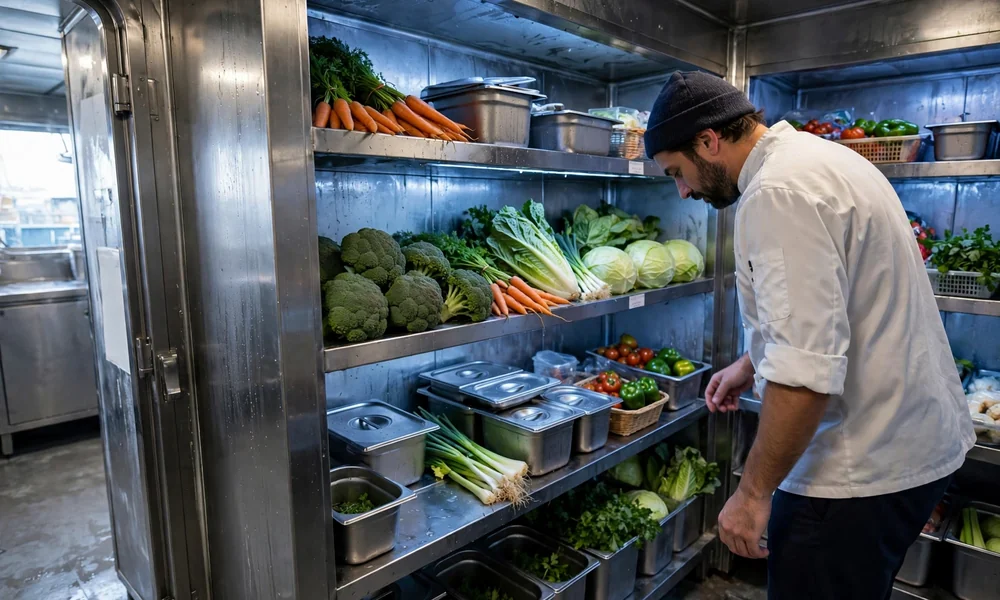
Everything starts before the ship leaves port, when trucks deliver weeks of food to the quayside and the galley crew loads it aboard. The ship’s stores sit deep in the hull, below the waterline, where the temperature is stable and the motion is gentlest. There are cold rooms for meat and dairy, freezers held at minus twenty degrees, and dry stores for flour, rice and canned goods, each one kept at its own temperature and humidity. A large cruise ship can carry more than a hundred tonnes of fresh food, and every item is logged as it comes aboard, so the chefs know exactly what they have and when it runs out.
Step 2: The galley is built around the flow of food
The galley itself is laid out like a production line, with food moving in one direction from raw to finished. At one end sit the preparation areas, where vegetables are washed and cut and meat is portioned; in the middle stand the ranges, ovens and fryers where the cooking happens; and at the far end are the plating stations, where dishes are finished and sent up to the dining rooms. Nothing crosses back, because a kitchen that serves thousands cannot afford cross-contamination or wasted steps. The whole room is stainless steel, from the counters to the walls, because steel can be hosed down and sanitised between services, and it does not harbour bacteria the way wood or plastic can. The floor is non-slip, the ceilings are low, and every surface is designed to be cleaned in minutes.
Step 3: The cooking runs on a strict timetable
Cooking for three thousand people is not like cooking at home; it is an industrial operation run to a timetable measured in minutes. The executive chef plans the menus weeks ahead, and each dish is broken down into a recipe card that tells the cooks exactly how much of each ingredient to use and how long to cook it. The main courses are cooked in bulk in tilting kettles and combi ovens that can roast a hundred chickens at once, while the sauces are made in steam-jacketed pans the size of bathtubs. The galley works in shifts around the clock, because breakfast starts before dawn and the late-night buffet ends after midnight. The cruise ship galley runs on the same principles at an even larger scale, but a luxury ship galley adds a second challenge, which is that its guests expect restaurant quality at cruise-ship volume.
Step 4: Stabilisers and fittings keep the kitchen working in a swell
A kitchen on land never moves; a kitchen at sea is always moving, and the galley is built for it. Pots sit in gimballed holders that stay level as the ship rolls, oven racks have locking bars, and every work surface has a raised lip so nothing slides off onto the floor. The ship’s stabilisers, great fins under the hull, cut the roll dramatically, but the galley is designed for the days when the sea is rough anyway. Cooks learn to work with the motion, timing a pour to the moment the ship steadies, and the whole team wears non-slip shoes because a wet steel floor in a swell is unforgiving. In the worst weather, some menus are simplified, because a sauce that needs a steady hand cannot be made when the room is heaving.
Step 5: Plating and service move the food upstairs
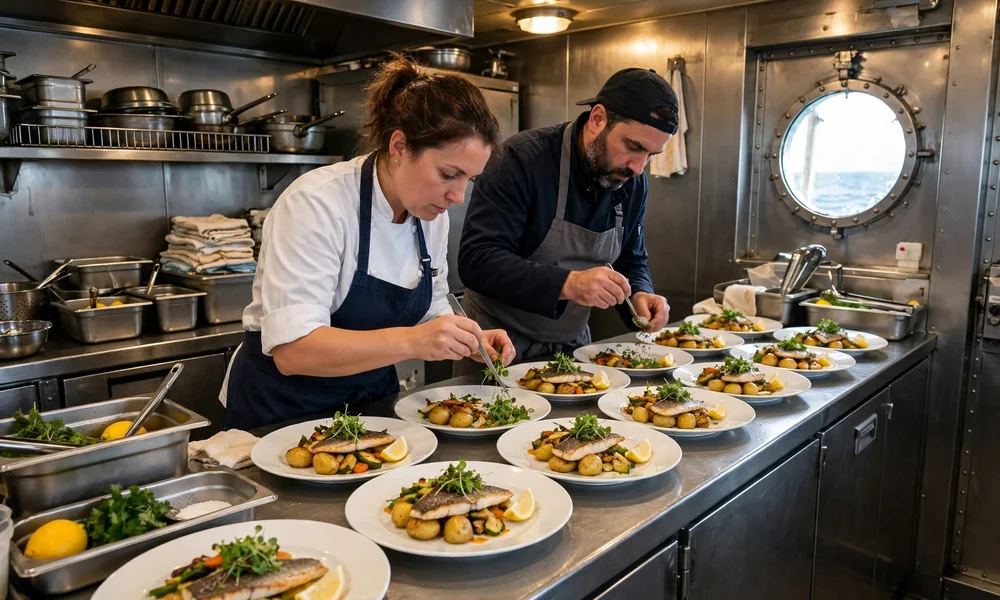
When a dish is ready, it moves to the plating line, where a team of cooks finishes each plate by hand: sauce, garnish, a final check that it looks right. The plates are stacked into heated trolleys and wheeled to dumbwaiters, small lifts that carry the food up to the dining rooms, where waiters take over. The timing is everything: a plate that waits too long goes cold, and a dining room of five hundred guests cannot wait for the kitchen. The galley and the dining room are in constant contact by phone and by screen, calling orders and courses, so the flow never stops. A yacht galley serves a dozen guests from a kitchen the size of a large home kitchen, but a ship galley serves a small town, and its plating line never pauses during service.
Step 6: Cleaning, waste and the next service
The moment one service ends, the cleaning begins. Industrial dishwashers the size of small rooms wash thousands of plates an hour, and the galley is hosed down, sanitised and inspected before the next service starts. Food waste is separated, pulped and stored for disposal under strict maritime rules, because a ship cannot simply throw waste overboard. The galley team also checks the stores, counts what was used, and tells the executive chef what needs ordering at the next port. The submarine galley works under the same discipline in a space a fraction of the size, feeding a crew that cannot resupply for months. On a cruise ship the cycle repeats three times a day, every day, for the whole voyage.
| Specification | Typical large luxury cruise ship galley |
|---|---|
| Meals per day | Around 10,000 across all venues |
| Galley crew | 150 to 300 cooks and staff |
| Fresh food carried | More than 100 tonnes per voyage |
| Cold storage | Separate rooms for meat, dairy and produce |
| Ovens | Combi ovens roasting hundreds of portions |
| Service hours | Around the clock, three main services daily |
A luxury ship galley is not sold on its own, so there is no price tag for the kitchen, but the galley of a large cruise ship represents an estimated $10 million to $20 million of equipment, fit-out and stores, and that is an estimate for the kitchen spaces and their machinery alone. The food budget is separate, and it runs to millions of dollars per voyage, because feeding three thousand guests three times a day is one of the largest costs of running the ship.
Here is a rare fact: a cruise ship galley can use more than ten thousand eggs in a single day, and the ship’s stores team orders them by the pallet, not the dozen.
When the last dessert is served and the dining room empties, the galley crew cleans down, checks the stores, and starts again. The passengers remember the food; they never see the kitchen that made it, the steel room deep in the ship where a small army cooks through the night so that breakfast is ready at dawn. That is the quiet work of a luxury ship galley, and it never stops while the ship is at sea.