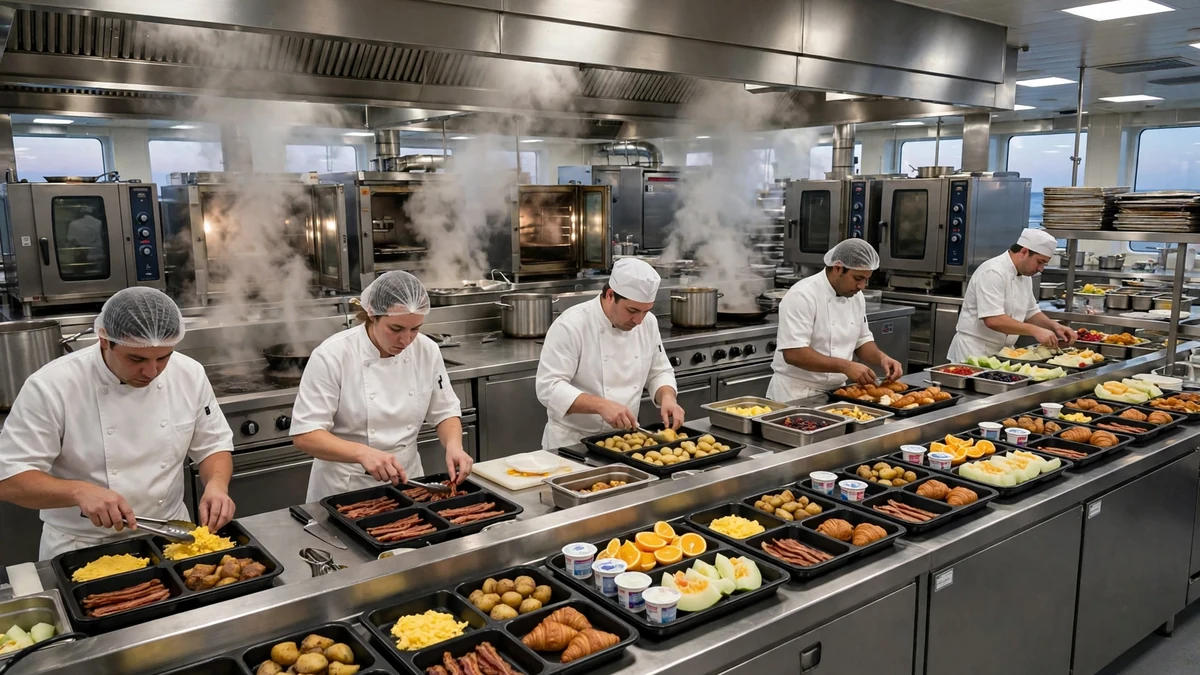
At four in the morning the galley was already loud, and no guest had eaten a thing. Under the white lights, a line of cooks moved along a steel counter the length of a bus, cracking eggs into hotel pans by the hundred, while behind them a baker slid tray after tray of bread into ovens the size of wardrobes. A cruise ship galley is not a kitchen that happens to be big. It is a factory that happens to cook, and it runs on the same discipline as a production line.
The galley sits low in the ship, usually on a deck below the main restaurants, and it serves them all through dumbwaiters, heated trolleys, and a choreography of timing that would impress an air traffic controller. The food arrives by the tonne in port, is stored in cold rooms the size of apartments, and is turned into plated meals by a brigade of more than a hundred cooks working in shifts around the clock. Every part of the room is designed around one idea: nothing stops, nothing waits, and nothing is allowed to slow the line down.
How a Cruise Ship Galley Works
The galley works as a series of stations, each one doing a single job and passing its work down the line. There is a hot station for grills and ovens, a cold station for salads and desserts, a pastry section, a butchery, and a plating line where the finished dishes are assembled and checked. Each station has its own team, its own equipment, and its own store of ingredients within arm’s reach, so a cook never has to cross the room in the middle of a service. The stations are arranged in the order the food travels, from raw stores at one end to the service lifts at the other, and the floor is marked with lanes so the trolleys move in one direction only.
Step 1: Loading and storing food for a week at sea
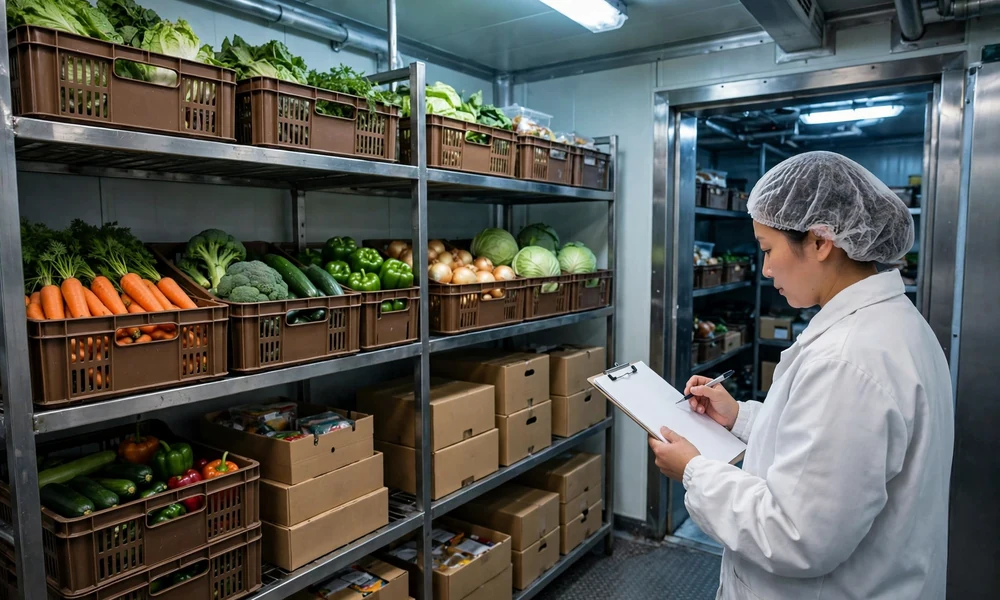
Before the ship sails, the galley takes on provisions by the tonne. Pallets of meat, fish, vegetables, dairy, and dry goods are craned aboard in port and lowered to the galley deck, where a team checks every delivery against the order. A large ship can carry more than a hundred tonnes of food for a single week, and the storage is planned so the oldest stock is always used first. The galley never runs out at sea, because there is no shop to run to.
Step 2: Preparing ingredients in bulk
Preparation starts the day before service, and it is done in quantities that look absurd on land. Vegetables are peeled and cut by machines that can process hundreds of kilos an hour, meat is portioned by weight on scales that record every cut, and sauces are made in tilting kettles the size of bathtubs. The butchery breaks down whole carcasses, the bakery mixes dough in bowls a person could climb into, and the cold station prepares salads and desserts in trays of fifty portions at a time. A luxury yacht galley cooks for a dozen people with a team of two, but a cruise ship galley cooks for a small town, and the only way to do it is to treat preparation as a separate shift that never stops.
Step 3: Cooking on the hot line
The hot line is where the galley earns its reputation, and it runs like a race. Ranges, grills, fryers, and combi ovens sit in a row, each one sized for volume rather than finesse, and the cooks work from tickets that arrive in batches from the restaurants above. The extraction canopy above the line pulls thousands of cubic metres of air an hour out of the room, because the heat from a dozen ovens running at once would otherwise make the galley unworkable within minutes.
Step 4: Plating and sending food upstairs
Plating is the last step before the food leaves the galley, and it is the most carefully timed. Dishes are assembled on a heated line, checked by a senior chef for portion size and presentation, and loaded onto trolleys that are wheeled into dumbwaiters and service lifts. The lifts carry the food up to the restaurants, where waiters take over, and the timing is planned so a dish arrives at the table minutes after it leaves the plate, not before. The galley tracks every cover, and the head chef watches a board that shows how many tables are seated, how many mains have gone out, and how many are still to come.
Step 5: Washing up at industrial scale
Behind the cooking line sits the dishwashing operation, and it is as large as the kitchen itself. Conveyor dishwashers the length of a car run continuously during service, washing thousands of plates, glasses, and cutlery items an hour with water hot enough to sterilise. Pots and pans are washed by hand in sinks the size of baths, and the waste food is scraped into a system that grinds and treats it before discharge. A cruise ship waste system handles everything the ship produces, and the galley is its biggest single source, because every meal leaves behind peelings, bones, and plate waste that has to go somewhere.
Step 6: Cleaning down and starting again
When service ends, the galley is stripped and cleaned before the next one begins, and the turnaround can be less than an hour. Every surface is scrubbed, the floors are hosed down, the extraction filters are checked, and the equipment is inspected for the next shift. A cruise ship lifeboat is built to save lives in an emergency, but the galley has its own safety routines, with fire suppression over every cooking station and drills that every cook must know by heart. The galley never truly closes, because the ship never truly sleeps.
Cruise Ship Galley Specifications
| Specification | Typical figure |
|---|---|
| Galley floor area | 800 to 2,000 square metres |
| Meals served per day | 15,000 to 30,000 across all venues |
| Kitchen crew | 120 to 250 cooks and support staff |
| Cold storage volume | 500 to 1,500 cubic metres |
| Food loaded per week | 100 to 200 tonnes |
| Combi ovens | 10 to 30 units, each cooking hundreds of portions |
| Extraction rate | 20,000 to 50,000 cubic metres of air per hour |
| Dishes washed per hour | 5,000 to 10,000 items at peak service |
What a Cruise Ship Galley Costs
The galley of a large cruise ship costs an estimated $10 million to $30 million to build and fit out, depending on the size of the ship and the number of restaurants it serves. The equipment alone, ovens, cold rooms, dishwashers, and extraction, accounts for most of that, and the installation has to be done while the ship is still under construction, because the largest pieces will not fit through a finished doorway.
A Rare Fact About Cruise Ship Galleys
A cruise ship galley keeps a separate kitchen for food that must never touch the main line, because some passengers have allergies so severe that a single crumb can send them to the medical centre. Even rarer, the galley carries its own supply of eggs with the shells stamped in a different colour for each day of the voyage, so the chefs can tell at a glance how fresh an egg is without cracking it, a system invented because a ship at sea cannot send a bad batch back to the supplier.


