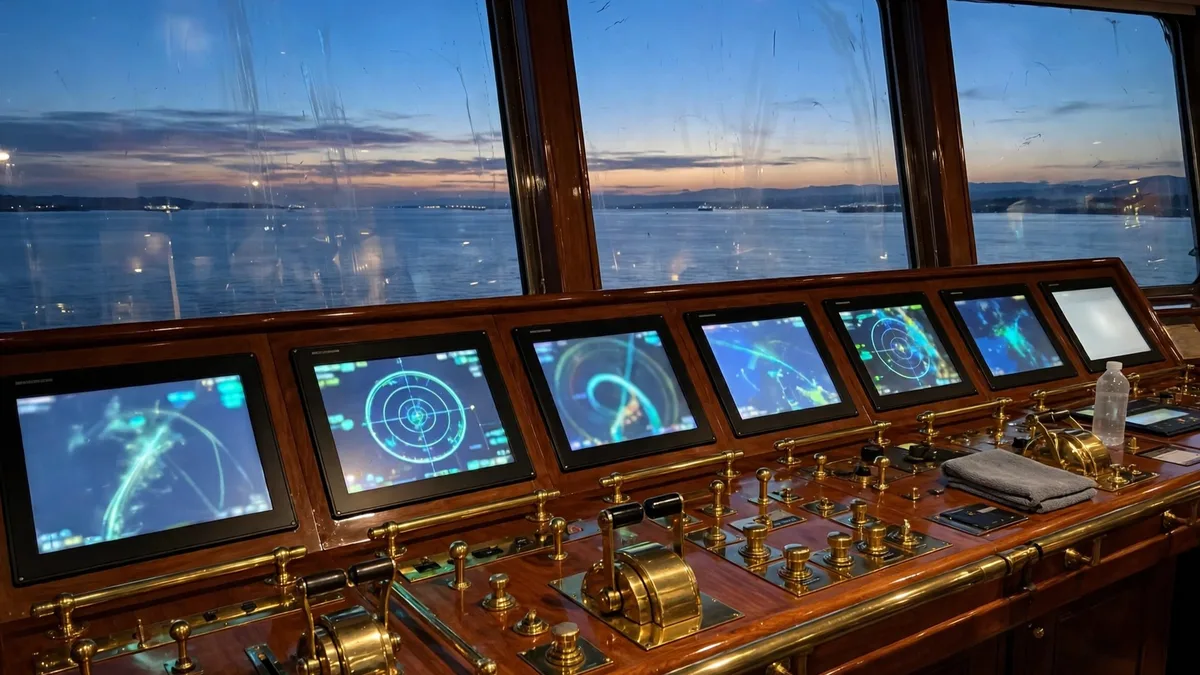
The bridge of a luxury ship is the quietest room on board, and it is also the one that matters most. From a wide, glass-fronted space high above the bow, a handful of officers steer thousands of tonnes of steel through fog, storms and crowded harbours, with nothing between them and the sea but a wall of glass and a row of glowing screens.
Passengers almost never see it. They see the dining rooms, the pools and the suites, while the bridge stays behind a locked door, cool, dim and calm. This is how a luxury ship bridge is made.
How It’s Made
Step 1: The bridge deck is designed around the view
Every bridge starts on paper, long before any steel is cut. Naval architects draw the room around a single rule: the officer on watch must be able to see the water from horizon to horizon, and down to the bow, without standing up or leaning. That rule fixes the height of the deck, the angle of the windows and the width of the room, and everything else has to fit around it.
Step 2: The steel shell and the glass wall go up
Once the design is settled, the bridge deck is built as part of the ship’s steel superstructure. Curved steel plates are welded into place to form the front of the deck, with wide openings left for the windows, and the structure is reinforced so it can carry the weight of the glass, the consoles and the people without flexing in heavy seas. The windows themselves are made from thick laminated glass, several layers bonded together so a single pane can survive a wave breaking over the bow or a bird strike at speed.
Step 3: Consoles and controls are built and wired
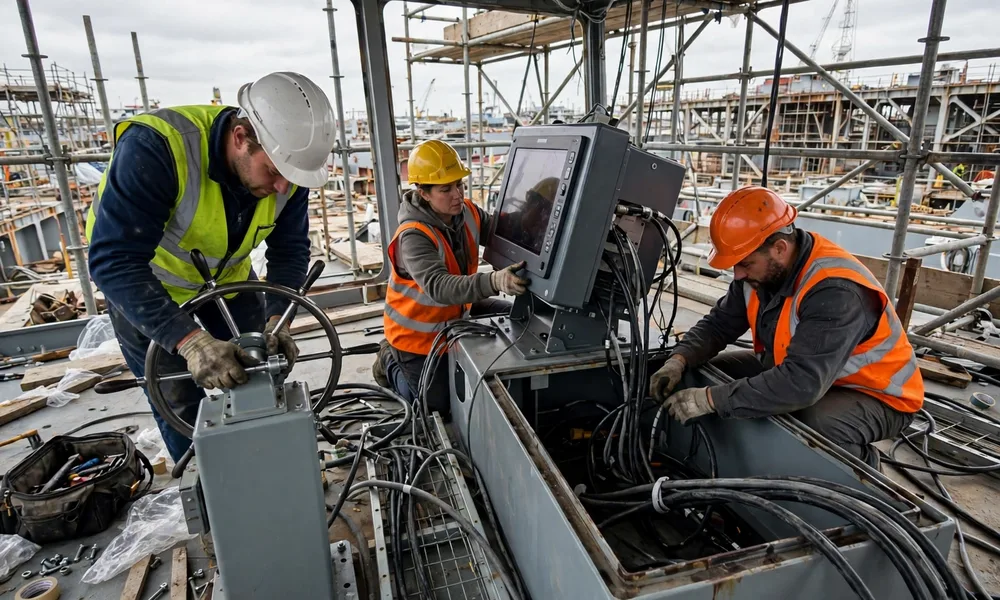
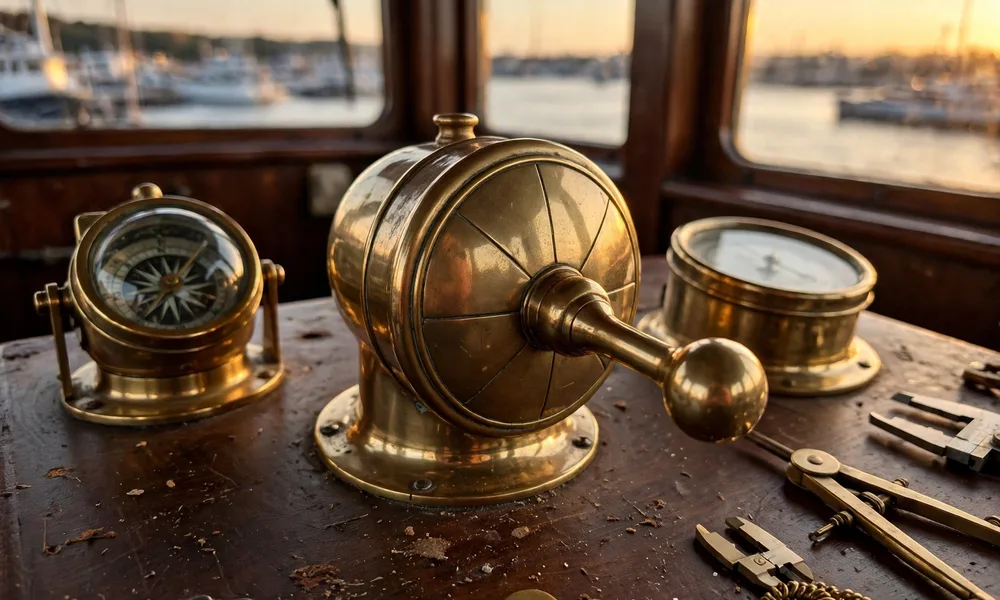
With the shell weather-tight, the consoles arrive, and this is where the bridge stops looking like a construction site and starts looking like a machine. Each console is a long, low cabinet of steel and wood, built to hold the steering controls, the engine telegraph, the radar, the chart displays and the radios, and every one of them is wired by hand. Kilometres of cable run beneath the raised floor, each one labelled, clipped and tested, because a single loose connection in the dark could silence the radio or freeze a screen at the worst possible moment.
Step 4: Screens, sensors and navigation systems are fitted
The next stage is the fitting of the bridge’s senses. Radar scanners are mounted on the mast above, satellite receivers are bolted to the roof, and depth sounders, speed logs and compass sensors are connected through the hull below. Inside, the screens are mounted into the consoles and calibrated so that the radar picture, the electronic chart and the camera feeds all agree with each other, showing the same coastline, the same ships and the same course. A good bridge is built so that three different systems can confirm the same fact, and if one of them disagrees, the officer on watch will know about it at once.
Step 5: The room is finished like a luxury interior
Only when the electronics work is the bridge finished as a room, and on a luxury ship this is done to the same standard as the passenger cabins. Polished wood panels cover the console fronts, leather is fitted to the captain’s chair and the watch seats, and the ceiling is lined with acoustic panels that swallow sound, so the only noise is the soft hum of the air conditioning and the occasional click of a switch. The lighting is the most carefully judged part of the whole room: bright enough to read a chart, dim enough to keep night vision, and warm enough that tired eyes can stay sharp through a four-hour watch.
Step 6: The bridge is tested at sea before it is handed over
The last stage of the build happens away from the shipyard, on the open water. During sea trials the bridge is put through everything it will face in service: hard turns, emergency stops, radar checks in rain, radio tests at long range, and a full night watch with the lights dimmed to working level. Engineers stand behind the officers with notebooks, logging every flicker, every delay and every control that feels wrong, and the shipyard fixes each one before the ship is delivered. Only when the bridge has steered the ship through a storm of tests, and the captain is happy with every screen, every switch and every sightline, does the room become the bridge of a working luxury ship.
| Spec | Detail |
|---|---|
| Location | High on the forward superstructure, with a near-360-degree view |
| Windows | Thick laminated glass in heated frames to stop condensation |
| Consoles | Steel and wood cabinets holding steering, engine and radar controls |
| Navigation | Radar, electronic charts, satellite positioning and depth sounders |
| Crew on watch | Usually a captain or officer, a helmsman and a lookout |
| Testing | Proven during sea trials before the ship is delivered |
The most expensive part of a ship’s bridge is not the glass or the wood, but the redundancy. Every vital system has a backup, and every backup has a backup, because the bridge is the one room on the ship that can never be allowed to go dark. That is why the wiring is checked twice and the trials take weeks, and why the finished room feels so calm: it was built by people who knew it would be judged on the worst night of the ship’s life, not the best. The glass, the consoles and the wiring are all built to outlast the ship itself, and they usually do.
What One Costs
A luxury ship bridge typically costs an estimated $8 million to $25 million to build and fit out, and the price is set mostly by the navigation electronics, the radar and the custom consoles rather than the size of the room. A large cruise ship bridge with full redundancy, satellite systems and a panoramic glass wall sits at the top of the range, while a smaller yacht bridge with fewer systems costs far less. The price is in the engineering, not the furniture, and how a luxury ship bridge works explains what all those screens and controls actually do, while how a luxury yacht bridge works shows how the same idea is scaled down for a private yacht.
A Rare Fact
Some luxury ship bridges have a secret: a second, smaller set of controls hidden in the wings of the bridge, the open platforms that stick out on either side of the ship. When a captain is docking, they step out onto the wing with a joystick in hand, steering the ship sideways with bow thrusters while looking straight down at the quay.
A luxury ship bridge is a steel room, a wall of glass and a forest of cables, built slowly and tested at sea so it can steer a floating city through the dark. It is the one room on board where silence is a sign that everything is working, and where the most important thing in the whole ship is the view out of the window. For the price of the systems inside it, why a luxury ship bridge costs so much explains what a bridge built to this standard really adds up to.