Every passenger remembers the bow of a luxury ship, because it is the part that leads into the horizon. The stern is the part they live with: the wide flat decks at the back, the swim platform lowered to the water, the tenders swinging out over the sea. It is also the hardest end of the ship to build well.
The bow only has to part the water, but the stern has to put the water back together again, cleanly, after the hull has pushed it aside. If the water leaves the stern in a messy tumble, the propellers work in dirty water, the ship vibrates, and fuel is wasted. This is how a luxury ship stern is made.
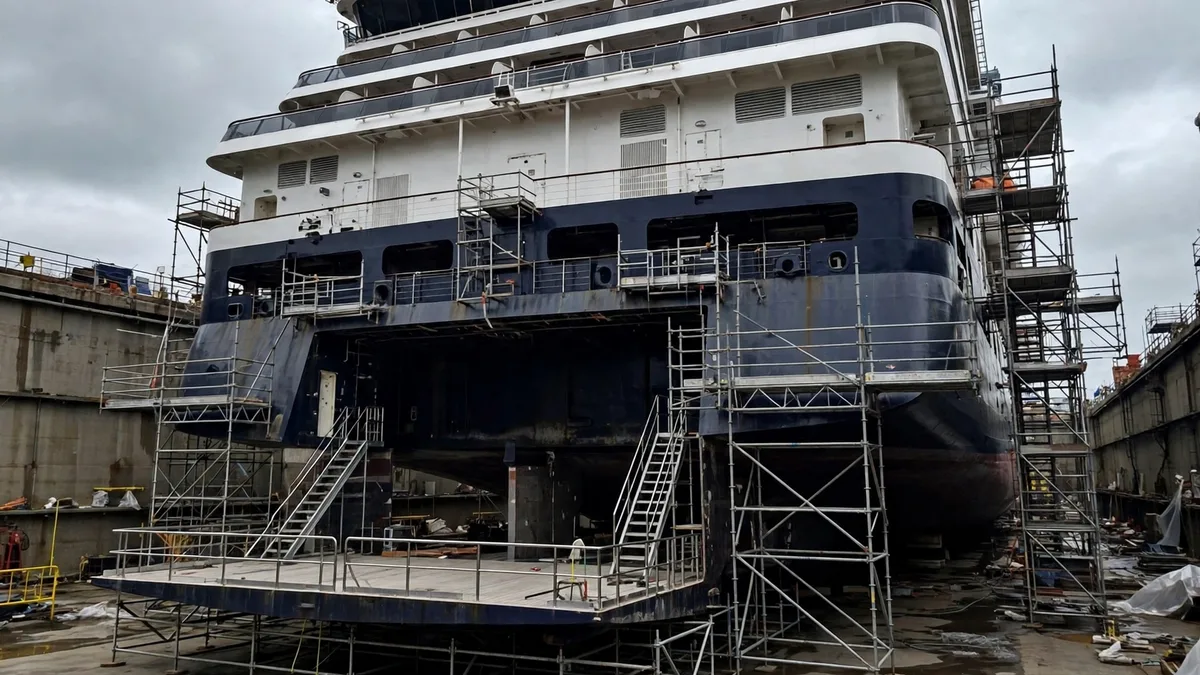
How It Is Made
Step 1: The shape is drawn for clean water
Every stern starts as a drawing, and the drawing is ruled by the water. Naval architects shape the run of the hull, the way the bottom rises towards the stern, so the water that flowed under the ship arrives at the propellers smoothly, without bubbles or swirl. A stern that is too full chokes the flow, while one that is too fine leaves no room for the engines and cabins aft.
The drawing also fixes the transom, the flat back of the ship, and how deep it sits in the water.
Step 2: The frames are set and the shell is plated
Like the bow, the stern is built on a skeleton of steel frames, curved ribs that run from the keel up to the deck. The frames at the stern are flatter and wider than those forward, because the stern is broad, and each one is set in the building dock and checked against the drawing before the next is placed.
Steel plates are rolled to the shape of the frames, lifted into place by crane, and welded on in strakes, long rows running fore and aft. The plates around the propeller openings are thicker than the rest, because the water there is at its most violent, and the welds in that area are tested with ultrasound before the ship is allowed to move on.
Step 3: The propeller openings are cut and lined
A luxury ship stern has to make room for the propellers, and that means cutting great round openings in the shell where the propeller shafts pass through. The yard cuts the openings to the drawing, then lines them with heavy steel rings that carry the thrust of the propellers into the hull.
The shaft brackets, the arms that hold the propeller shafts steady outside the hull, are fitted next. They are cast and machined to a smooth shape, because a rough bracket stirs up the water and steals speed. Each bracket is bolted and welded in place, then checked for line, so the shaft runs true and the propeller does not wobble.

Step 4: The rudders are hung on their stocks
Behind each propeller hangs a rudder, a great flat blade of steel that turns the ship. The rudder is built as a hollow steel box, welded up from plate, filled and faired smooth, then hung on a rudder stock, the vertical shaft that runs up through the hull to the steering gear above.
Hanging a rudder is slow, heavy work. The blade is lifted by crane, lowered onto its stock, and the bearings are set so the rudder turns without play and without binding.
Step 5: The transom and swim platform are built in
The transom closes the back of the ship, a flat wall of steel stiffened with frames and often pierced by a great door that opens onto the swim platform. The door is built like a watertight gate, hinged and sealed, and it has to open flat to make a deck at water level and close tight enough to keep the sea out in a storm.
Below the door, the swim platform itself is fitted, a wide steel deck that lowers on hydraulic arms until it floats just above the water. Its hinges, rams and seals are installed and tested in the dock, because a platform that jams halfway is no use to a guest in a swimsuit, and a platform that leaks will flood the tender garage behind it.
Step 6: The stern is faired, painted and flooded
When the steelwork is done, the stern is faired like the bow, ground smooth where the water flows fastest, around the propeller openings and the rudders. The fairing matters most here, because rough steel at the stern is felt all over the ship as vibration.
Then the stern is painted, including the antifouling below the waterline, and the compartments aft are flooded and drained to prove the seals hold. The rudders are swung, the platform is lowered and raised, and the propellers are turned by hand to prove the shafts run free, before the dock is flooded and the ship floats for the first time.
| Part | Detail |
|---|---|
| Transom | The flat back of the ship, sized to just kiss the water at cruising speed |
| Frames | Flatter, wider steel ribs than forward, plated in long rows fore and aft |
| Propellers | Round shaft openings lined with heavy rings, held by smooth cast brackets |
| Rudders | Hollow steel blades hung on stocks, swung and checked for play and clearance |
| Platform | A watertight transom door and a hydraulic swim platform that lowers to the water |
| Finish | Faired smooth where the water runs fastest, painted, flooded and tested |
The hardest part of making a stern is the water flow. A bow can be judged by eye, but a stern can only be judged by the water it leaves behind, and a small hollow in the wrong place will show up as vibration in the cabins and extra fuel on the bill, long after the yard has handed the ship over.
What One Costs
Building a luxury ship stern typically costs an estimated $5 million to $14 million, set mostly by the size of the transom, the number of propellers and rudders, and the swim platform gear. A simple stern with one propeller sits near the bottom, while a wide stern with twin propellers, big rudders and a full beach club costs far more. The numbers on the specification sheet tell the rest, and luxury ship stern specs explained walks through the transom, the rudders and the platform figures, while how a luxury ship propeller works shows what the blades at the back actually do.
A Rare Fact
Old sailing ships carried their name and home port on the stern, painted in gold on the flat transom where everyone in harbour could read it, and the carving around it was often the finest woodwork on the whole ship. Steel ships kept the name board, and a luxury ship still carries her name across the stern today.
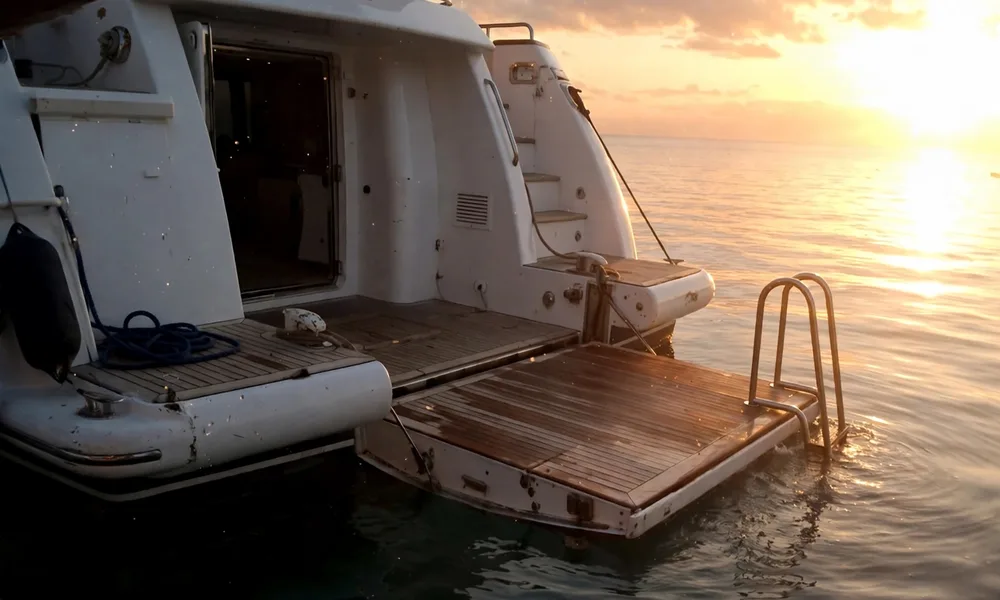
A luxury ship stern is drawn for clean water, framed with wide ribs, plated in long rows, fitted with propeller openings, rudders and a lowering swim platform, then faired, painted and tested. It is the end of the ship the passengers live on, and the end that decides whether she runs quietly or shakes herself apart. The room the rudders answer to sits high above it, and how a luxury ship bridge works shows how the orders get from there to the stern.


