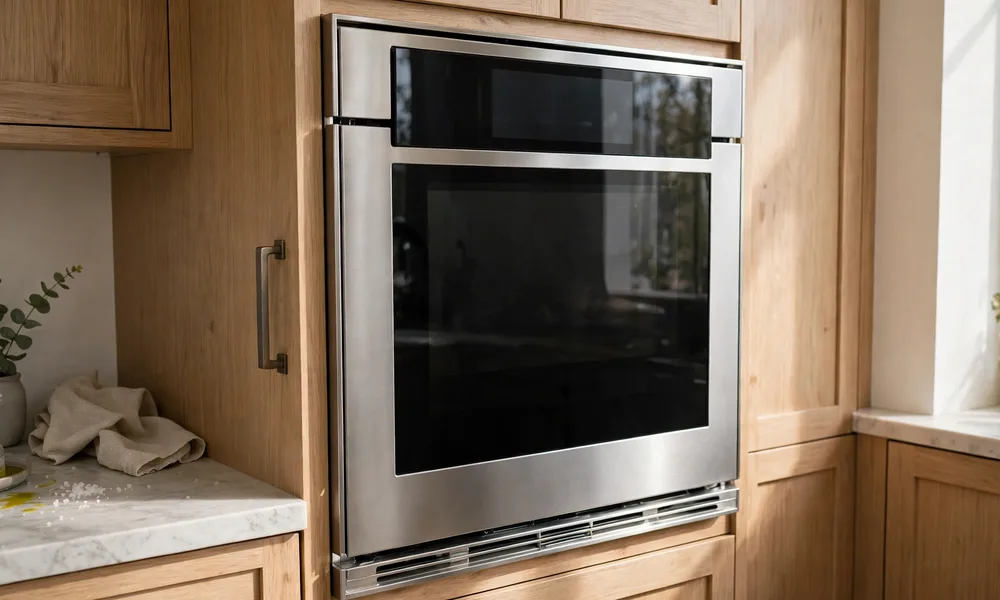
A luxury smart oven does not look like a machine. It sits flush in the kitchen wall, a sheet of black glass and brushed steel, and when you slide a tray inside it already knows what you are cooking, how hot it should be, and when to tell you dinner is ready.
Behind that calm front is a factory full of folded steel, heating elements, fans, sensors and circuit boards. This is how a luxury smart oven is made, from a flat sheet of metal to the first roast it cooks in a real home.
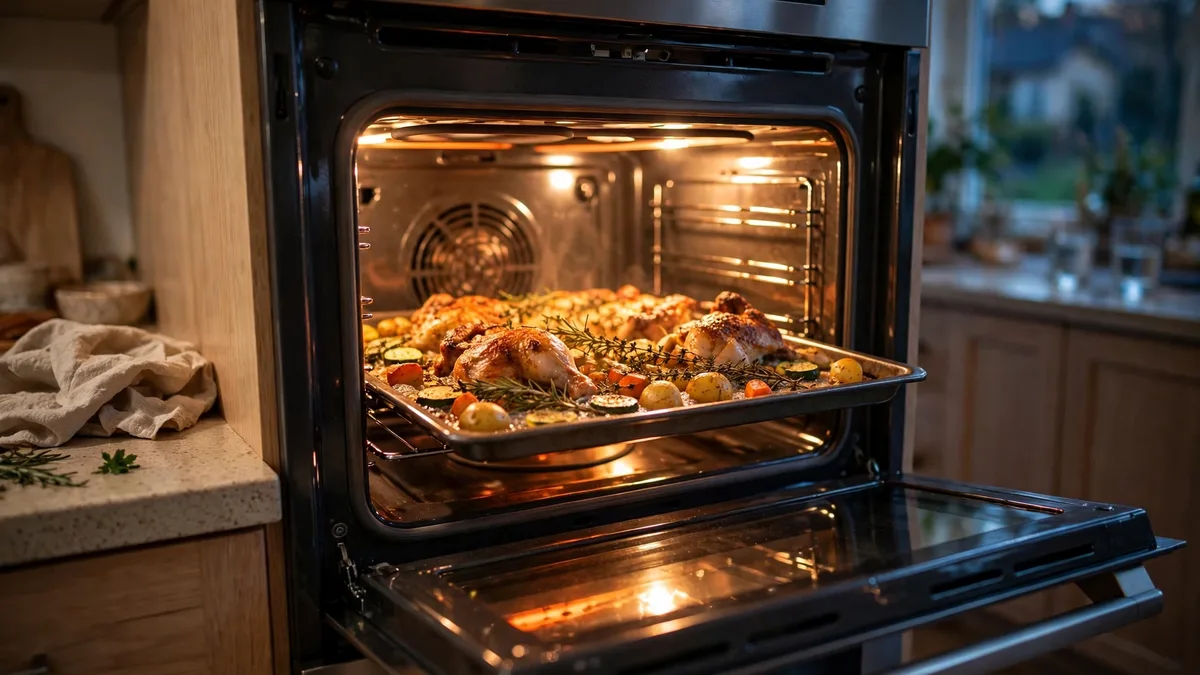
How It’s Made
Step 1: The steel cavity is folded and welded
Every smart oven begins as a flat sheet of stainless steel. Machines cut it to size, then press brakes fold it into the box shape of the cooking cavity, with rounded corners that are easier to wipe clean and spread heat more evenly than sharp ones. The seams are welded, then ground smooth, because any rough edge inside a hot oven would trap grease and burn it onto the steel.
The cavity is the heart of the oven, and it has to survive years of heat. Workers check each one for warping, since a cavity that twists when hot will leave cold spots where food cooks unevenly. Only cavities that hold their shape under a test bake move on.
Step 2: The heating elements and fan are fitted
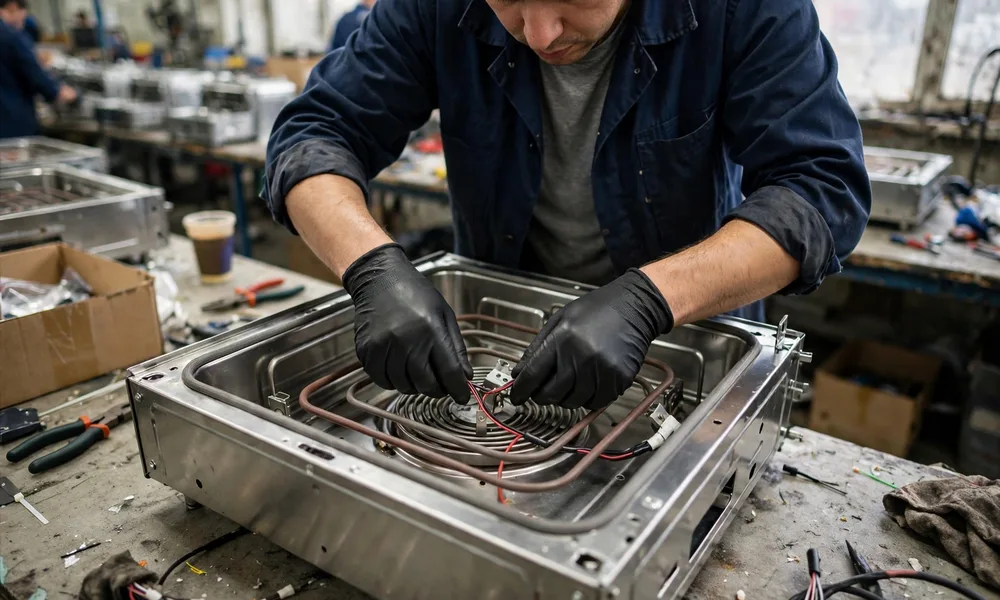
A luxury oven cooks with more than one source of heat. A ring element wraps around a fan at the back wall, a grill element sits under the roof, and a base element hides under the floor of the cavity. Each element is a coil of resistance wire sealed inside a steel tube, bent to shape by hand and machine, then bolted into place with ceramic insulators that keep the heat where it belongs.
The fan is what makes the oven smart about heat. It pulls hot air across the food and pushes it back past the element, so the temperature stays even from the top shelf to the bottom. The fan motor is balanced carefully, because a fan that wobbles will hum, and a luxury oven is expected to run almost silently.
Step 3: The sensors and probes go in
An ordinary oven guesses at temperature. A luxury smart oven measures it. A thin temperature sensor sits in the wall of the cavity, a meat probe plugs into a socket on the side, and a humidity sensor watches the steam that food gives off as it cooks. Together they tell the oven what is really happening inside, not just what the dial asked for.
Each sensor is tested against a known temperature before the oven leaves the line. If one reads even a few degrees off, the oven would overcook everything it ever makes, so faulty ones are pulled out and replaced on the spot.
Step 4: The glass door and touch display are built
The door of a luxury smart oven is a sandwich of glass. Two or three panes sit in a steel frame, with air gaps between them that keep the outside cool enough to touch while the inside runs at two hundred degrees. The inner pane is coated to reflect heat back into the cavity, and the whole door is hung on hinges that hold it steady at any angle, so it never slams or drops.
Above the door sits the touch display, a sheet of black glass bonded to a screen and a set of touch sensors. Workers fit it into the front panel and connect it to the control board, then test every part of the screen, because a dead corner on a touch display would hide the very buttons the cook needs most.
Step 5: The computer and wireless radio are installed
This is the step that turns an oven into a smart oven. A small computer board is mounted behind the front panel, carrying the processor, the memory and the wireless radio that talks to the home network. The board is loaded with software that holds hundreds of cooking programs, from slow roasting a joint to proving bread dough at a gentle warmth.
Once the software is in, the oven is connected to a test network on the factory floor. Engineers check that it answers the app, downloads an update, and sends back its temperature readings. An oven that cannot talk to the network is just an oven, so any board that fails this test is swapped out before the oven is sealed.
Step 6: The oven is baked, tested and packed
A finished smart oven is switched on and run through a full heating cycle before it leaves the factory. It is heated to its top temperature, held there, and cooled again, while the sensors log every degree. The door seal is checked for leaks, the fan is listened to, and the display is run through every menu, because a fault found here costs minutes, while a fault found in a customer kitchen costs a reputation.
Only then is the oven cleaned, wrapped and packed. The door is taped shut, the racks are bagged, and the whole unit is cradled in moulded foam inside a heavy box, ready for the journey to a showroom or a home.
| Spec | Detail |
|---|---|
| Cavity | Folded stainless steel, welded and ground smooth, tested for warping |
| Heating | Ring, grill and base elements with a balanced convection fan |
| Sensors | Cavity sensor, meat probe and humidity sensor feeding the control board |
| Door | Two or three panes of glass with air gaps, cool to the touch |
| Controls | Touch display with hundreds of cooking programs and wireless connection |
| Testing | Full heating cycle to top temperature before packing |
The hardest part of building a luxury smart oven is the balance between heat and electronics. The cavity must run hot enough to roast and crisp, while the computer behind the glass must stay cool enough to think clearly. The oven that gets this right feels simple to use, because all of the hard work is hidden behind a calm black screen.
What One Costs
A luxury smart oven typically costs an estimated $3,000 to $8,000, and the price is set mostly by its size, the quality of its steel and glass, and how clever its software is. A single wall oven sits near the bottom of the range, while a large double oven with a steam function and a full-colour display costs far more. The same factory care goes into the rest of the smart kitchen, and how a luxury smart fridge is made shows a bigger appliance built the same careful way, while how a luxury smart lock is made follows a smaller piece of smart home engineering.
A Rare Fact
A luxury smart oven can use its humidity sensor to tell when bread dough has proved, because the dough gives off a steady stream of moisture as it rises. Some ovens watch that moisture and switch themselves from proving warmth to baking heat at exactly the right moment, without the cook touching a single button.
A luxury smart oven is folded steel, coiled wire and a small computer, built slowly and tested hot before it ever meets a meal. It is made to disappear into a kitchen wall and then quietly take charge of the cooking, one sensor reading at a time. For another screen-led appliance built with the same patience, how a luxury smart TV is made shows what happens when the glass itself becomes the star.