In a room cleaner than an operating theatre, a worker in a white suit and gloves lifts a sheet of glass no thicker than a coin and holds it up to the light. There is nothing on it yet, no picture, no colour, just a faint shimmer where the coating catches the lamp. In a few hours this sheet will be the face of a luxury smartphone, touched thousands of times a day.
This is how a luxury smartphone is made, from a titanium frame and a bonded glass display to a fitted camera, a slim battery, the tiny motors and sensors inside, and the final hands-on test, where the finished phone is held, swiped and photographed before it is allowed to leave.

Step 1: The frame is machined and polished
Every luxury smartphone starts as a frame, and on the best models that frame is titanium. A bar of the metal is cut, milled and drilled by computer-controlled machines into a thin band with openings for the buttons, the charging port and the speakers, and the inside edge is machined to hold the glass and the back panel. The band is then polished, sometimes for hours, until the metal has a soft brushed or mirror finish, and a thin coating is added so it resists fingerprints. The guide to how a smartphone titanium frame works shows what that strength does once the phone is in a pocket all day.
Step 2: The display is bonded to the glass
The screen is made separately, in a factory where the air is filtered and the workers wear full cleanroom suits. A panel of organic light-emitting diodes is laid onto the cover glass, and the two are bonded together with a clear adhesive under pressure, so no speck of dust or bubble of air is ever trapped between them. The bonded display is checked under bright light for dead pixels, and a single dead pixel is enough to reject the whole panel. The display is then fitted into the titanium frame, and a flat cable is folded through the body to carry the picture from the main board.
Step 3: The camera module is built and fitted
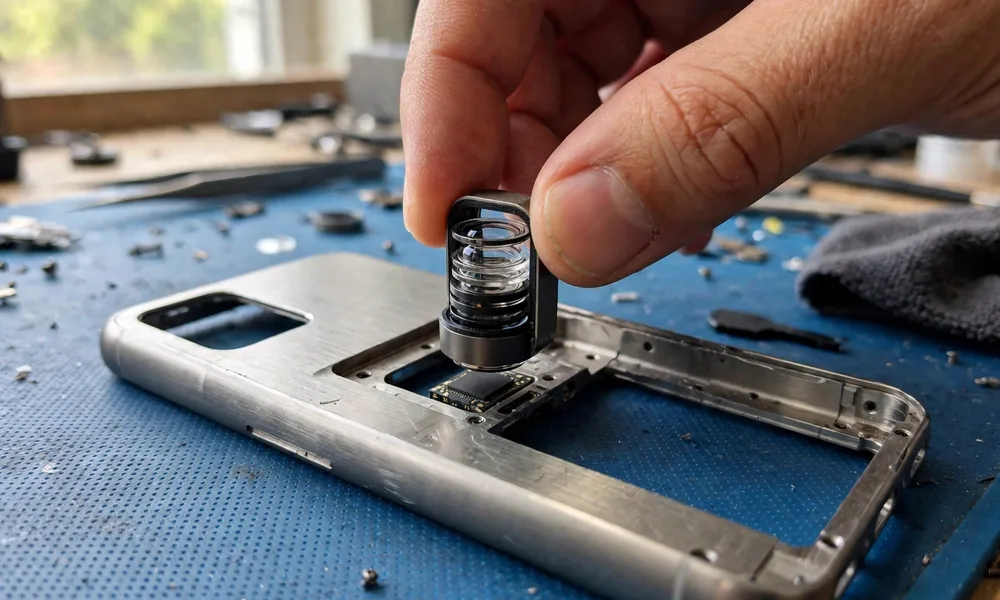
The camera is the most intricate part of a luxury smartphone, and it is built like a tiny piece of jewellery. Lenses of polished glass are stacked inside a small metal barrel, each one ground to a curve measured in microns, and behind them sits a sensor no bigger than a fingernail. The whole module is assembled in a clean room, sealed against dust, and then lowered into the frame, where it sits slightly proud of the back panel, protected by a ring of metal and sapphire glass. The guide to how a periscope zoom lens is made shows an even more folded version of the same idea, bending light sideways to fit a long lens into a thin phone.
Step 4: The main board and chips go in
Inside the frame, the main board is a dense plate the size of a credit card, carrying the processor, the memory, the storage and the modem that talks to the mobile network. The board is built in layers, with chips stacked on top of each other to save space, and it is lowered into the frame and screwed down. Around it go the smaller parts: the vibration motor that makes the phone buzz, the speakers, the microphones, the wireless charging coil and the antennas, which are built into the frame itself so the metal band becomes part of the radio.
Step 5: The battery is fitted and sealed
With the board in place, the battery goes in, and it is shaped to fill the space left around the camera and the board. Luxury phones use a layered pouch cell, a thin flat battery glued into the frame, with a small board that watches its temperature and charge. The battery is tested for swelling and heat before the back panel goes on, and the panel is then bonded to the frame with a waterproof adhesive, pressed in a jig and left to cure. The guide to how a 5G modem chip is made follows the tiny chip that lets the sealed phone talk to the network at full speed.
Step 6: Software, calibration and the final test
Before a luxury smartphone leaves the factory, it has to prove itself as a whole device. The operating system is loaded, the screen is calibrated so its colours match a reference exactly, and the camera is pointed at a test chart and focused, so every phone takes the same photograph of the same scene. Only a phone that passes both the machine test and the human one is cleaned, wiped down and packed with its cable.
The spec sheet at a glance
| Specification | Typical luxury figure | What it tells you |
|---|---|---|
| Frame | Machined titanium, polished | How strong the phone is, and how light it feels |
| Display | 6.1 to 6.9 inches, bonded glass | How sharp the picture looks, and how solid the screen feels |
| Weight | Roughly 190 to 230 grams | How heavy it feels in the hand all day |
| Processor | Latest high-end mobile chip | How fast it runs games and camera work |
| Memory | 12 to 16 gigabytes | How many apps it can keep open at once |
| Storage | 256 gigabytes to 1 terabyte | How many photographs and videos it can hold |
| Main camera | 48 to 200 megapixels | How much detail a photograph can hold |
| Battery | Roughly 4,500 to 5,500 milliamp-hours | How long it lasts away from a charger |
| Water resistance | Sealed to a high rating | How well it survives rain and a short dip |
What good build looks like
A well-made luxury smartphone gives itself away in small details. The seam between the frame and the glass should be even all the way round, the buttons should click with the same feel on both sides, and the camera lenses should sit perfectly flush in their metal ring, with no dust visible under the glass.

What it costs
A luxury smartphone typically costs an estimated $1,100 to $1,800, depending on the storage, the camera and the materials in the frame. The estimate covers the phone alone, not a case, a charger or a service plan. The price is mostly in the display, the camera and the titanium frame.
A rare fact
One detail few owners ever learn is that the glass on a luxury smartphone is strengthened by a bath of hot salt. The glass is dipped in molten potassium salt, and larger potassium ions swap places with smaller sodium ions in the surface, squeezing the glass tighter together.
From a bar of titanium on a milling machine to a finished phone tested in a human hand, a luxury smartphone is made in slow, dust-free stages, each one checked before the next begins. The result is a slab of glass and metal that feels like a single object, even though it holds a camera, a battery, a board and a dozen sensors inside.