Morning mist still hung over the marina when the speedboat slipped its lines and pointed its bow at open water. The owner touched the throttles, the twin engines cleared their throats, and the boat rose onto its plane with barely a shudder, spray peeling away from the hull in two clean sheets.
A luxury speedboat is a contradiction built on purpose: a boat that weighs as little as possible yet carries air conditioning, a galley, a cabin, and a sound system; a hull that must slice through waves at sixty knots yet feel calm at anchor.
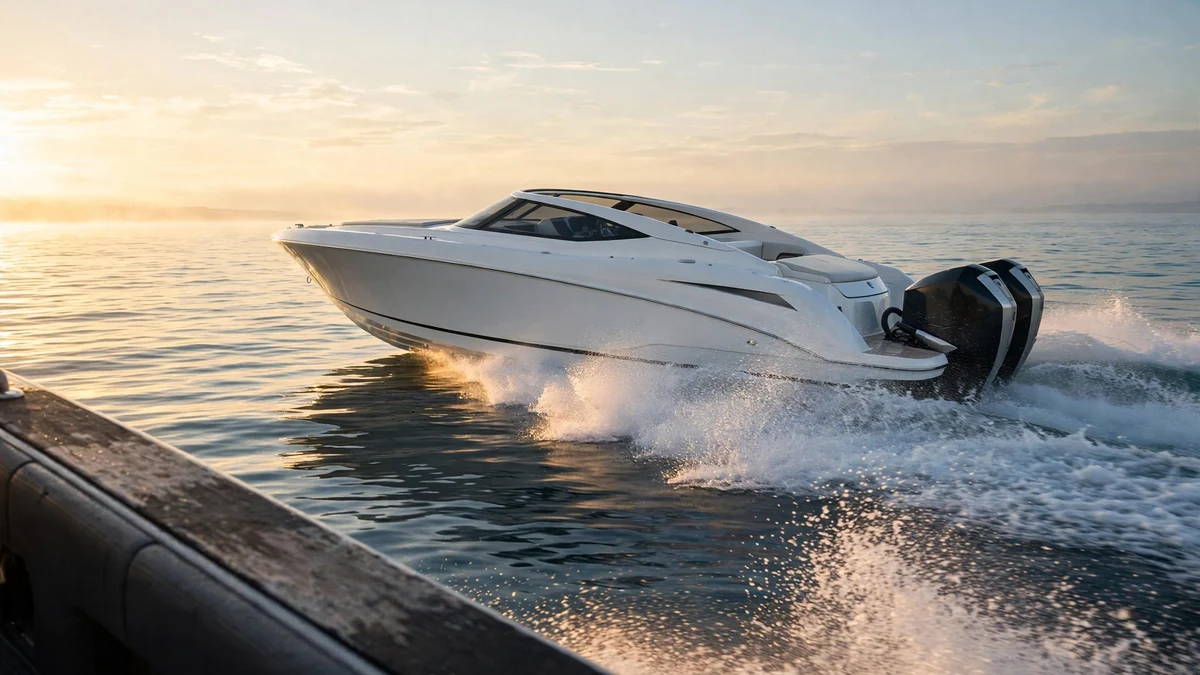
How a Luxury Speedboat Is Made
A speedboat starts life not on a factory floor but on a computer screen, where naval architects shape a hull that can do two things that fight each other: go very fast, and stay comfortable doing it. The answer is usually a deep-V hull, narrow at the bow and flaring toward the stern, with a sharp entry that cuts waves instead of slamming into them.
Step 1: Designing the hull for speed and comfort
The hull is the whole boat in a sense, so the design stage takes months. Engineers decide the length, usually between ten and fifteen metres for a luxury speedboat, and the beam, which sets how much cabin space there is below. They run the shape through fluid dynamics software, watching how water flows along the hull at fifty knots and where spray will go. Get the steps right and the boat needs less power to go faster; get them wrong and it porpoises, bouncing nose-up and nose-down across the water.
Step 2: Building the mould and laying the hull
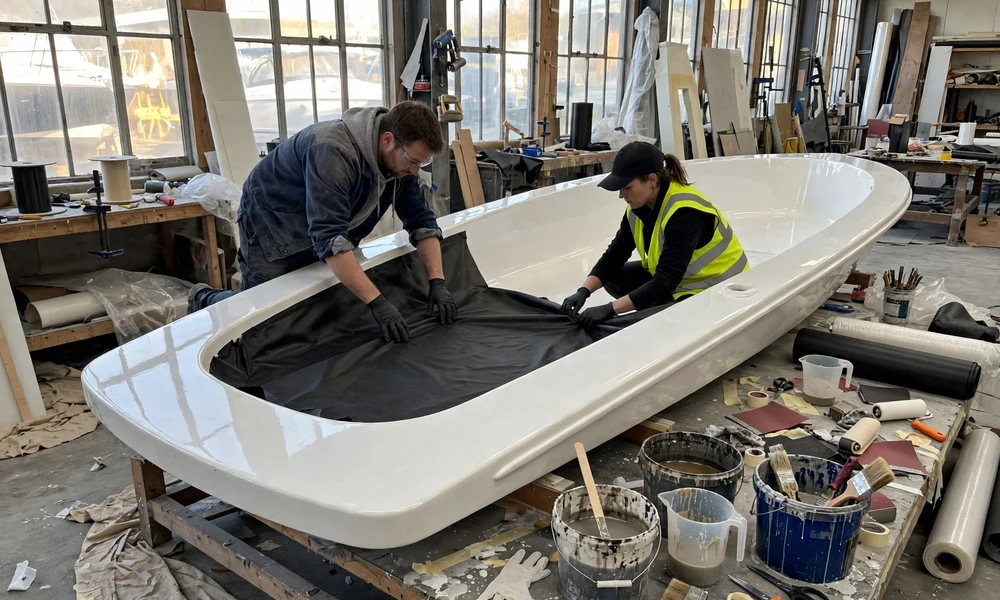
Once the design is settled, the yard builds a mould, a full-size negative of the hull, polished to a mirror finish because every flaw in the mould becomes a flaw in the boat. The hull itself is laid up by hand: layers of fibreglass cloth and carbon fibre are placed into the mould, soaked in resin, and then cured under vacuum so the resin is pulled into every fibre and no air is trapped. The result is a shell that is enormously strong for its weight, stiff enough to hold its shape at speed, and light enough that two engines can push it past sixty knots.
Step 3: Fitting the stringers and the deck
A bare hull shell is a floppy thing, so the next step is to give it a skeleton. Longitudinal stringers, long beams of foam-cored fibreglass, are bonded into the hull, and bulkheads divide the interior into compartments that add stiffness and keep the boat afloat if one section floods. The deck is built as a separate moulding, with its own non-slip surfaces and moulded seating, and then bonded to the hull in a joint that is glued, bolted, and glassed over so the two halves become one structure.
Step 4: Installing the engines and the drives
Power usually comes from two or three outboard engines hung on the transom, each producing 400 to 600 horsepower, or from inboard engines driving sterndrives through the hull. The engines are bolted to a reinforced transom that must take not just their weight but the full thrust of the propellers, and the fuel system is installed with tanks low in the hull to keep the centre of gravity down. Steering is hydraulic, the throttles are electronic, and the whole installation is wired so the captain can trim the drives from the helm and lift the bow or drop it with a touch. Yacht propeller materials matter here more than anywhere, because the propellers are the one part of the boat that turns all that horsepower into speed, and they spin in water that is full of debris at sixty knots.
Step 5: Fitting the luxury interior
With the structure and engines in place, the boat goes to the fit-out shop, where it stops looking like a machine and starts looking like a lounge. The cabin below gets a double berth, a small galley, and a head, all trimmed in teak or pale oak with leather and stainless steel. The helm gets a glass dashboard with navigation screens, engine displays, and a sound system, and the cockpit gets sun pads, a wet bar, and seating that converts from dining to lounging.
Step 6: Sea trials, tuning, and the handover
No speedboat leaves the yard without sea trials, and they are the most enjoyable part of the build. Test drivers run the boat through its full speed range, measuring top speed with GPS, checking that the hull planes cleanly, and tuning the propellers and engine trim until the ride is flat and the fuel burn is right. They test the handling at full lock, the stopping distance, and the ride through real chop, and they check that the boat is dry at speed, with spray going wide of the cockpit. Only when the numbers match the design does the boat get its final polish, its anchor and its lines, and the keys handed over. The ground tackle is specced to the same standard as the rest of the boat, and the yacht anchor winch that hauls it must be as reliable as the engines, because a speedboat that cannot hold its position at anchor is a speedboat that cannot stop.
Luxury Speedboat Specifications
| Specification | Typical figure |
|---|---|
| Length | 10 to 15 metres |
| Top speed | 50 to 65 knots |
| Engines | Two or three outboards, 400 to 600 hp each |
| Hull material | Fibreglass and carbon fibre, vacuum-infused |
| Fuel capacity | 800 to 1,500 litres |
| Range at cruise | 200 to 300 nautical miles |
| Draft | 0.6 to 0.9 metres |
What a Luxury Speedboat Costs
A luxury speedboat is priced like the performance machine it is. A well-equipped ten-metre boat with twin 400-horsepower outboards typically costs an estimated $400,000 to $700,000, while a fifteen-metre flagship with triple 600-horsepower engines, a full cabin, and a carbon hull can reach an estimated $1.5 million to $2.5 million. The anchor gear alone is specced like equipment from a much larger yacht, and the luxury yacht anchor it carries is built to hold the boat in a blow, not just to look right on the bow.
A Rare Fact About Luxury Speedboats
Some of the fastest luxury speedboats do not really float at top speed at all. Their stepped hulls trap pockets of air beneath the boat, so at sixty knots much of the hull is riding on a cushion of air rather than on water, and only the steps and the propellers are properly wet. It is the same trick a hovercraft uses, done with nothing but the shape of the hull, and it is why a well-designed speedboat can be both quicker and more fuel-efficient than a heavier boat with the same engines. The boat is, in a small and literal way, flying.
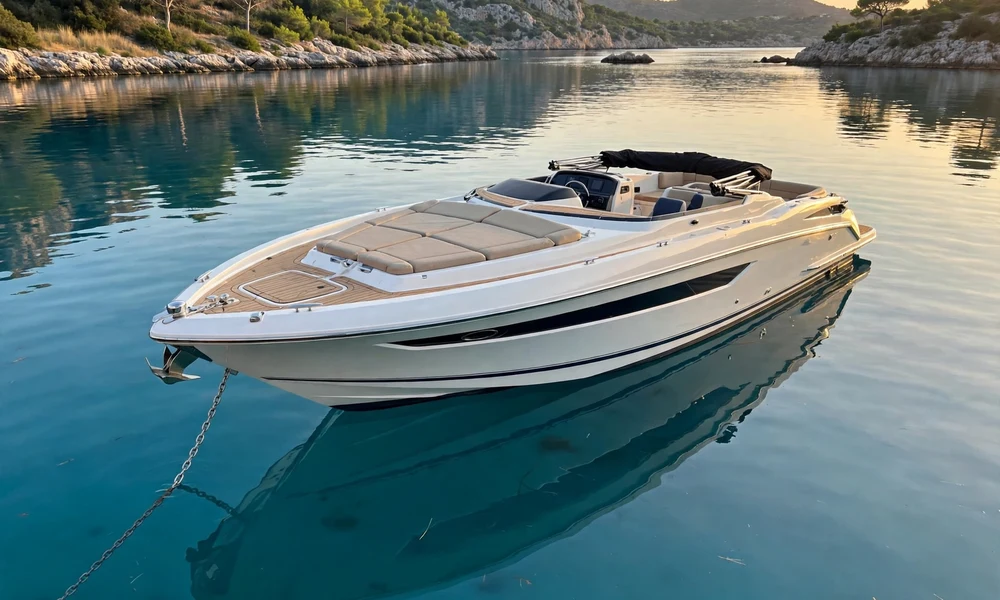
The next time a speedboat streaks past and the spray hangs in the air behind it, remember what went into that minute of speed: a hull shaped by software, a shell of carbon and glass, engines hung on a transom built to take their full force, and a cabin finished like a hotel room. A luxury speedboat is not a fast boat with nice seats. It is a machine that was designed to be fast and comfortable at the same time, and the fact that it manages both is the whole achievement.


