The captain gave the order, and the anchor chain began to move. Down on the foredeck, the windlass groaned once, then settled into a steady rhythm, hauling link after link of heavy chain out of the water while the anchor rose from the seabed forty metres below. Nobody on the sun deck noticed. The yacht barely shuddered, the chain came up clean, and within minutes the anchor was seated in its pocket and the yacht was under way. That quiet, uneventful moment is the whole point of a yacht anchor winch, and it is a far more demanding machine than it looks.
An anchor winch, usually called a windlass on a yacht, is the machine that raises and lowers the anchor and chain. On a small boat it can be a hand-cranked drum, but on a superyacht it is a hydraulic or electric giant that must lift several tonnes of steel chain and anchor, hold them against the pull of wind and current, and do it all without tearing the deck apart.
How a Yacht Anchor Winch Is Made
Building a winch starts with a single question: how much weight must it lift? Engineers calculate the weight of the anchor plus the full length of chain, then add a safety margin for the drag of a fouled anchor and the pull of a storm. A 50-metre yacht might carry 150 metres of 16-millimetre chain weighing over three tonnes, plus an anchor of 300 kilograms, so the winch is designed to pull five tonnes or more without straining. Every part after that, from the motor to the smallest bolt, is sized around that number.
Step 1: Casting and machining the frame
The winch frame is the backbone, and it is usually cast from bronze or a high-grade aluminium alloy, then machined flat so the moving parts sit perfectly true. The frame bolts through the deck to a reinforced structure below, because the load from the chain does not stop at the winch: it travels through the frame into the hull itself. Machinists cut the bearing seats to tolerances of a fraction of a millimetre, since a shaft that runs even slightly out of true will wear its bearings out in a single season.
Step 2: Making the gypsy that grips the chain
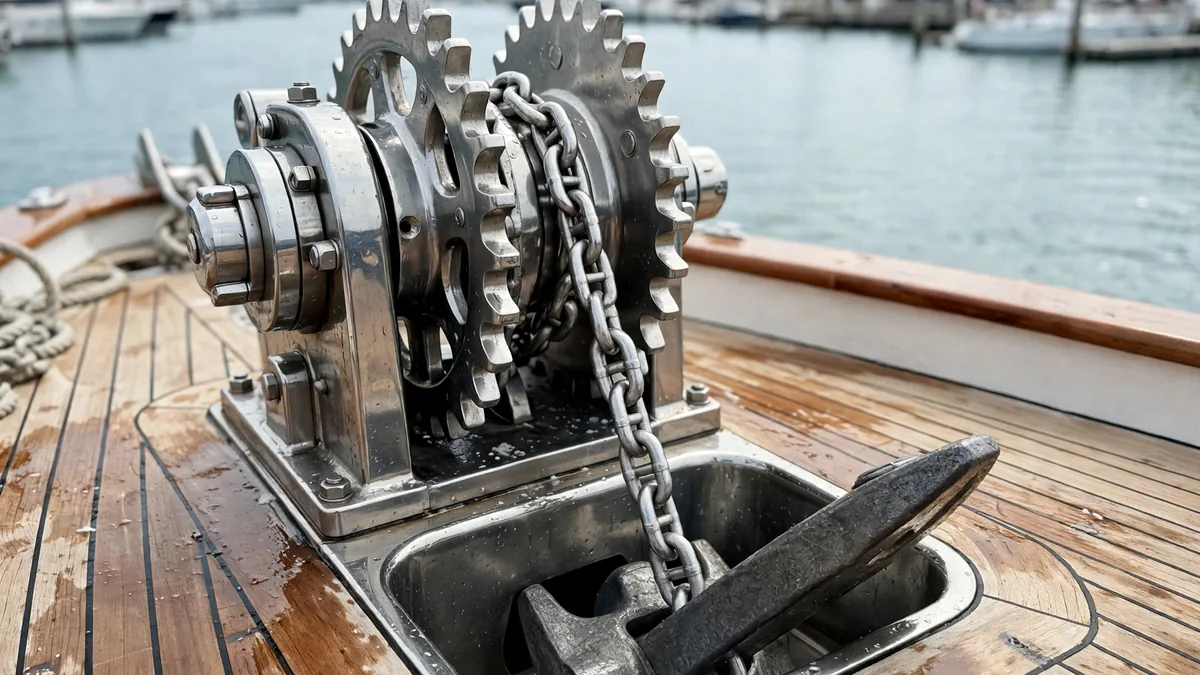
The heart of the winch is the gypsy, the wildcat wheel with pockets shaped to fit each chain link exactly. The gypsy is cast in bronze or stainless steel, then machined so every pocket matches the chain’s link size and pitch. If the pockets are too loose, the chain slips; if they are too tight, the links jam and the winch stalls. The luxury yacht anchor it hauls is shaped to dig into the seabed, but the gypsy is shaped to hold the chain, and the two have to work as a pair.
Step 3: Fitting the motor and gearbox
Power comes from a hydraulic motor or a large electric motor, chosen for the torque the winch needs at very low speed. The motor drives a gearbox, usually a worm gear or a multi-stage planetary set, which trades speed for pulling force: the motor spins fast, the gypsy turns slowly, and the chain comes in at a steady, controlled pace. The gearbox is sealed against salt water and filled with oil, and its gears are cut from hardened steel and ground to a smooth finish so they run quietly.
Step 4: Building the chain locker below
Under the deck, the chain falls into a chain locker, a deep compartment shaped to let the chain pile itself neatly as it comes in. A chain stopper, a heavy steel jaw, sits between the winch and the hawse pipe, and it takes the load off the winch once the anchor is up: the crew sets the stopper, and the chain’s pull is held by the hull, not the gearbox. Without that simple device, the winch would have to hold the anchor’s weight for the whole voyage.
Step 5: Sealing it against the sea
Everything on the foredeck is washed by waves, so sealing is a build step of its own. Shafts pass through the deck with double lip seals, the motor housing is rated waterproof, and every electrical connection is made with marine-grade plugs and heat-shrink. Yacht winch materials are chosen for this exact battle: stainless steel for the parts that see the water, bronze for the parts that slide, and coatings that keep the two from corroding each other.

Step 6: Installing, testing, and proving the pull
Installation means lowering the winch onto its deck foundation, aligning the gypsy with the hawse pipe so the chain runs fair, and connecting the hydraulics or the power cables. Then comes the proof test: the crew anchors in deep water and hauls the full length of chain and anchor back aboard, timing the recovery and watching the load gauge. The winch must pull its rated load without overheating, hold it on the brake without slipping, and lower the anchor smoothly under control. Only when it passes does the deck get its final polish and the winch get its cover, ready for the day the captain says the word and the chain starts to move.
Yacht Anchor Winch Specifications
| Specification | Typical figure |
|---|---|
| Pulling power | 3 to 8 tonnes on a 40 to 70 metre yacht |
| Chain size | 13 to 22 millimetres, calibrated stud-link |
| Anchor weight | 150 to 500 kilograms |
| Recovery speed | 8 to 15 metres per minute |
| Drive | Hydraulic or 24-volt electric motor |
| Gypsy material | Bronze or stainless steel, machined pockets |
| Brake | Spring-applied, power-released holding brake |
What a Yacht Anchor Winch Costs
A windlass for a superyacht is a serious piece of equipment, and its price reflects that. A complete hydraulic windlass for a 50-metre yacht typically costs an estimated $25,000 to $80,000, with the largest units for yachts over 80 metres reaching an estimated $150,000 or more once the motor, controls, and installation are counted. Owners rarely question the price, because the winch is the one machine that has to work in the worst conditions the yacht will ever meet, and a failure at anchor in a storm is not a repair bill but an emergency. A yacht propeller is built to the same philosophy, where the metal in the water is the last place to save money.
A Rare Fact About Yacht Anchor Winches
Some of the largest superyacht windlasses are built with two gypsies on one shaft, so the yacht can deploy two anchors at once or use the second drum as a warping winch for mooring lines. Even rarer, a few yachts carry a winch with a chain counter so precise that the captain can read the exact length of chain on the seabed from the bridge, and the system will stop the windlass automatically before the anchor reaches the bow, so the crew never has to guess. It is a small piece of software on a very old machine, and it turns anchoring from a deck exercise into a bridge command.
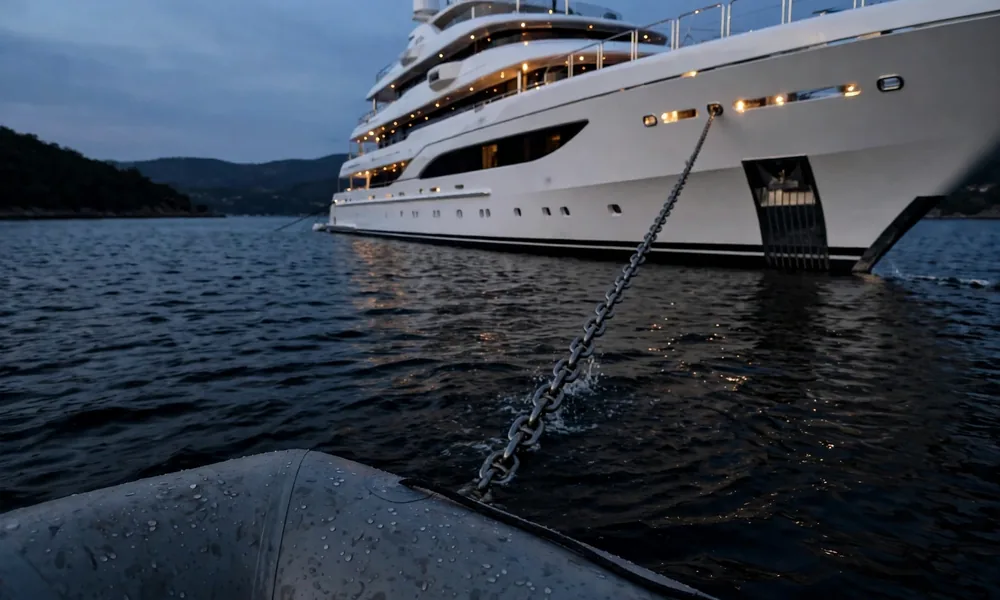
The next time you watch a yacht anchor glide up out of the water and settle into its pocket without a shudder, remember the cast frame, the machined gypsy, and the brake holding tonnes of steel on a spring. The winch is not the glamorous part of a yacht, but it is the part that lets the yacht stop, and that makes everything else possible.


