Under the stern of every yacht, out of sight and out of mind, spins the one part that turns engine power into motion. A propeller is a piece of shaped metal, and the choice of that metal decides whether a yacht is fast, quiet, efficient — or stuck in a boatyard with a cracked blade.
A yacht propeller is usually bronze, and the reason is a century of hard lessons in salt water. Steel rusts, aluminium corrodes, and plain copper is too soft. The alloys that survive are the bronzes: copper mixed with aluminium, nickel and manganese in careful proportions, cast into blades that are then machined and polished to a mirror shine.
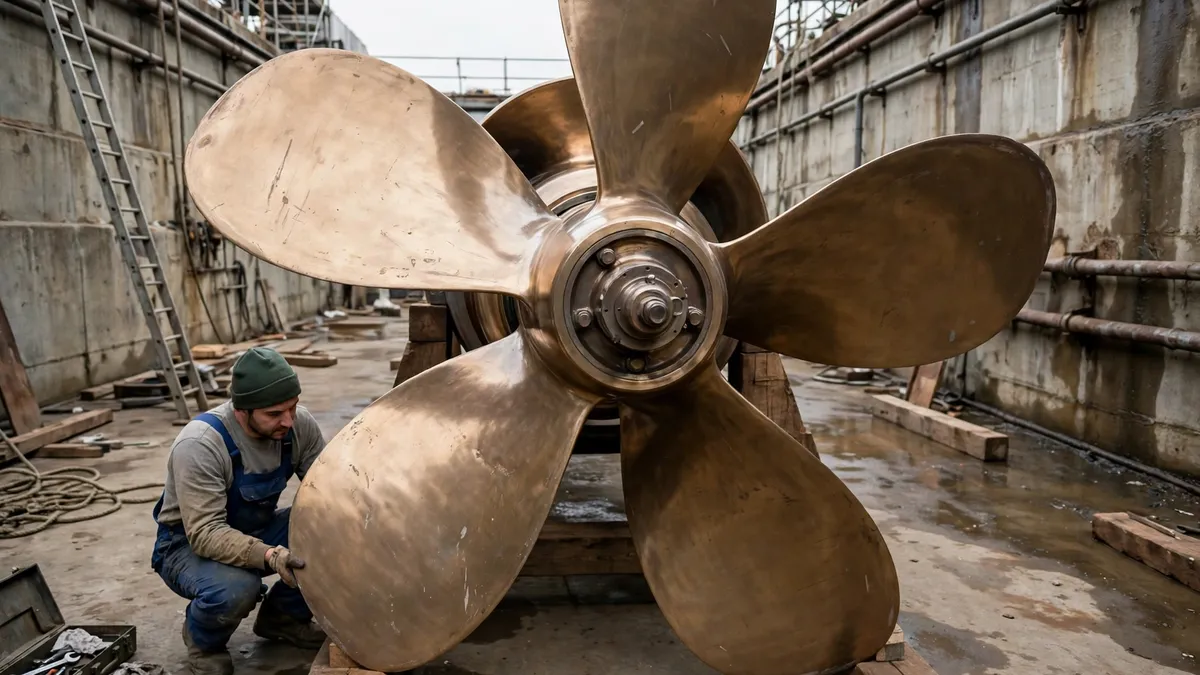
The Materials Behind the Yacht Propeller
At its simplest, a propeller is a screw that bites into water. Each blade is a twisted wing, and as it turns, the angle of the blade pushes water backwards and the yacht forwards. The loads are enormous: a blade must resist bending, resist cavitation — the tiny collapsing bubbles that can eat metal away — and survive a lifetime immersed in salt water. The material must be strong, tough, corrosion-proof and easy to repair, because a propeller that cannot be fixed in a boatyard is a propeller that will strand its owner.
Step 1: Nickel-aluminium bronze, the workhorse alloy
Most modern yacht propellers are cast from nickel-aluminium bronze, known as NAB, an alloy of roughly eighty percent copper with aluminium, nickel, iron and manganese. The aluminium gives it strength and a hard surface, the nickel adds toughness, and the iron helps it resist cavitation erosion. NAB is about twice as strong as the older manganese bronze it replaced, and it forms a protective oxide film in seawater that slows corrosion to a crawl. It is the default choice for propellers from small sailing yachts to large motor yachts.
Step 2: Manganese bronze and the older fleet
Before NAB took over, manganese bronze was the standard. Despite the name, it is really a brass — mostly copper and zinc, with manganese, iron and aluminium added for strength. Its weakness is dezincification, a slow corrosion that leaches zinc out of the alloy in seawater, leaving a spongy, weakened copper skeleton behind.
Step 3: Casting a blade in a sand mould
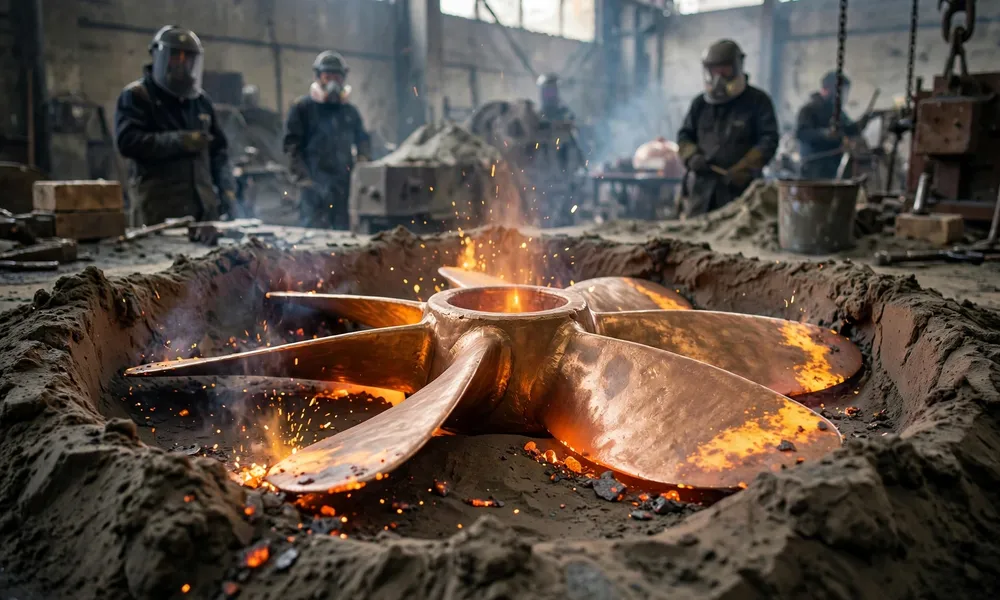
A propeller starts as a pattern, a full-size model of the finished blade shape, pressed into special foundry sand to make a mould. Molten bronze, heated to over 1,000 degrees Celsius, is poured into the mould and left to cool slowly. Once cool, the casting is dug out of the sand, the pouring channels are cut away, and the rough propeller is revealed, its blades thick, rough and dull. The submarine propeller is cast in a similar way, though its blades are shaped for silence rather than speed, and the foundry work is held to even tighter tolerances.
Step 4: Machining, pitch and the shape of thrust
The rough casting goes to a machine shop, where computer-controlled mills carve each blade to its final shape. The most important number is the pitch: the distance the propeller would travel forward in one turn if it were screwing through a solid, and it is set by the twist built into each blade. The machinist works to tolerances of fractions of a millimetre, because a blade that is even slightly out of shape will vibrate, and vibration on a yacht is felt in every cabin. The hub is bored and keyed to fit the propeller shaft, and the blades are checked for balance.
Step 5: Polishing away cavitation
After machining, the propeller is polished, and the polish is functional, not cosmetic. Cavitation happens when the pressure on the back of a fast-spinning blade drops so low that the water itself boils into tiny bubbles, which then collapse with enough force to pit the metal. Polishing is done by hand with progressively finer abrasives, and a good polisher can spend a full day on a single large propeller.
Step 6: The shaft, the anode and the corrosion team
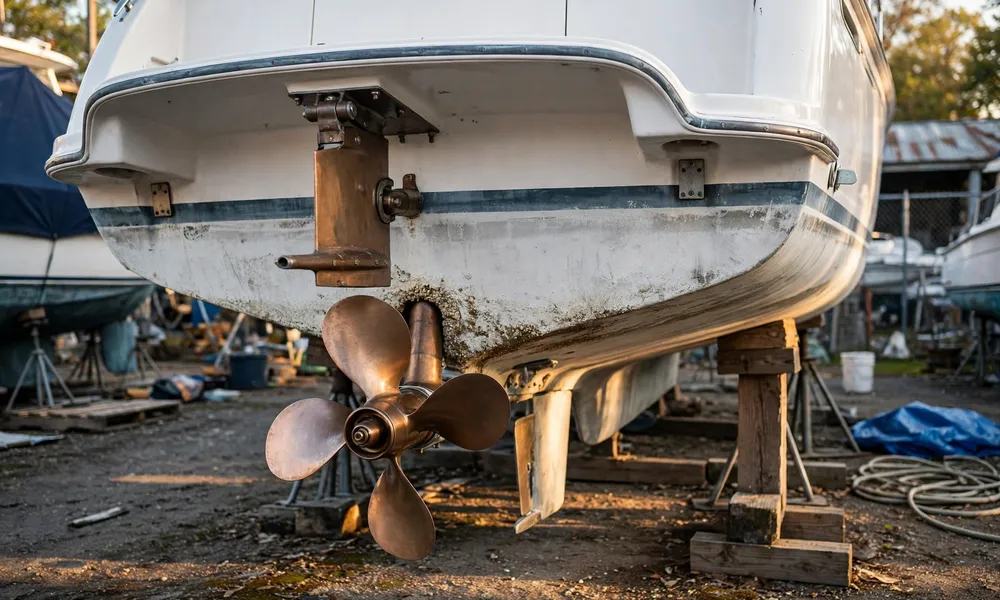
A propeller never works alone. It sits on a stainless steel shaft, sealed where it passes through the hull, and it is protected by a sacrificial anode, usually a lump of zinc bolted to the shaft or the hull nearby. The anode corrodes first, deliberately, giving up its own metal so the bronze propeller does not have to. The shaft itself is usually a marine stainless steel such as Aquamet, chosen for strength and corrosion resistance, and the coupling that joins it to the gearbox must transmit the full torque of the engine without slipping. The same teamwork of metals protects the yacht stabilizer fins, whose bronze and steel parts are guarded by anodes in exactly the same way.
Step 7: Folding, feathering and the sailing compromise
Sailing yachts face a special problem: a fixed propeller drags in the water when the boat is under sail, slowing it down. The answer is a folding or feathering propeller, whose blades fold back against the hub or rotate to lie flat with the water flow when the engine is off. These propellers add moving parts — bronze blades on stainless steel pins, with gears and springs inside the hub — and every extra part is a place where salt water can cause trouble. Their pivots and gears are made from harder stainless steels and phosphor bronze, chosen to survive years of folding and unfolding without seizing. The cruise ship engine never faces this problem, since its propellers never need to fold away, but it shares the same bronze and the same fight against cavitation.
Yacht Propeller at a Glance
| Specification | Detail |
|---|---|
| Main alloy | Nickel-aluminium bronze (NAB), about 80% copper |
| Older alloy | Manganese bronze, a copper-zinc brass |
| Melting point | Bronze poured at over 1,000°C |
| Typical blades | 3–5 blades for yachts, sometimes 2 for sailing yachts |
| Blade finish | Machine-milled, then hand-polished to a mirror shine |
| Shaft material | Marine stainless steel, such as Aquamet |
| Corrosion guard | Sacrificial zinc anode on shaft or hull |
| Main enemy | Cavitation erosion and galvanic corrosion |
What Does It Cost?
A new bronze propeller for a yacht typically costs between $1,500 and $15,000 (estimate) depending on size, with large five-blade propellers for motor yachts running higher still (estimate). A folding or feathering propeller costs more, often $3,000 to $20,000 (estimate), because of the extra machining and moving parts. Repair is usually cheaper than replacement: a damaged blade can be welded, reshaped and rebalanced for a few hundred dollars (estimate). The anode that protects it all costs only tens of dollars (estimate) and is replaced every year or two.
A Rare Fact
A propeller blade can be eaten away by water itself. Cavitation bubbles collapse with such violence that they punch microscopic pits into the bronze, and over time those pits join into rough patches that look like the metal has been sandblasted from the inside. The cure was not a stronger metal but a better shape: blades designed so the water pressure never drops low enough to boil. The most destructive force acting on a yacht propeller is not salt, not rocks, and not the engine — it is the water it swims in.


