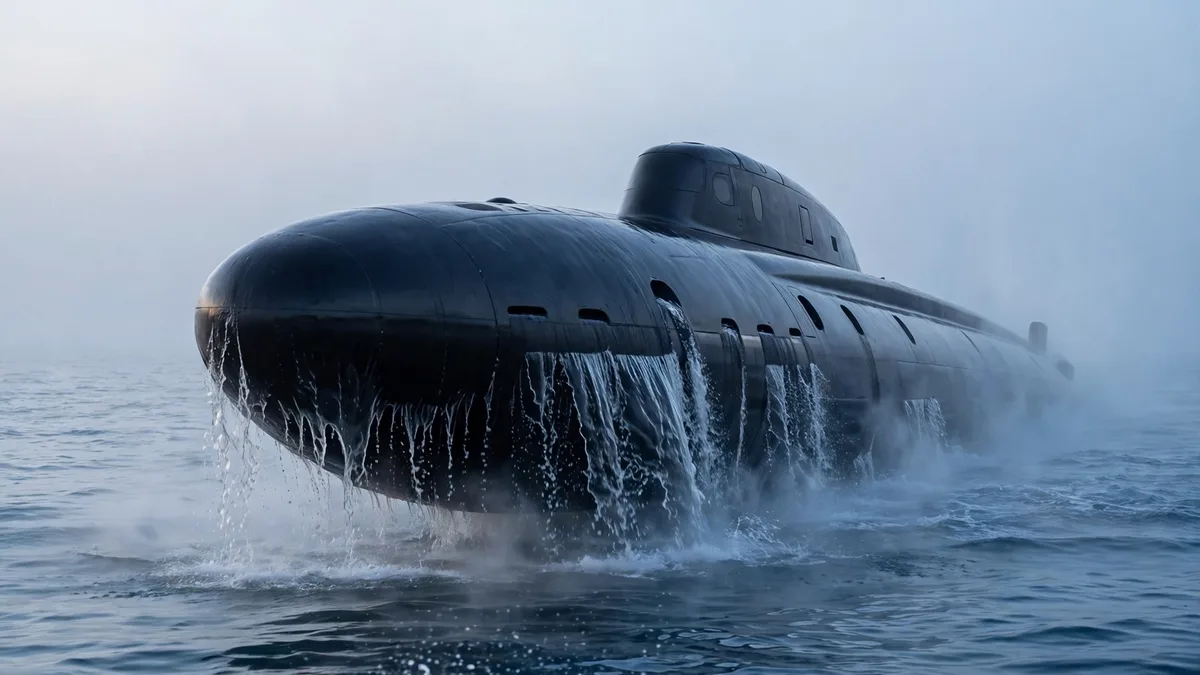
A submarine does something no other vessel on earth does on purpose: it sinks itself, on command, and then comes back up again. The ballast tanks are the reason it can do that, great steel chambers that fill with water to drag the boat down and empty again with air to lift it back to the surface, and they are the most important system on the whole boat after the hull itself.
On a luxury submarine, the kind that takes guests down to a reef for an hour and brings them back for lunch, the ballast tanks are worked gently and precisely, because the passengers expect a smooth descent, not a rollercoaster. Yet the principle is the same as on any submarine, and it is a beautiful piece of simple physics. This is how a luxury submarine ballast tank works.
How It Works
Step 1: The tanks sit between the hulls, ready to fill or empty
A submarine has two hulls, not one: the pressure hull inside, where the crew lives, and a lighter outer hull that gives the boat its shape. The main ballast tanks sit in the space between them, usually at the bow and the stern, with smaller trim tanks inside the pressure hull for fine adjustments. When the tanks are full of air, the boat is light and floats on the surface like any ship, but when they fill with water, the boat grows heavy and sinks.
Step 2: Opening the vents lets the sea in and the boat goes down
To dive, the crew opens the flood valves at the bottom of the tanks and the vent valves at the top, and the sea rushes in through the bottom while the air escapes through the top, with a sound like a great sigh. As the tanks fill, the boat grows heavier, the waterline climbs up the hull, and the submarine slips beneath the surface, slowly at first and then faster as the last of the air leaves the tanks.
Step 3: Trim tanks fine-tune the boat’s balance underwater
Once the boat is under the water, the main ballast tanks are full and the boat is roughly the same weight as the water it displaces, which means it neither sinks nor floats, it simply hangs in the water. But roughly is not good enough, so the crew uses the trim tanks, smaller tanks inside the pressure hull that can be pumped full or emptied to shift weight forward or backward, up or down. It is a constant, quiet balancing act, done with pumps and valves, and it is what keeps the boat level while it cruises along the reef.

Step 4: Compressed air blows the water out and the boat rises
To surface, the crew does the opposite of diving: they close the flood valves and the vents, then open the blow valves, and high-pressure air from the boat’s air banks rushes into the top of the tanks, forcing the water out through the bottom. The boat grows lighter with every litre of water that leaves, and it rises, slowly at first, then faster as more of the hull breaks the surface, until the tanks are full of air again and the boat is floating.
Step 5: A low-pressure blower finishes the job on the surface
Blowing the tanks with high-pressure air is fast but wasteful, so once the boat is on the surface, the crew switches to a low-pressure blower, a big fan that pushes air into the tanks at a gentle pressure to drive out the last of the water. The blower is slower, but it saves the precious high-pressure air for the next dive, and it is the system the crew uses for routine surfacing, keeping the air banks full for emergencies.
Step 6: The emergency blow can empty the tanks in seconds
Every submarine carries a last resort, the emergency blow, and it is the one system the crew hopes never to use. If the boat is sinking and will not stop, the captain can open all the blow valves at once, and the full force of the air banks empties the main ballast tanks in seconds, sending the boat rocketing to the surface in a storm of white water. On a luxury submarine the system is the same, sized for the boat and tested just as carefully, because the physics of sinking does not care whether the passengers are tourists or sailors.
| Spec | Detail |
|---|---|
| Location | Between the outer and pressure hulls, mainly bow and stern |
| Diving | Vents open, sea floods in, air escapes, boat grows heavy |
| Surfacing | Compressed air blows the water out, boat grows light |
| Trim tanks | Smaller tanks inside the hull for fine balance adjustments |
| Air banks | Steel bottles of air at hundreds of times normal pressure |
| Emergency blow | Empties the main tanks in seconds to surface at once |
The most remarkable part of a ballast tank is how simple it is. There is no engine in it, no computer and no moving part except a valve, and yet it is the system that lets a submarine do the one thing no other vessel can: choose whether to float or to sink. That is why the valves are tested on every dive and the air banks are kept full, because a ballast tank is simple, but it is never allowed to be wrong. The tanks are emptied and filled on every dive, and they are inspected on every return to port, because a valve that sticks is a dive that goes wrong. On a well-run boat, the ballast system is the quietest part of the dive, and the most trusted.
What One Costs
A luxury submarine ballast tank system typically costs an estimated $1 million to $8 million, and the price is set mostly by the size of the tanks, the capacity of the air banks and the complexity of the valves rather than the luxury fittings of the boat. A small tourist submarine with simple tanks and a modest air bank sits at the bottom of the range, while a larger boat with redundant blow systems and heavy-duty valves costs far more. The price is in the steel and the air, not the controls, and how a luxury submarine sonar works explains the system that lets the crew see while submerged, while how a luxury submarine battery is made shows what powers the boat while it is underwater.
A Rare Fact
A submarine does not need its ballast tanks to stay at one depth, it needs them to hover, and hovering is harder than diving. To stay level at a fixed depth, the boat must weigh exactly the same as the water it pushes aside, to the kilogram, and the crew achieves it with the trim tanks, pumping a little water in or out as the boat drifts up or down.

A luxury submarine ballast tank is a steel chamber, a valve and a bottle of compressed air, working together to let a boat sink on purpose and come back up again. It is the simplest system on the submarine and the one that makes everything else possible. For the instrument that guides the boat while it is down there, the specifications of a luxury submarine sonar show what the boat’s ears are built to hear.