On a grey morning at sea, a luxury submarine is almost invisible. The hull is hidden below the waves, the sail is barely awash, and the only sign of the boat is a slim dark tube standing in the water, drawing breath. It looks too thin and too simple to matter, yet that tube is the snorkel mast, and without it a diesel submarine would have to surface every few hours to run its engines, giving away its position to anyone watching.
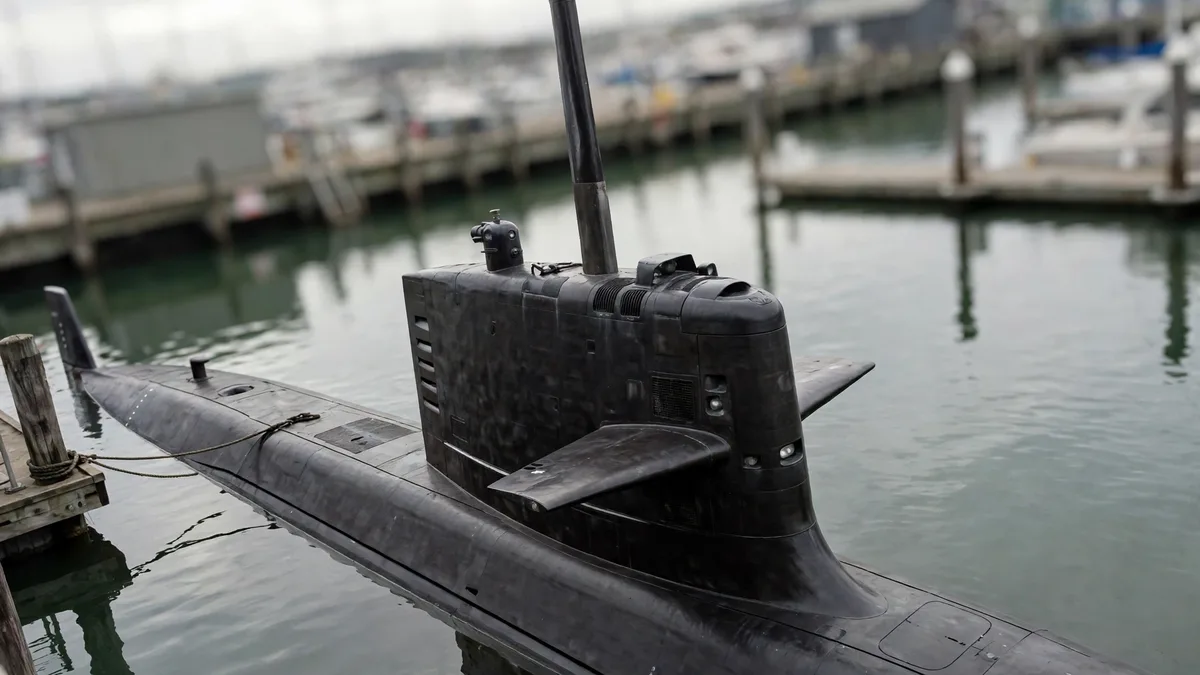
A luxury submarine snorkel mast is a tall steel tube that rises from the sail of the boat to just above the surface, carrying fresh air down to the engines and the crew while the hull stays hidden underwater. It is not a periscope, which is an optics tube for looking, and it is not a simple pipe either. It must seal itself in a fraction of a second when a wave breaks over it, hold back the full pressure of the sea, and keep breathing through storms.
How It’s Made
Step 1: Designing a tube that breathes and seals
Every snorkel mast starts with a problem that has to be solved on paper first. The tube must be tall enough to clear the waves at periscope depth, wide enough to feed the engines all the air they need, and slim enough not to leave a wake that gives the boat away. Engineers work out the airflow the diesel engines demand at full power, then size the bore of the tube so the air moves fast without whistling or shaking the mast. Too narrow and the engines starve; too wide and the mast becomes a sail that drags in the water.
Step 2: Rolling and welding the steel tube
The mast begins as flat sheets of steel, rolled into cylinders and welded along the seam. The rolling is done slowly, a little at a time, so the tube stays perfectly round, because a tube that is even slightly oval will bind in its guides when it is raised and lowered. The seam weld is ground smooth inside and out, then tested with ultrasound to make sure there is no hidden flaw that sea pressure could open up. Several tube sections are made this way, each one a little narrower than the one below, so the mast telescopes down into the sail when it is lowered. The same care with a sliding steel tube appears in other submarine gear, and the way a luxury submarine snorkel mast works shows how those smooth sections rise and fall while the boat stays hidden below.
Step 3: Building the head valve and float valve
The head valve is the most delicate part of the whole mast, and it is built like a piece of fine machinery rather than a pipe fitting. It is a hinged cap at the top of the tube, held open by a spring and closed by a float that lifts the instant water reaches it. The hinge pins are polished and the sealing face is machined flat, then fitted with a rubber ring that must press evenly all the way round, because a valve that leaks even slightly will let seawater pour down into the engines. Below it sits the float valve, a second seal that rises on its own buoyancy if water gets past the head valve.

Step 4: Fitting the raising gear and air trunk
A snorkel mast spends most of its life lowered inside the sail, so it needs raising gear that can lift it smoothly and hold it steady against the drag of the sea. The gear is usually a hydraulic cylinder or a rack and pinion drive, built into the sail and connected to the bottom of the mast. The cylinder is filled with oil, sealed against salt water, and tested to lift the full weight of the mast hundreds of times without a hitch, because a mast that sticks halfway up is worse than no mast at all. Below the mast runs the air trunk, the wide pipe that carries the incoming air down to the engine room.
Step 5: Installing the mast in the sail
With the tube, valves and raising gear ready, the mast is lowered into the sail of the submarine, a job that needs a crane, a calm day and a great deal of patience. The sail is the fin on top of the hull, and inside it is a forest of pipes, cables and other masts, so the snorkel mast must slide into its guides without touching anything around it. Fitters guide it down by hand, checking the clearance at every stage, and the mast is raised and lowered several times before the guides are finally bolted tight. The guides are greased with a lubricant that survives salt water, and the seals where the mast passes through the top of the sail are fitted and tested. The reason a simple-looking tube can cost so much is plain once the work is seen up close, as the way a luxury submarine snorkel mast earns its price shows.
Step 6: Testing, dunking and the first breath
The finished mast is tested harder than almost any other part of the boat. First it is raised and lowered in the dock hundreds of times, while engineers watch for sticking, shaking or any sound that should not be there. Then the head valve is dunked again and again, and the air trunk is flooded on purpose to prove the water trap and the float valve work. The engines are started with the mast raised, and the airflow is measured to prove the diesels can run at full power on snorkel alone. Engineers below listen for water in the trunk and watch the engine instruments for any dip in power. The figures behind that quiet breathing are worth a look too, and the way a luxury submarine snorkel mast’s specs are explained shows what height and airflow mean for a boat at periscope depth.
| Specification | Typical mast |
|---|---|
| Structure | Telescoping steel tube sections sliding through the sail |
| Height raised | Several metres above the sail, clearing the waves |
| Head valve | Hinged cap with float, snapping shut on contact with water |
| Float valve | Second buoyant seal below the head valve |
| Raising gear | Hydraulic cylinder or rack and pinion inside the sail |
| Air trunk | Wide steel pipe to the engine room with a water trap |
| Material | Corrosion-resistant steel, machined smooth, sealed joints |
| Testing | Hundreds of raise, dunk and pressure cycles before sea trials |

A luxury submarine snorkel mast is an estimate of $300,000 to $900,000, depending on its height, the size of the air trunk and the complexity of its valves. The price covers the steel tube sections, the head and float valves, the raising gear, the air trunk, the installation in the sail and the long programme of dunk and sea testing, with the valves alone often costing more than the steel around them.
Here is a rare fact worth knowing. The first snorkels were fitted to Dutch submarines in the late 1930s, and the idea was so simple that other navies copied it within a few years, yet early snorkel masts were so unreliable that a wave over the top could flood the engines and fill the boat with choking diesel fumes, forcing the crew to surface anyway. The modern luxury version closes its head valve in a fraction of a second, seals dry through storm after storm, and lets a boat run its engines for days without ever breaking the surface, all through a tube no wider than a dinner plate.


