A submarine is a steel tube that dives into water that wants to crush it, and the pressure hull is the tube. It is the inner shell that holds the crew, the air and everything they need to live, and it is built to survive pressures that would flatten an ordinary ship like a tin can.
On a luxury submarine, the kind that carries guests down to a coral reef rather than into a war zone, the pressure hull is the whole reason the trip is possible. It is a cylinder of special steel, welded ring by ring, tested until it can be trusted with people’s lives, and then hidden behind the sleek outer hull that guests actually see. This is how a luxury submarine pressure hull is made.
How It’s Made
Step 1: The steel is chosen for strength, not for cheapness
Everything starts with the steel, and ordinary ship steel will not do. A pressure hull needs a steel that is strong, tough and able to be welded without turning brittle, so the yard orders a special high-strength alloy, usually a low-carbon steel with a small amount of nickel or chromium, made in a mill that can certify every single plate. Each plate arrives with its own paperwork, showing exactly where it was made and what it is made of, and the yard checks it again before it is allowed near the hull.
Step 2: Plates are rolled into rings and welded together
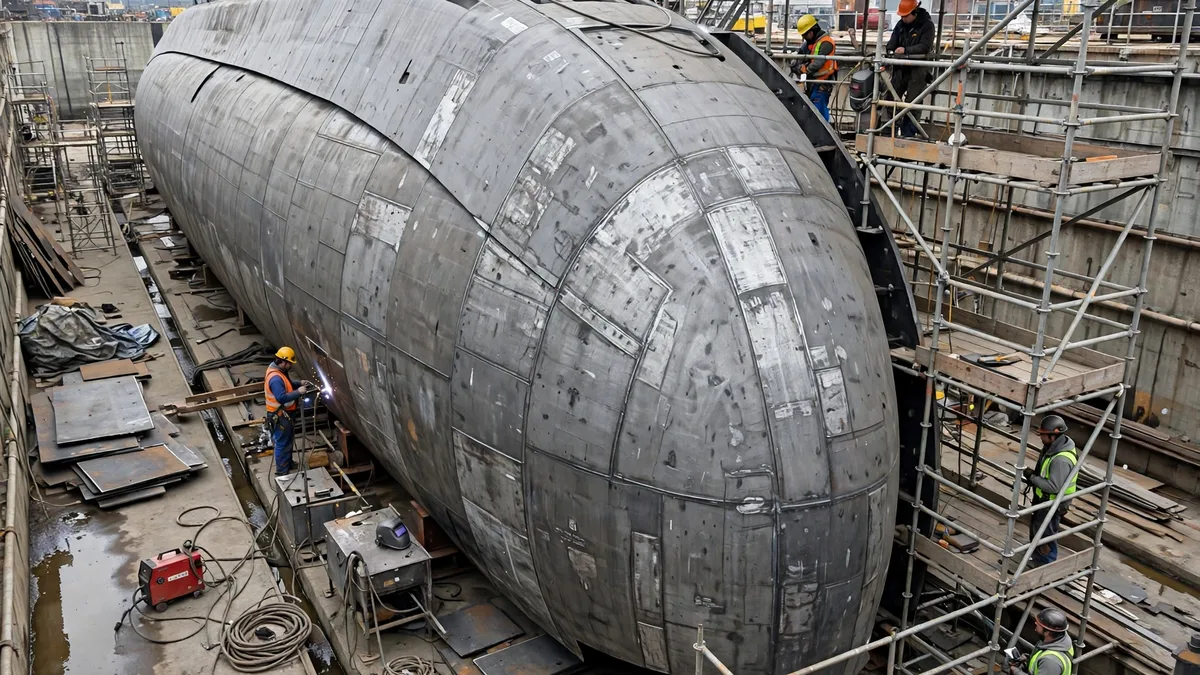
The plates are heated and rolled into curved sections, then welded into rings, and the rings are welded to each other to form the long cylinder of the hull. The welding is the most skilled work in the whole build, done by welders who are certified for pressure work and who weld in pairs, one on each side of the joint, so the heat is even and the metal does not warp. Every weld is then checked with X-rays and ultrasound, and any weld that shows the smallest flaw is cut out and done again.
Step 3: Ring frames are fitted inside to stop the hull buckling
A plain steel tube would buckle under pressure long before it burst, so the inside of the hull is fitted with ring frames, heavy steel hoops welded around the inner wall at regular intervals, like the ribs of a barrel. The frames stiffen the cylinder so it keeps its round shape when the water presses in from every side, and they are welded to the hull with the same care as the hull itself, because a frame that comes loose under pressure is as dangerous as a bad weld. Between the frames, the yard fits the floors, bulkheads and decks that divide the hull into compartments, turning an empty tube into a boat that people can live in.

Step 4: Hatches, penetrations and the sail are added
A hull with no openings is useless, so the next stage is cutting the holes it needs and reinforcing each one. Hatches are fitted with thick steel doors and rubber seals that can be closed in seconds, and every pipe, cable and shaft that passes through the hull gets a special fitting, a penetration, that is welded and sealed so tightly that water cannot follow it inside. The sail, the fin on top that carries the periscope and the snorkel, is welded on last, because it is the part of the hull that takes the most punishment from waves at the surface.
Step 5: The hull is coated and the interior is fitted out
With the steelwork complete, the outside of the hull is coated with anti-corrosion paint and, on many boats, a layer of rubber tiles that quiet the sound of the hull moving through the water. Inside, the hull is painted, insulated and fitted with the tanks, pipes and machinery that make the boat work, but the living spaces come last, and on a luxury submarine they are finished like a small hotel: soft lighting, leather seats, wide viewing windows set into the hull, and air conditioning that keeps the air fresh at depth.
Step 6: The hull is pressure-tested in a dock before it ever dives
The final stage is the test that matters most. The completed hull is sealed, filled with water and pressurised to a level beyond its rated diving depth, a test that takes hours and is watched by engineers, surveyors and the boat’s future captain. Every hatch, every penetration and every weld is checked for the smallest leak, and the hull is measured to make sure it has not changed shape under pressure.
| Spec | Detail |
|---|---|
| Material | High-strength low-carbon steel alloy, certified plate by plate |
| Shape | Cylinder stiffened by internal ring frames, like a barrel |
| Welding | Pressure-certified welders, every joint X-rayed and ultrasound-checked |
| Openings | Hatches, penetrations and the sail, each pressure-tested alone |
| Coating | Anti-corrosion paint outside, often with sound-quieting rubber tiles |
| Testing | Pressurised beyond rated depth in a dock before the first dive |
The most expensive part of a pressure hull is not the steel, but the certainty. Every plate is certified, every weld is X-rayed, and the finished hull is pressurised beyond its rated depth before it is allowed to dive, because the crew inside will trust their lives to it in water they cannot see through. That is why the build takes years and the paperwork is thick, and why a good hull feels so solid when the boat slips under the surface. The hull is the boat, and everything else is fitted inside it.
What One Costs
A luxury submarine pressure hull typically costs an estimated $5 million to $40 million to build, and the price is set mostly by the size of the hull, the grade of steel and the depth it is rated for rather than the luxury fittings inside. A small tourist submarine with a shallow rating sits at the bottom of the range, while a large deep-diving hull with thick plate and heavy ring frames costs far more. The price is in the engineering, not the seats, and how a luxury submarine periscope works explains the instrument that lets the crew see from inside the hull, while how a luxury submersible works shows how a smaller diving craft is put together.
A Rare Fact
A pressure hull is not built to be rigid, it is built to flex. As a submarine dives, the water pressure squeezes the hull inward, and the steel actually shrinks, by a few centimetres over the length of the boat, then springs back when the boat surfaces. Engineers design for that movement, leaving room for the hull to breathe, and on some boats the crew can hear it: a low, slow creaking as the steel takes the load, which is the sound of the hull doing exactly what it was built to do.

A luxury submarine pressure hull is a steel cylinder, a set of ring frames and a thousand inspected welds, built slowly and tested beyond its limits so it can carry people into water that wants to crush it. It is the one part of the boat that can never be allowed to fail, and it is built like it. For the scale of the engineering around it, the specifications of a luxury research submarine show what a working deep-diving boat is built to do.


