The shed is so big that a passenger jet could fit inside it, and the air smells of steel, paint and fresh teak. Under the lights sits a hull longer than a football field, its bow rising like a cliff, while welders in harnesses work along its flanks. Nothing about this build is small, and nothing about it is hurried.
A luxury superyacht is the largest private machine most people will ever see. It is a ship, a hotel and a home in one, built to cross oceans in comfort and to anchor off places other boats cannot reach. Hundreds of people work on a single hull, from steelworkers to cabinetmakers, and the build can take three years or more.
The scale changes everything. A mistake in a small boat is an afternoon of rework; a mistake in a superyacht can cost months. This is how a luxury superyacht is made, from the first steel plate to the day the owner steps aboard.

How a Luxury Superyacht Is Made
Step 1: Steel plates become a hull
A superyacht hull begins as flat steel plate, cut by computer-guided plasma torches into shapes that look nothing like a boat. The plates are rolled and pressed into curves, then welded to a skeleton of frames and bulkheads that runs the length of the ship. Each weld is inspected, often with ultrasound, because the hull must survive ocean waves for decades. When the shell is complete it is blasted clean and painted, layer after layer, until the finish is smooth enough to mirror the sky. The strength of that shell is everything, and our guide to superyacht hull construction explains the engineering inside the steel.
Step 2: The engine room goes in first
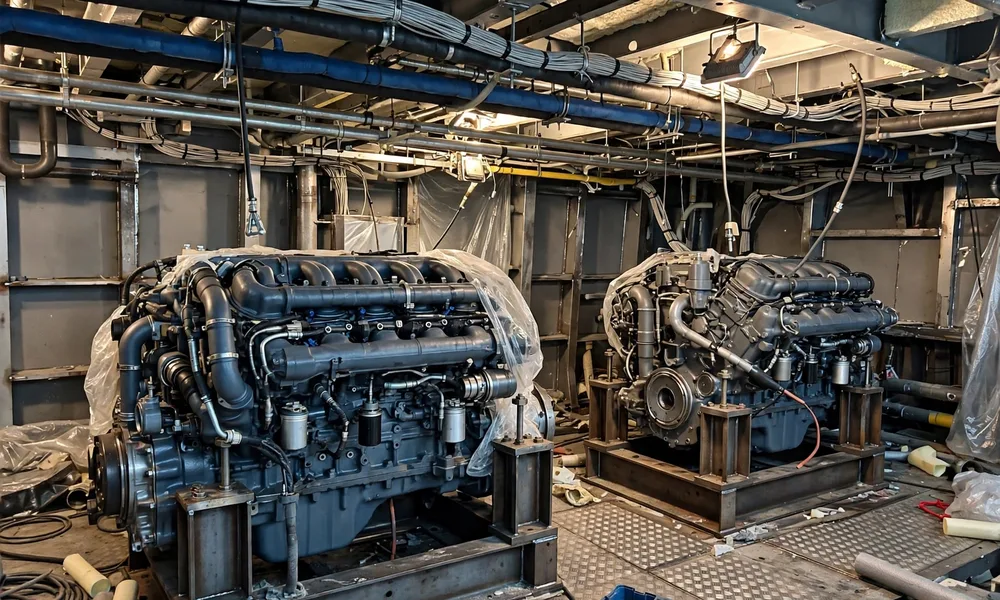
Long before the yacht looks finished, the engine room is filled. Two main diesel engines, each the size of a small car, are lowered through openings in the deck by crane, along with generators, gearboxes, fuel tanks and kilometres of pipe. The engines are bolted to seatings welded into the hull, aligned to the propeller shafts to a fraction of a millimetre, and wrapped in sound insulation so the guest cabins stay silent. Everything heavy goes in early, because once the decks are closed, there is no way to get an engine out without cutting the ship open.
Step 3: Decks, cabins and the superstructure
With the machinery in place, the decks are fitted one by one. The superstructure — the white tiers above the hull that hold the guest cabins, saloons and bridge — is built as separate blocks, lifted into place by crane and welded down. Inside, the yacht is divided into watertight compartments, with crew quarters forward and low down, guest cabins amidships, and the owner suite usually on its own deck. At this stage the yacht is a maze of bare metal and cable trays, and it is hard to believe it will ever look like a hotel.
Step 4: Systems behind the walls
A superyacht carries the systems of a small town. Fresh water is made on board by desalination plants, sewage is treated before discharge, and air conditioning cools hundreds of tonnes of steel and glass in tropical sun. Kilometres of cable carry power from the generators to everything from the galley ovens to the stabiliser fins, and a computerised management system watches it all from the bridge. Fire detection, bilge alarms, navigation radar, satellite links and dynamic positioning all live behind the panelling. The same heavy engineering drives the workhorse end of the fleet, as our guide to how a luxury diesel yacht is made shows.
Step 5: The interior, fitted by craftsmen
Once the steel is painted and the systems are in, the interior teams move in. Cabinetmakers fit cabins in book-matched walnut and oak, stonemasons install marble bathrooms, and upholsterers cover sofas and headboards in leather and fabric chosen by the owner. A single superyacht can use thousands of square metres of veneer, every sheet matched by grain so the walls look like one continuous piece of wood. The work is slow and dusty, and it happens while the electricians and plumbers are still finishing their own systems around it. This is the stage where the yacht stops being a ship and starts being a home.
Step 6: Paint, teak and the final finish
The outside finish of a superyacht is famously obsessive. The hull is sanded, filled and painted in a dust-free hall until it shines like glass, a process that can take months and many coats. Teak decks are laid plank by plank, caulked and sanded by hand, and the swim platform, tender garage and beach club are fitted out. From a distance the yacht looks effortless; up close, every line is the result of weeks of hand finishing. Few things on board are bought off the shelf, and almost everything is made or fitted for that one hull.
Step 7: Launch and sea trials
The launch of a superyacht is a ceremony. The hull slides down the slipway or is floated out of a dry dock, and the whole town turns out to watch. Then comes months of sea trials: the engines are run at full power, the stabilisers are tested in a swell, the anchors are dropped and weighed, and the yacht is sailed through every condition the crew can find. Only when the trials are clean and the paperwork is signed does the yacht change hands. A large superyacht typically takes two to four years from first steel to delivery. The electric end of the range follows the same long path, as our guide to how a luxury electric yacht is made explains.
Luxury Superyacht Specs
| Specification | Typical range |
|---|---|
| Length overall | About 40 to 100 metres |
| Gross tonnage | About 500 to 3,000 gross tonnes |
| Hull material | Steel hull, aluminium superstructure |
| Engines | Two diesels, about 2,000 to 5,000 horsepower each |
| Top speed | About 15 to 22 knots |
| Range | About 4,000 to 6,000 nautical miles |
| Guests and crew | About 10 to 14 guests, 12 to 30 crew |
| Build time | About 2 to 4 years |
What Does a Luxury Superyacht Cost?
A new luxury superyacht of around 50 metres is estimated to cost roughly $40 million to $80 million, while a custom yacht of 80 metres or more is estimated at $150 million to $300 million or more. Running costs are estimated at roughly 10 percent of the build price every year. Prices are estimates only and vary by size, builder, materials and fit-out.
A Rare Fact
Some superyachts carry their own submarine. A few of the largest yachts have a garage that holds a small three-person submersible, launched through a moon pool or a side door, so guests can dive to a reef or a wreck while the yacht waits above.

A luxury superyacht is not built, it is assembled from a hundred trades, each working in the same steel shell at the same time. Welders, engineers, cabinetmakers and painters all leave their mark, and the result is a ship that can cross an ocean and host a dinner party on the same day.


