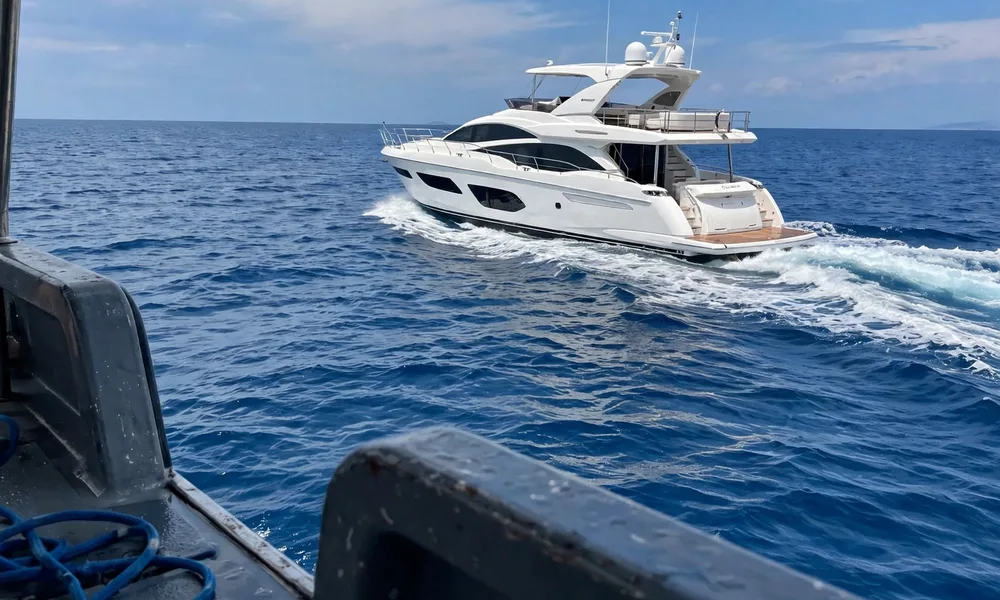
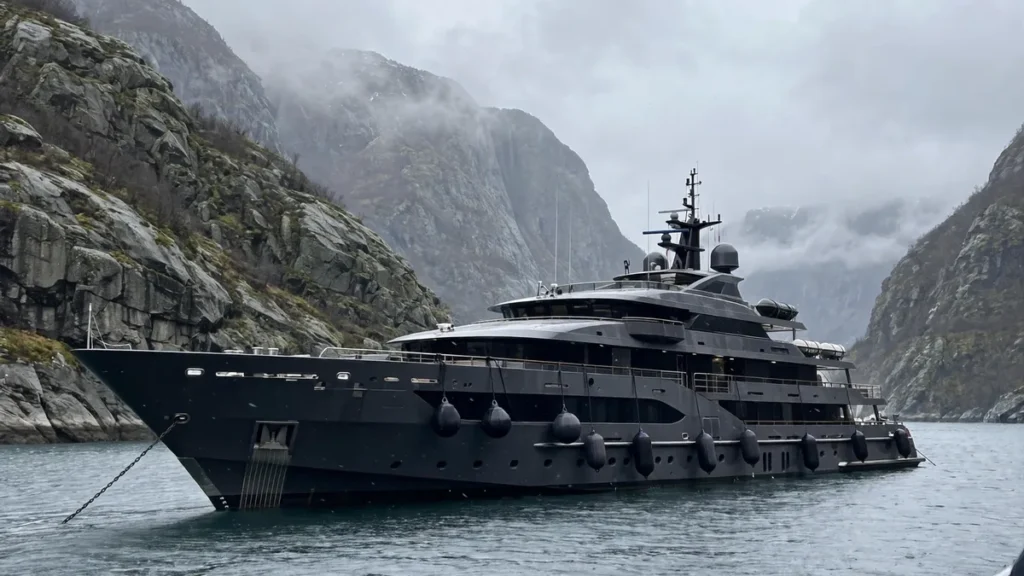
A luxury diesel yacht does not announce itself with noise. In the shed it sits on blocks, a long white hull with a single propeller shaft running aft, and the smell of fresh paint and cut timber in the air. The engines are already in, low in the hull, and the whole boat is built around them, because on a diesel yacht the engines decide where everything else goes.
Diesel has powered luxury yachts for a century, and the reasons have barely changed: the fuel is safe to store, the engines run for thousands of hours, and the torque is there from low revs, pushing a heavy hull through a head sea without strain. This is how a luxury diesel yacht is made.

Step 1: The hull
The build starts with the hull, laid up in a female mould from fibreglass, carbon fibre, and foam core, or welded from aluminium plate on larger yachts. The hull shape is a compromise: fine at the bow to cut through waves, full at the stern to carry the weight of the engines and the swim platform. Bulkheads, the structural walls that divide the hull into compartments, are bonded in while the shell is still in the mould, because they give the hull its stiffness.
Once cured or welded, the hull is lifted, turned, and set on blocks. The engine beds, heavy steel or composite bearers that will carry the engines, are aligned to the shaft line with a laser, because a shaft that is even a millimetre out will vibrate for the life of the boat.
Step 2: The diesel engines
The engines are the heart of the build. A luxury diesel yacht usually carries two marine diesels, each producing several hundred to over a thousand horsepower, built from cast iron blocks with turbochargers and aftercoolers. Each engine is lowered into the hull on a crane and bolted to its beds, then connected to its gearbox and propeller shaft.
Alignment is checked again and again, hot and cold, because the engine moves on its mounts as it warms up. How a luxury trawler yacht is made follows the same engine-first logic on a long-range boat, where reliability over thousands of miles matters more than outright speed.
Step 3: Fuel, exhaust, and cooling
Diesel needs fuel, air, and cooling, and all three systems are built around the engines. Fuel tanks sit low and central, often holding several thousand litres, with filters and polishing systems that keep the fuel clean. Exhausts run up through the superstructure, insulated so they do not heat the cabins, and fitted with water injection that cools the gases and quiets the note.
Cooling is by seawater, drawn in through hull fittings, passed through heat exchangers, and pumped back out. The intakes are screened against weed and debris, because a blocked intake can overheat an engine in minutes.
Soundproofing is fitted around the engine room as the machinery goes in, thick panels that absorb the low thump of the diesels before it reaches the cabins. The engine room door is heavy and sealed, and the ventilation is ducted so cooling air comes in without carrying noise out. On a well-built yacht, a guest in the saloon hears little more than a distant hum.
Step 4: The superstructure and deck
With the machinery in place, the superstructure goes on: the wheelhouse, the saloon, and the upper decks, usually moulded as separate pieces and bonded to the hull. The deck layout is planned around outdoor living, with a cockpit aft, a flybridge above, and a foredeck for sunbathing and anchoring.
Teak decking, stainless rails, and large windows are fitted now, before the interior, because the deck fittings need access from below. The steering gear, rudders, and stabilisers are installed at the stern, the stabilisers being fins that extend underwater to cut rolling at anchor and underway.
Step 5: The interior
The interior of a diesel yacht is built for long stays at sea. Cabins are arranged around the engine room, with sound insulation so thick that the engines are barely a murmur in the master suite. Joiners fit light oak or walnut veneers, leather panels, and stone worktops, and the galley is built to restaurant standard, with full-size refrigeration and a proper stove.
Crew quarters sit forward, close to the anchor gear, and the engine room itself is lined in white, with every pipe labelled and every filter within reach. How a luxury sportfishing yacht is made shows a different interior trade on a fishing boat, where the cockpit and fish handling take the space a cruising yacht gives to cabins.

Step 6: Sea trials and handover
A finished diesel yacht is tested hard before it is sold. Sea trials run the engines through their full range, from idle to full throttle, checking temperatures, pressures, and fuel burn at every speed. The boat is run in a head sea to test the hull, and the stabilisers, steering, and anchoring systems are all exercised.
Noise and vibration are measured in every cabin, because a luxury yacht that hums or rattles at cruising speed has failed its brief. Diesel versus electric yacht propulsion compared sets out why many owners still choose diesel, trading the silence of electric drive for range, refuelling speed, and proven service networks in remote ports.
Specifications
| Detail | Specification |
|---|---|
| Hull material | Fibreglass, carbon fibre, or aluminium |
| Length overall | Around 18 to 30 metres |
| Engines | Twin marine diesels |
| Power | Around 800 to 2,000 horsepower per engine |
| Top speed | Around 22 to 30 knots |
| Cruising speed | Around 16 to 20 knots |
| Fuel capacity | Around 5,000 to 12,000 litres |
| Range | Around 1,000 to 2,500 nautical miles |
| Cabins | Usually three to five |
| Displacement | Around 40 to 120 tonnes |
Price
The estimated price of a luxury diesel yacht is around 3,000,000 to 8,000,000 dollars, and that figure is an estimate only, because the cost depends on length, engine power, and the level of interior finish. The engines and the hull account for a large share, followed by the interior joinery and the navigation equipment. A buyer is paying for a yacht that can cross a sea under its own power, refuel in almost any port, and keep its crew comfortable for weeks at a time.
A rare fact
Few people know that a diesel yacht can be quieter underway than many electric boats at anchor. The trick is the engine room: floating mounts, thick insulation, and water-injected exhausts can cut the sound in the saloon to the level of a quiet conversation, even while two large diesels are working hard below. The silence is engineered, not accidental, and it costs a surprising share of the build budget.
When the yacht finally leaves the yard and opens its throttles, it looks simple, just a white hull cutting a clean wake. That clean wake is the achievement of engines aligned to the millimetre, a hull shaped for the sea, and systems built to run for thousands of hours without complaint.