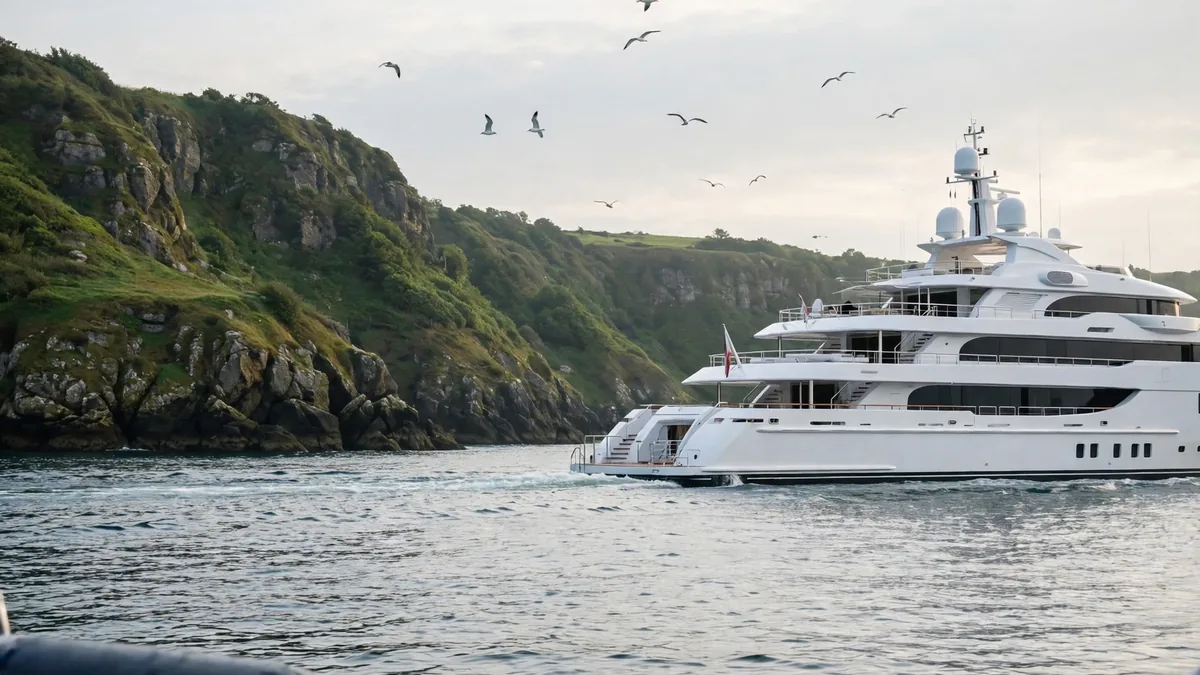
From the shore it looks effortless. A white superyacht glides past the cliffs, no smoke, no noise, no sign of the work happening below deck. On board, guests eat breakfast on a sun deck while the sea slides past, and the whole scene feels as calm as a hotel terrace. Nothing about the picture suggests that a small city is running underneath their feet.
That is the trick of a superyacht. Below the teak decks sits a power station, a water treatment plant, a laundry, a cold store, a workshop and a crew of people who keep all of it running around the clock. The yacht makes its own electricity, its own fresh water and its own calm in rough seas, and it does all of it while moving.
A superyacht at anchor is a floating hotel. A superyacht underway is a floating hotel that must also be a ship, and the systems that let it be both are what this guide is about. This is how a luxury superyacht works, from the engines in the hull to the stabilisers that keep the breakfast on the table.
How a Luxury Superyacht Works
Step 1: The engines drive the yacht
Most superyachts are driven by two large diesel engines, each turning a propeller through a gearbox and a long shaft that runs through the stern. The engines sit low in the hull on flexible mounts that soak up vibration, and they are sized so the yacht can cruise economically at moderate speed and still reach a sprint when the owner wants it. Some newer yachts add electric motors that can drive the propellers silently in harbour, with the diesels taking over at sea. The hull those engines push through the water has its own story, as our guide to superyacht hull construction shows.
Step 2: Generators make the electricity
A superyacht uses as much electricity as a small village, so it carries its own power station: two or three diesel generators, separate from the main engines, that run day and night. They power the air conditioning, the galley, the lighting, the navigation equipment, the stabilisers and the water makers, and they are sized so one can fail without anything going dark. Engineers watch the load constantly, starting and stopping generators as the demand changes, because a generator running too lightly wastes fuel and one running too hard wears out fast. Building all of this into a hull is a feat in itself, as our guide to how a luxury superyacht is made explains.
Step 3: Stabilisers keep the yacht level
The most loved system on any superyacht is the one the guests never see. Fins mounted on the sides of the hull, below the waterline, swing constantly to counteract the roll of the waves, while gyroscopic stabilisers spin inside the hull to steady the yacht at anchor. Together they can cut the rolling motion by most of its force, turning a queasy swell into a gentle sway. Without them, dinner in a rough sea would be served on the floor. With them, guests forget the sea is moving at all, which is exactly the point of the whole machine.
Step 4: The yacht makes its own fresh water
Fresh water is too heavy to carry in the quantities a superyacht needs, so the yacht makes its own. Seawater is forced through fine membranes in a reverse-osmosis plant, stripping out the salt and leaving drinking water that is cleaner than most tap water. The plant can make tens of thousands of litres a day, enough for showers, pools, laundry and the galley, and the water is stored in tanks and tested constantly. Waste water is treated aboard too, so the yacht leaves as little behind as possible. Smaller yachts solve the same problems in their own way, as our guide to how a luxury yacht works shows.

Step 5: The bridge steers and watches
On the bridge, the captain and officers steer the yacht with a combination of radar, satellite navigation, electronic charts and cameras, watching for other ships, shallow water and weather. Modern superyachts hold their position automatically with dynamic positioning, using thrusters at the bow and stern to stay over one spot without dropping anchor, which protects the seabed and lets the yacht hover off a beach. The bridge also controls the anchor windlass, the tender cranes and the watertight doors, so one room watches over the safety of the whole vessel.
Step 6: Air, climate and quiet
Comfort on a superyacht is mostly about air. A central climate system cools and dehumidifies every cabin, filters the air and keeps the temperature steady whether the yacht is in the tropics or the North Sea. Engineers work hard on quiet too: engines sit on flexible mounts, exhausts are silenced, and cabins are insulated so guests hear the sea rather than the machinery. A superyacht at night should be silent enough to sleep through, and the crew measure the noise in every cabin to prove it.
Step 7: Tenders, toys and the crew below
The last system is the human one. A superyacht carries tenders for going ashore, jet skis, diving gear and sometimes a small submarine, all launched from garages in the hull by cranes. Below deck, the crew live in their own cabins, eat in their own mess and work in shifts around the clock, keeping the engines running, the cabins clean and the guests fed. A superyacht is often said to need one crew member for every guest, and the ratio is no exaggeration: the floating city only works because the people below deck never stop working.
Luxury Superyacht Specs
| Specification | Typical range |
|---|---|
| Length | About 50 to 100 metres |
| Main engines | Two diesels, about 2,000 to 5,000 hp each |
| Generators | Two or three, about 200 to 500 kW each |
| Top speed | About 16 to 22 knots |
| Cruising range | About 4,000 to 6,000 nautical miles |
| Fresh water making | About 10,000 to 30,000 litres a day |
| Guests and crew | About 12 guests, 12 to 20 crew |
| Fuel capacity | About 80,000 to 200,000 litres |
What Does a Luxury Superyacht Cost?
A luxury superyacht is estimated to cost roughly $30 million to $100 million, while the largest custom builds are estimated at $100 million to $300 million or more. Annual running costs are estimated at 10 percent of the purchase price, and a major refit is estimated at $5 million to $20 million. Prices are estimates only and vary by size, builder and interior.
A Rare Fact
A superyacht at anchor can hold its position without dropping anchor at all, using satellite positioning and bow thrusters to hover over one spot. The system makes tiny corrections all day and night, and it exists because a single anchor dropped on a coral reef can do more damage in an afternoon than the yacht does in a year of cruising.

A luxury superyacht works by being two things at once: a ship that can cross oceans and a hotel that never closes. The engines push it, the generators light it, the stabilisers steady it, the water makers fill it, and the crew keep it all running while the guests watch the sunset. When it works well, nobody on deck thinks about any of it, and that is the finest compliment a machine like this can receive.


