There is a moment on a large yacht when the sea suddenly gets a new kind of visitor. A helicopter appears over the horizon, circles once, and settles onto a white circle painted on the deck, while the yacht rolls gently beneath it. To the guests it looks effortless, but the deck it lands on is one of the most carefully built parts of the whole boat.
A luxury yacht helipad is made as a reinforced aluminium deck with drainage, lighting, and tie-downs, strong enough to land a helicopter on a moving yacht. Here is how it is built, from the first drawing to the first landing.

How It Is Made
Step 1: The deck is designed for the helicopter’s weight
Everything starts with the helicopter the owner plans to fly, because the pad must be built around it. Engineers take the weight of the machine, add a safety margin for a hard landing, and work out how that load spreads through the deck when the yacht is rolling. The pad is usually sized with room to spare, since a helicopter never lands exactly on the centre mark, and the design must allow for the skids or wheels to touch down off-centre. The weight of the pad itself is counted too, because it sits high on the yacht and every extra kilo up there makes the boat roll a little more. The rules that govern this are strict, and the design is checked by a classification society before any metal is cut, because a helipad is not a sun deck with a painted circle.
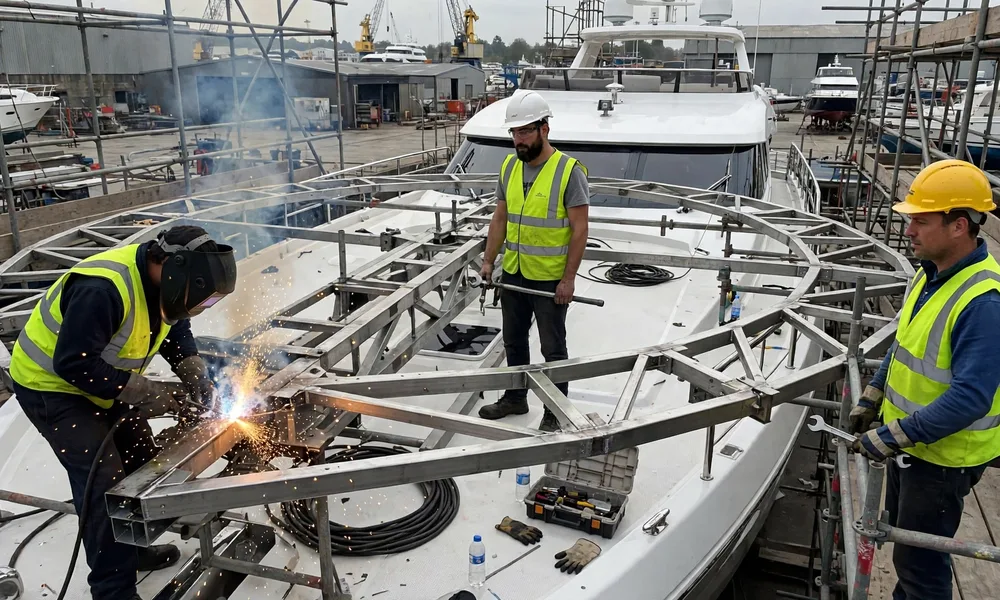
Step 2: An aluminium frame is welded
The structure of the pad is an aluminium frame, chosen because it is strong for its weight and does not rust in salt air. Welders build a grid of beams on the foredeck or above the tender garage, tying it into the yacht’s main structure so landing loads travel down into the hull rather than into the deck alone. The frame is kept as light as possible, since every kilo up high affects how the yacht rolls, and the welding is inspected joint by joint. The frame also has to cope with the heat of the helicopter’s exhaust and the blast of air from its rotors, which push down hard on the deck with every landing. A helipad frame is not hidden work; it is the skeleton of a landing ground, and it is built to aviation standards rather than boat standards.

Step 3: The deck surface is laid and marked
Over the frame goes the deck surface, usually aluminium plate with a non-slip finish that grips helicopter tyres and skids even when wet. The surface is laid in panels so a damaged section can be replaced without rebuilding the whole pad, and the joints are sealed against seawater. Then comes the marking: the landing circle, the touchdown point, and the yacht’s name or identification letters, painted in coatings that survive sun, salt, and rotor wash. The markings are not decoration; they tell the pilot exactly where to aim, and they must stay visible after years at sea.
Step 4: Drainage and fire systems go in
A helipad must deal with fuel, and that shapes the next stage of the build. The deck is given a slight fall so spilled fuel and rainwater run to scuppers at the edges, away from the yacht’s living spaces, and the drainage is sized to clear a heavy downpour quickly. Around the pad, fire-fighting equipment is fitted: foam monitors that can smother a fuel fire in seconds, extinguishers within easy reach, and a water supply that works even if the yacht’s main power fails. The crew drill with this equipment regularly, because the pad is only as safe as the people standing beside it. The deck is also earthed against static, since a helicopter builds up a charge in flight and the first touch of a skid can throw a spark.
Step 5: Lighting and tie-downs are fitted
For landings at dusk or in poor light, the pad is fitted with perimeter lights set flush into the deck, so they guide the pilot without becoming trip hazards. Floodlights on the superstructure light the pad without blinding the pilot, and a windsock or wind indicator tells the pilot which way the wind is blowing across the deck. Tie-down points are set into the surface at measured positions, so the helicopter can be lashed down firmly once it has landed and will not shift as the yacht rolls. A safety net is fitted around the edge of the pad, and a refuelling point is added only if the yacht is certified to carry aviation fuel, which many are not. When the helicopter is not aboard, the pad doubles as open deck space, but nothing is ever left loose on it, since rotor wash will throw anything unsecured across the yacht.
Step 6: The pad is tested with a real landing
The build is proved the only way that matters: a helicopter lands on it. The first test landings are done at anchor in calm water, with the pilot touching down gently and the crew checking the deck for any movement or damage. Later tests are done underway, with the yacht rolling in a swell, because a pad that only works in flat calm is no use at sea. Engineers measure how the frame flexes under load and check that the tie-downs hold, and the pad is only signed off when the landings are smooth and the structure is unchanged. The pilot also checks the approach from every direction, since wind and the yacht’s own superstructure can make one side of the pad harder to reach than the other. From design to sign-off, a yacht helipad takes several months to build.
Luxury Yacht Helipad Specifications
The figures below describe a typical helipad on a large luxury yacht. Smaller and larger yachts differ, but the way the pad is built is the same.
| Specification | Typical value |
|---|---|
| Pad diameter | About 10 to 12 metres |
| Structure | Welded aluminium frame |
| Deck surface | Non-slip aluminium plate |
| Helicopter weight | About 3 to 5 tonnes |
| Lighting | Flush perimeter lights |
| Build time | About 3 to 6 months |
What It Costs
A yacht helipad costs an estimated $300,000 to $1.5 million as part of a new build, depending on the size of the pad, the helicopter it must take, and whether refuelling is fitted. Those are estimates, not quotes, and they reflect the aviation-grade structure and safety systems rather than the deck alone. The yacht it sits on is a bigger story still, as how a luxury superyacht works explains.
A Rare Fact
Here is a detail most people never guess. Many yacht helipads are built to take a helicopter half as heavy again as the one the owner actually flies, as a safety margin for hard landings on a rolling deck. The pad must survive a touchdown that would be rough on solid ground, with the yacht moving under it, so engineers design for the worst landing rather than the normal one. The finished boat handles that weight with ease at sea, as how a luxury flybridge yacht works shows, and the largest yachts carry their aircraft like a floating airfield, as how a luxury explorer yacht works explains.


