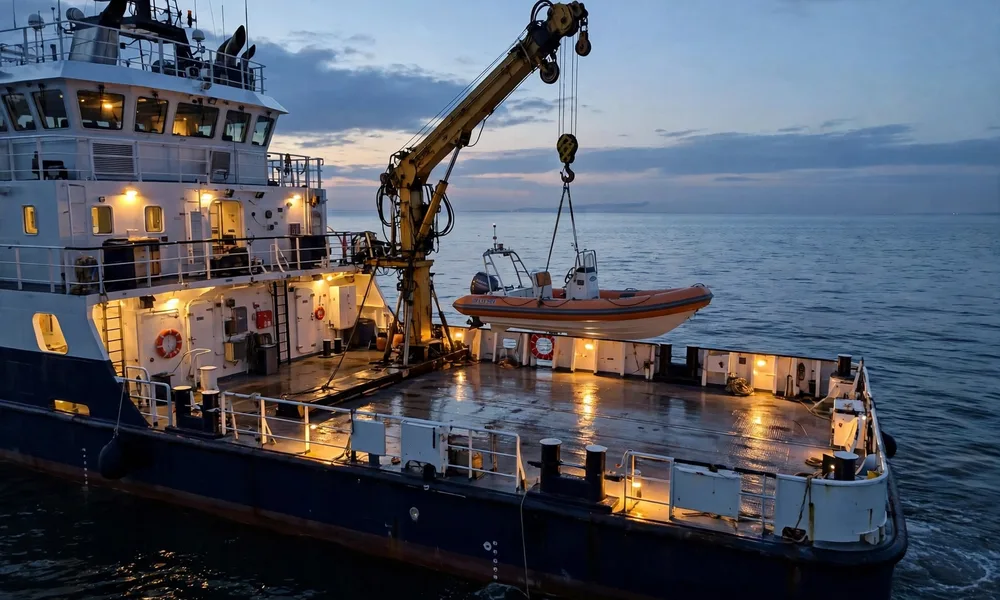
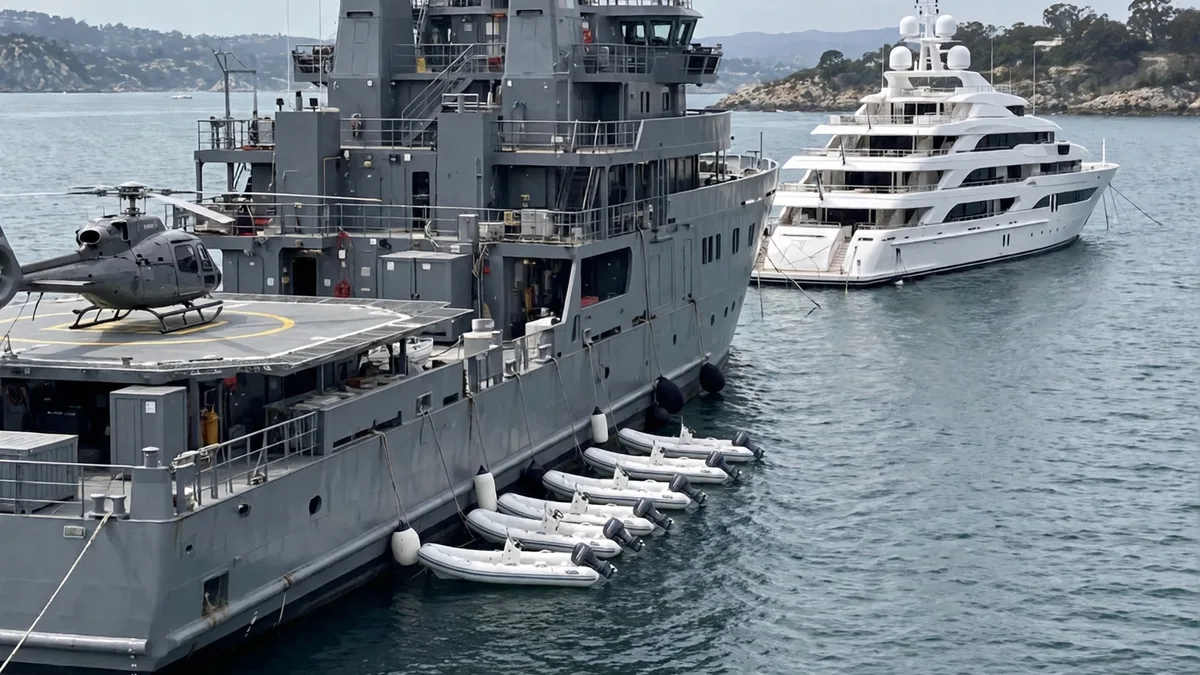
The superyacht is anchored in a bay so beautiful it looks painted, and nobody on deck is looking at it. They are looking at the ship anchored a hundred metres away, which is longer, plainer and far more interesting. It has a helicopter on its deck, a small submarine in a cradle, three tenders lined up in a row, and a crane that could lift a car. It is the support vessel, the shadow ship, and without it the yacht beside it would be a beautiful floating hotel with nowhere to go and nothing to play with.
Step 1: A working hull is built for deck space, not speed
A support vessel begins with a hull shaped for a single purpose: carrying as much as possible on deck. The hull is wide and flat-bottomed, with a large open deck running most of its length, and it is built from steel plate welded into blocks, just like a small cargo ship. Speed is not the priority, so the bow is full and blunt rather than fine, and the engines are sized for steady cruising rather than sprinting.
The hull is divided into watertight compartments, and the fuel tanks are placed low for stability, because a support vessel carries heavy loads high on deck and must never become top-heavy. The steel is coated against corrosion, and the deck is fitted with tie-down points, container sockets and crane rails, so that whatever the owner buys next, from a new tender to a submersible, can be bolted down safely. The yacht it serves is built for beauty first, as the guide to how a luxury yacht is made explains, and the support vessel is built for the opposite: everything on it is there to work.
Step 2: The deck, crane and hangar are fitted
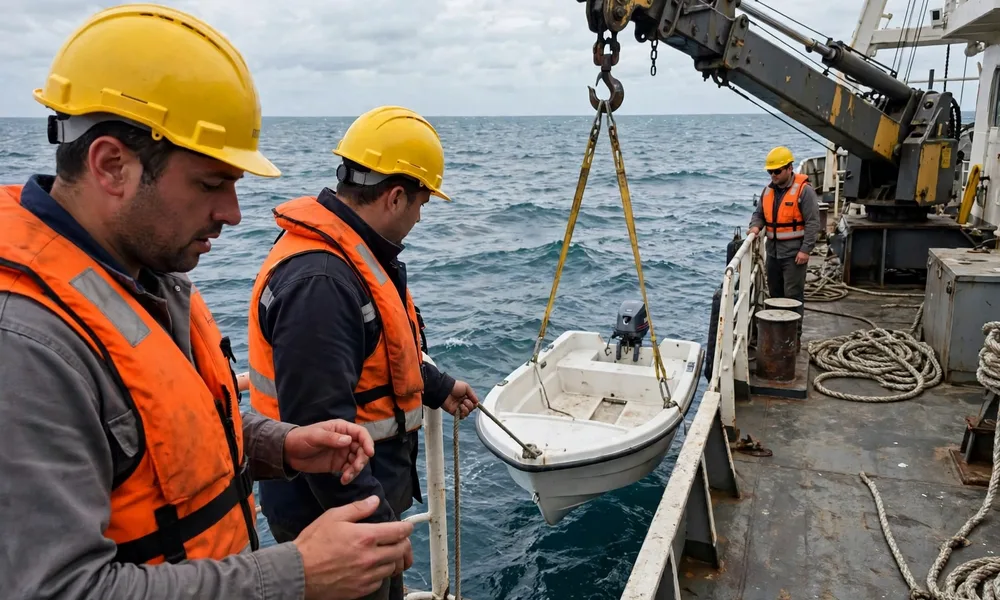
The working deck is the heart of the ship, and it is fitted like a small dockyard. A large crane, usually mounted amidships, lifts tenders, jet skis and submersibles over the side, and it is sized to handle the heaviest single item on board, often a tender weighing several tonnes. The crane operator works from a cab with a clear view of the deck, and the whole lifting operation is rehearsed until the crew can launch a tender in minutes.
Step 3: Engines, stabilisers and range are built in
A support vessel must keep up with its yacht, and that means range more than speed. The engines are usually medium-speed diesels, chosen for fuel economy over thousands of miles, and the fuel tanks are large enough for the ship to cross an ocean without refuelling. The bridge is fitted with the same navigation equipment as a much larger ship, because the support vessel often sails alone, arriving at the next anchorage days before the yacht.
Stabilisers are fitted to keep the deck steady while the crane is working, and many support vessels carry a dynamic positioning system that holds the ship in one place without anchoring, so a tender can be launched in open water. The engine room is kept simple and accessible, with room to work around every machine, because the crew at sea are the mechanics as well as the sailors. The research vessels that share these seas are built to the same practical standard, as the guide to luxury research vessel specs explained shows, and the support vessel borrows their toughness without their laboratories.
Step 4: The tenders, toys and submarine are loaded
With the ship finished, the cargo is loaded, and it is a list that reads like a toy shop. A large tender for ferrying guests ashore, a smaller fast tender for watersports, jet skis, paddleboards, diving gear, and on the biggest support vessels, a small submarine in a cradle on deck. Each item has its own cradle, its own tie-downs and its own launching routine, and the crew practice each one until it is routine.
Step 5: Crew quarters and the bridge are fitted out
A support vessel carries a larger crew than a yacht of the same size, because the crew do the driving, the launching, the flying and the fixing. Their quarters are fitted below deck, simple and comfortable, with cabins, a mess room and a galley, and the whole ship is designed so the crew can live aboard for months at a time. The bridge is fitted with comfortable chairs, good visibility over the working deck, and screens showing the crane load, the helicopter position and the state of every tender.
The finishing is practical rather than luxurious, but it is not rough. The paint is a smart grey or navy, the decks are non-slip, and the lighting is bright where the crew work and warm where they rest. A catamaran built for guests shows the other side of the same craft, as the guide to how a luxury catamaran works describes, but the support vessel is a ship that works for its living, and its comfort is measured in how well the crew can do their jobs.
Step 6: Sea trials, crane tests and the first rendezvous
The finished support vessel goes to sea for trials, and the tests are all about the deck. The crane lifts its heaviest load and holds it while the ship rolls, the helicopter lands and takes off in a crosswind, and the tenders are launched and recovered in a swell. The engineers watch the stabilisers, the dynamic positioning and the fuel consumption, and anything that sways, creaks or strains is strengthened before delivery.
Specifications
| Detail | Specification |
|---|---|
| Length | Around 50 to 80 metres |
| Deck space | Around 500 to 1,000 square metres |
| Crane capacity | Around 10 to 20 tonnes |
| Helicopter deck | One helicopter, with hangar on larger ships |
| Speed | Around 14 to 18 knots |
| Range | Around 5,000 to 8,000 nautical miles |
| Crew | Around 15 to 25 people |
| Tenders carried | Two to four, plus jet skis and diving gear |
What it costs
The estimated price of a new luxury support vessel is around 20 to 50 million dollars, and that figure is an estimate only, because the cost depends on the length, the size of the crane and whether a helicopter hangar is fitted. The steel hull and the crane account for a large share, followed by the engines, the helicopter deck and the tenders it carries. A buyer is paying for a ship that lets their yacht stay beautiful, by doing all the heavy work somewhere else.
A rare fact
Few people know that some support vessels carry their own small submarine and a crew member whose only job is to pilot it. The pilot trains for months, dives almost every day the yacht is at anchor, and knows the local reefs better than any dive guide in the area. Guests who dive in the submarine often ask to meet the pilot afterwards, and they are usually surprised to find that the person who took them thirty metres down is also the person who launched their tender that morning.