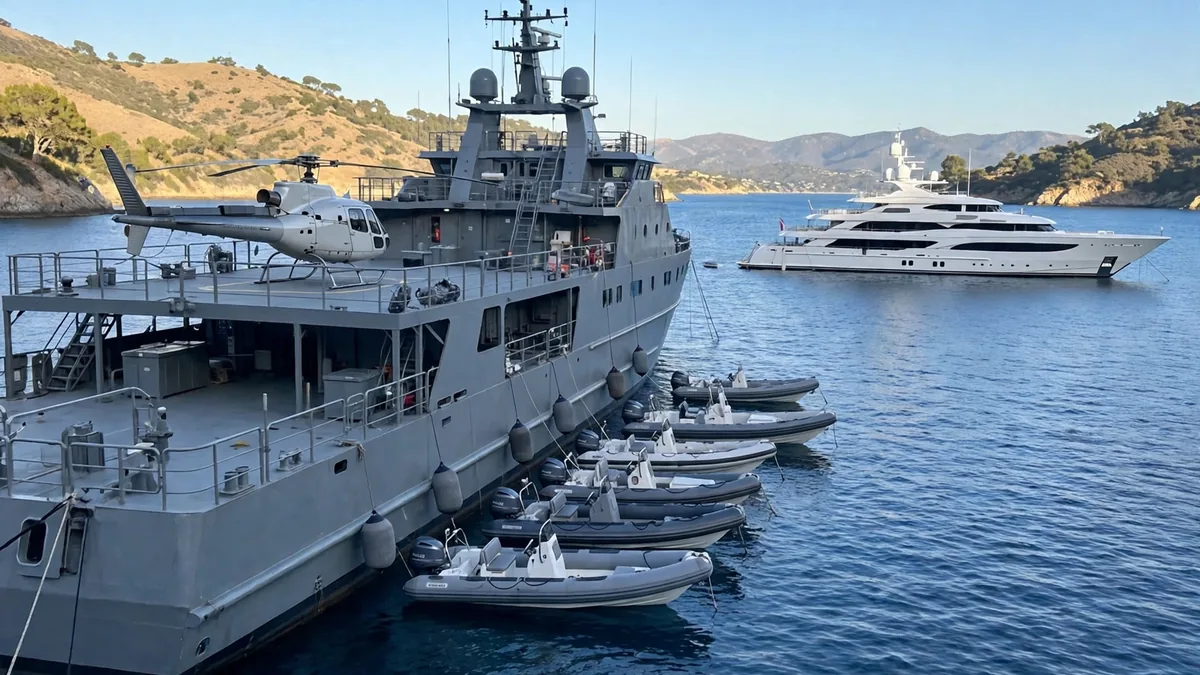
The superyacht is anchored in a bay so beautiful it looks painted, and nobody on deck is looking at it. It is the support vessel, the shadow ship, and without it the yacht beside it would be a beautiful floating hotel with nowhere to go and nothing to play with.
This is how a luxury support vessel works, system by system: the deck that carries everything, the cranes that lift the toys into the water, the helicopter deck and hangar, the tenders and the submarine, the fuel and stores that keep the yacht going, and the crew who run it all from the bridge. It is a different story from the factory tale, and the guide to how a luxury support vessel is made shows how the vessel itself is built, where the hull, the deck and the cranes come together before a single toy is ever loaded.
The deck: a floating car park for toys
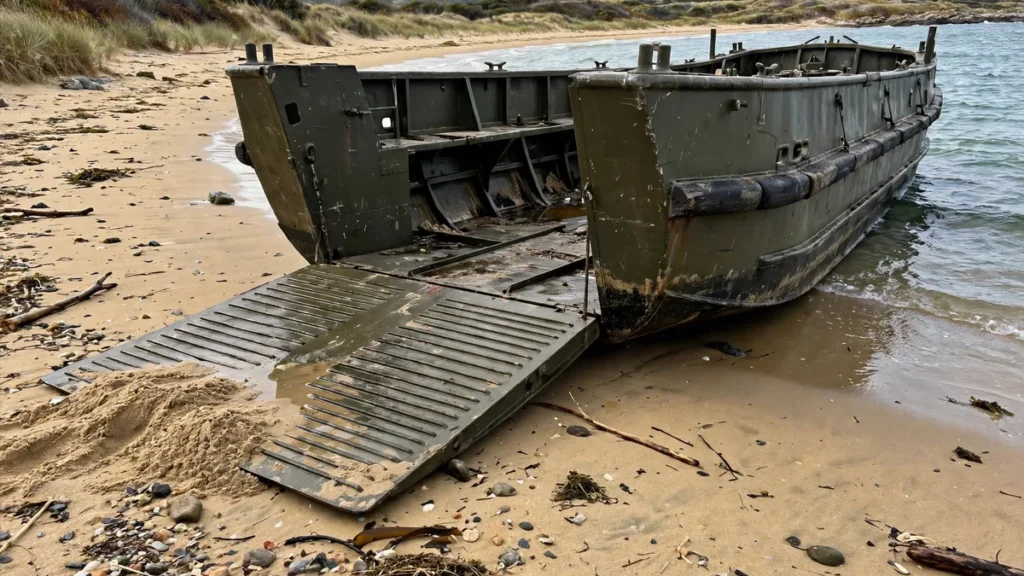
The heart of a support vessel is its deck, a huge open space running most of the length of the ship, built to carry as much as possible and to be rearranged at will. The deck is the reason the vessel exists: the yacht it serves has no room for any of this, and the support ship carries it all, a hundred metres away, ready when it is wanted.
The cranes: lifting toys into the sea
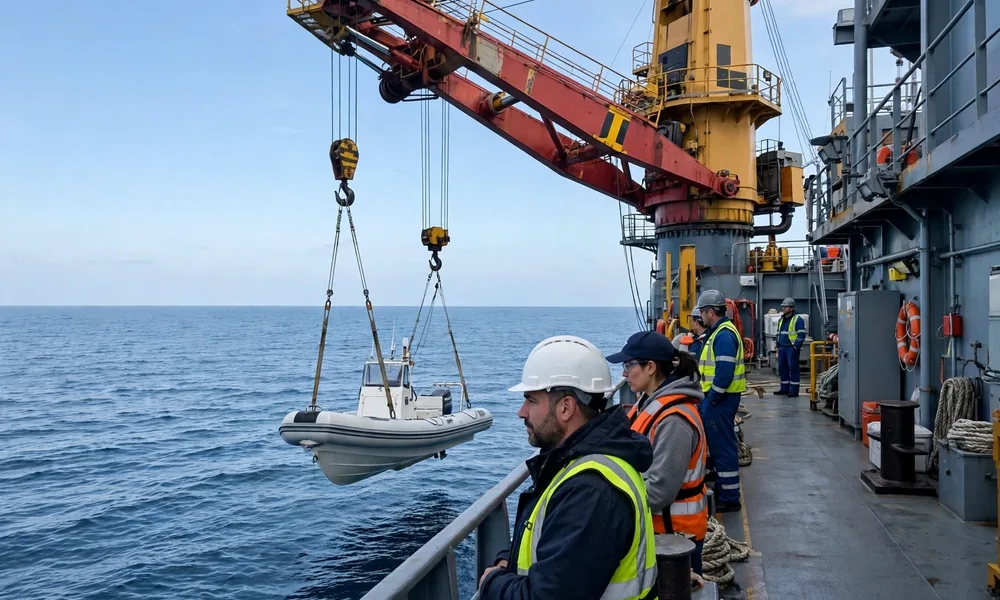
Nothing on the deck can swim, so everything must be lifted into the water, and that is the job of the vessel’s cranes. Smaller cranes and davits handle the jet skis and the diving gear, and the crew practise the lifts in calm water first, because a crane that works in a harbour must also work in a rolling sea, where the ship is moving and the load is swinging and the timing matters more than the strength.
The helicopter deck: an airport on a ship
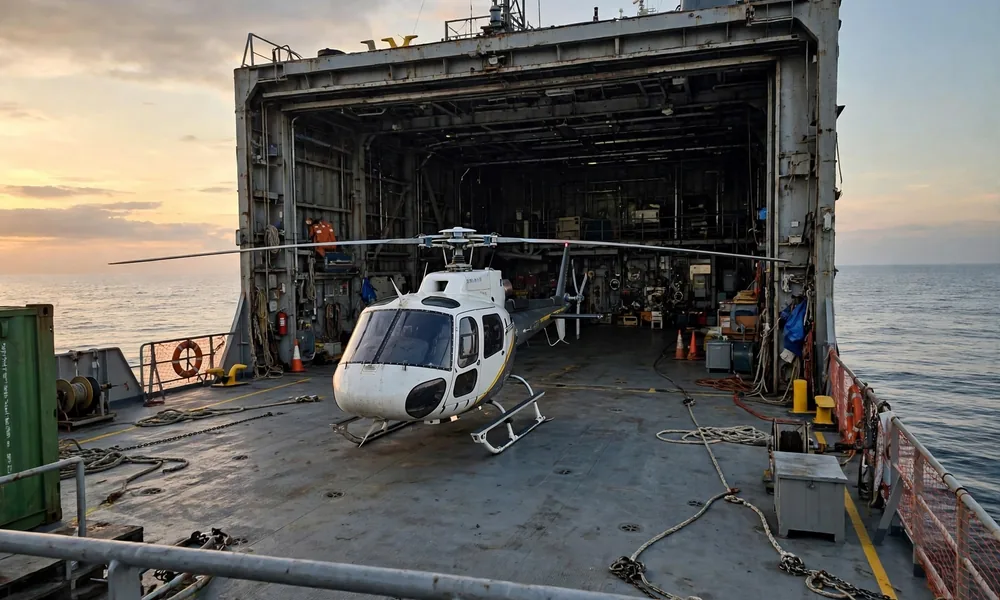
At the stern of the vessel sits a helicopter deck, a flat circle of steel marked with a large letter H, certified for landing in the same way a small airport is certified. The deck is fitted with a net to catch a sliding helicopter, with tie-down points to lash it down in rough weather, and with a hangar beside it where the helicopter can be stored out of the salt spray. Fuel for the helicopter is stored in tanks below the deck, pumped up through pipes that are kept separate from the ship’s own fuel, and a small team on board is trained to guide the helicopter in, to refuel it, and to secure it before the ship moves on. The guide to luxury support vessel specs, explained sets out the numbers behind the whole vessel, where the size of the helicopter deck, the reach of the cranes and the area of the main deck are all part of one calculation about what the yacht can actually do.
The tenders and the submarine: the yacht’s real transport
The tenders carried on the support vessel are the yacht’s real transport, because a superyacht is too large to come close to a beach or a small harbour, and its guests must be ferried ashore in smaller boats. The submarine is the most exotic toy of all, a small two or three person craft that dives to a hundred metres or more, with a clear dome that lets its passengers watch the reef in silence, and it is launched by crane too, lowered into the water like a tender, then driven away under its own power while the support vessel waits above.
Fuel and stores: the yacht’s petrol station
A support vessel is also the yacht’s fuel station and warehouse, carrying far more fuel, water and food than the yacht itself can hold. Below deck, cold stores hold weeks of food, a workshop holds spare parts and tools, and cabins hold the extra crew who maintain the toys and run the tenders, because the yacht’s own crew is busy looking after the guests and has no time to fix a jet ski.
The bridge: running two ships at once
Everything is run from the bridge, a wide room at the front of the vessel with windows that look out over the deck and the sea beyond. From here the captain steers the ship, watches the yacht it serves, and coordinates the cranes, the tenders and the helicopter, all at once, using radios to talk to the yacht’s captain and to the crew on deck. The bridge carries the same navigation equipment as any large ship, radar, charts and satellite positioning, and it also carries a plan of the day: which tender goes ashore at what time, when the helicopter flies, and when the submarine dives, because a support vessel that misses its schedule leaves a yacht full of guests with nothing to do. The guide to why a luxury support vessel is so expensive explains why a vessel like this costs so much, where the cranes, the helicopter deck and the crew are the reasons a plain-looking ship can cost as much as a small yacht.
The support vessel at a glance
| Part | Typical luxury figure | What it tells you |
|---|---|---|
| Main deck | 400 to 800 square metres of open, tie-down deck | How many tenders, toys and containers fit aboard |
| Cranes | Main crane lifting 10 to 30 tonnes, plus smaller davits | How heavy a toy can be lifted into the water |
| Helicopter deck | Certified landing deck with hangar and fuel store | Whether the yacht’s helicopter can live aboard |
| Tenders | Several tenders, from open runabouts to limousine boats | How guests reach the shore from an anchored yacht |
| Submarine | Two or three person craft, diving to 100 metres or more | How deep the guests can go without getting wet |
| Fuel and stores | Diesel, petrol and aviation fuel, plus weeks of food | How long the yacht can stay away from port |
| Crew | A dozen or more crew, including crane and dive specialists | Who keeps the toys running while the yacht relaxes |
What it costs
A luxury support vessel typically costs an estimated $30 million to $80 million to build, depending on its length, the size of its cranes and whether it carries a helicopter and a submarine, and the estimate covers the ship alone, not the crew, the fuel or the toys, which can cost millions more before the vessel ever leaves the yard.
A rare fact
One detail few people ever learn is that a support vessel often carries a full hospital-grade medical room, because it works far from shore with helicopters, submarines and diving gear, and the nearest hospital can be hours away by air.
Put the systems together, deck first, then cranes, helicopter deck, tenders, fuel and bridge, and a luxury support vessel stops looking like a plain ship parked beside a pretty yacht and starts looking like what it is: the workshop, the garage, the airport and the fuel station that make the yacht’s life possible, built by people who know that the most luxurious thing a superyacht can have is a hard-working shadow, a hundred metres away, carrying everything the yacht cannot.